Many people still see dog accessories as fashion statements, especially in cold months filled with coats, booties and tartan harnesses. Yet that simple yellow ribbon or band on a lead is not about style at all. It is a quiet warning, and ignoring it can turn a routine walk into a stressful or even dangerous situation.
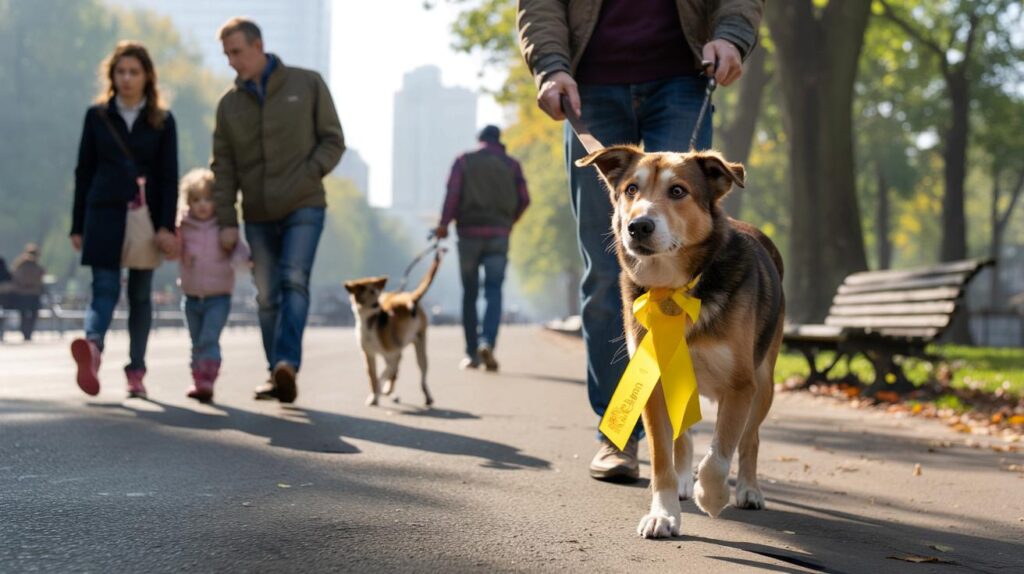
More than decoration: a quiet code for “keep your distance”
The yellow ribbon is part of an international visual code used by dog owners and trainers. It signals a single, crystal-clear idea: this dog needs space.
The initiative is sometimes linked to campaigns like “The Yellow Dog Project”, but the principle is broader than any one scheme. It’s a social cue in public spaces, similar to seeing someone wearing noise-cancelling headphones on the Tube or a “Baby on board” badge on a crowded bus.

The yellow ribbon tells you: please don’t touch this dog, don’t approach, and don’t let your own dog rush up.
Think of it as a movable safety bubble. The owner is not being rude or overprotective. They are asking for a buffer zone so their dog, and everyone around them, can stay calm and safe.
Many people see a dog with soft eyes and a wagging tail and assume contact is welcome. That reflex – bending down, hand outstretched, high-pitched “Hello!” – is exactly what the yellow ribbon is trying to stop.
Illness, fear, rehab: why a dog might need space
A yellow marker does not automatically mean “aggressive dog”. In reality, the reasons are varied, often subtle, and almost always justified.
Health issues and post-surgery pain
Some dogs wearing a yellow ribbon are unwell or recovering from surgery. Cold weather, arthritis or recent operations can make any unexpected bump or grab excruciating.
For these animals, a stranger’s sudden touch can undo weeks of recovery work, both physically and emotionally. The ribbon is simply a visible “please handle with care”.
Anxious or reactive dogs
Other dogs are what trainers call “reactive”. They might:
- bark or lunge when another dog gets too close
- panic around fast movements, children or bikes
- have a history of trauma or poor socialisation
- struggle with crowded pavements or narrow paths
Reaction is not always about biting. It can be shaking, freezing, trying to flee, or escalating vocalisations. The yellow ribbon helps keep the dog just below that stress threshold where it can still think and learn.
Training, rehab and concentration
Many yellow-ribbon dogs are actively in training – for basic manners, for behavioural rehab, or sometimes for specialist work.
If you interrupt that dog with a pat or let your own dog barrel into them, you may undo hours of carefully structured work. Owners use the ribbon to protect their training sessions from well-meaning but unhelpful human interference.
Dogs in season and hormonal tensions
For unspayed females in heat, the yellow signal can also mean: please keep your male dog away. One brief off-lead encounter can mean an unwanted pregnancy and a highly stressed owner. The ribbon is a pre-emptive barrier against persistent four-legged suitors.
How you should behave when you see a yellow ribbon
The correct response to a yellow ribbon is simple, but it goes against a lot of people’s instincts: you ignore the dog.
Do not change course towards the dog; if anything, give a little more space and pass calmly.
That means:
- no eye contact – staring can feel threatening to some dogs
- no speaking to the dog or calling it over
- no reaching out to touch, even “just a quick stroke”
- no offering treats without explicit permission
If you have your own dog with you, shorten the lead and keep them at your side. Do not allow a nose-to-nose “just saying hello” greeting. Those split-second greetings are often where scuffles start.

This might feel cold or even a bit unfriendly, especially if you love animals. In this context, that calm indifference is the most respectful thing you can offer both the dog and its human.
Why this quiet code matters in cities
Public spaces in the UK and US are getting busier: more dogs adopted since the pandemic, more flats without gardens, more people sharing narrow pavements. That density magnifies every small misunderstanding between dogs and humans.
The yellow ribbon system acts as a low-tech traffic management tool for social interactions. It reduces unexpected contact, which in turn reduces the chance of bites, falls, and conflicts between owners.
| Without yellow ribbon awareness | With yellow ribbon respected |
|---|---|
| People rush up to “say hi” | Dog and owner pass quietly and stay relaxed |
| Reactive dog barks or snaps | Dog remains below stress threshold |
| Owner feels judged or blamed | Owner feels supported and safer outside |
| Higher risk of incident or complaint | Less friction between dog owners and public |
For many owners, a simple strip of yellow fabric is the difference between avoiding walks through fear of confrontation and being able to give their dog the exercise it needs.
Common misconceptions about the yellow ribbon
“If it’s dangerous, it shouldn’t be in public”
This line ignores the reality that many dogs just need management, not isolation. They may only struggle in specific situations: crowded streets, sudden approaches, off-lead dogs racing towards them.
Owners using a yellow ribbon are usually being cautious and proactive. They are trying to prevent issues before they happen, not hiding a “dangerous dog in disguise”.
“But I’m good with dogs, they all love me”
Even experienced handlers can misread a stressed or unwell animal. Confidence does not override pain, trauma or genetics. The yellow ribbon is not about your skill level; it’s about respecting the owner’s knowledge of their own dog.
Being “good with dogs” starts with listening to the clearest message the owner can send: please give us space.
What to do if you want to ask questions
Curiosity is natural. If you genuinely want to understand why a dog is wearing yellow or what you can do to help, you can ask – but only from a distance, and only if the owner seems relaxed and not mid-crisis.
- keep several steps back
- address the human, not the dog
- use neutral, non-judgmental language (“Does the yellow mean you’d like us to give you space?”)
- accept “yes” or “no” without pressing for details
Many owners will happily explain when they’re not busy managing a tricky moment. Others may be too focused on keeping their dog calm, which is a good reason to simply move on.
Scenarios every pedestrian and dog owner should picture
Imagine a young dog recovering from leg surgery, walking slowly with a stiff gait. A child runs up from behind, throws their arms around the dog’s neck, and the dog, startled and in pain, snaps. In that instant, everyone loses: the child, the dog, and the owner. A visible yellow ribbon – respected by the adults nearby – could have prevented that chain of events.
Picture a rescue dog, terrified of other dogs after repeated attacks at a previous home. Each time an off-lead dog charges over “just to say hello”, its panic deepens. Each walk becomes harder. With a yellow marker and a bit of public awareness, those encounters can be replaced by calm, predictable passing, giving this dog a chance to relearn that outside is safe.
Useful terms and how they relate to the yellow ribbon
Two words often come up in conversations about these dogs:
- Reactive: a dog that responds strongly to triggers such as other dogs, people, bikes or noise. Reaction can mean barking, lunging, freezing or trying to flee.
- Threshold: the point at which a dog can no longer cope calmly with a situation and shifts into survival mode. The yellow ribbon helps keep strangers outside that threshold distance.
When you respect the yellow signal, you are helping the owner keep their dog under that threshold. That makes training more effective, walks less stressful, and incidents far less likely.
The next time you see that small strip of yellow on a lead or collar, treat it as you would a road sign. Adjust your course, keep your hands to yourself, and let the dog pass without fuss. That quiet choice from you can mean a safer, calmer day for an animal that is already trying very hard to cope with the world around it.