For generations, households in a small rural village have placed their rubbish bins outside their doors, following a long-standing local habit. That tradition is now ending after a court ruling required the commune to adopt shared waste containers. The decision has triggered a heated local dispute touching on costs, public services, and competing visions of what rural life should look like in 2025.
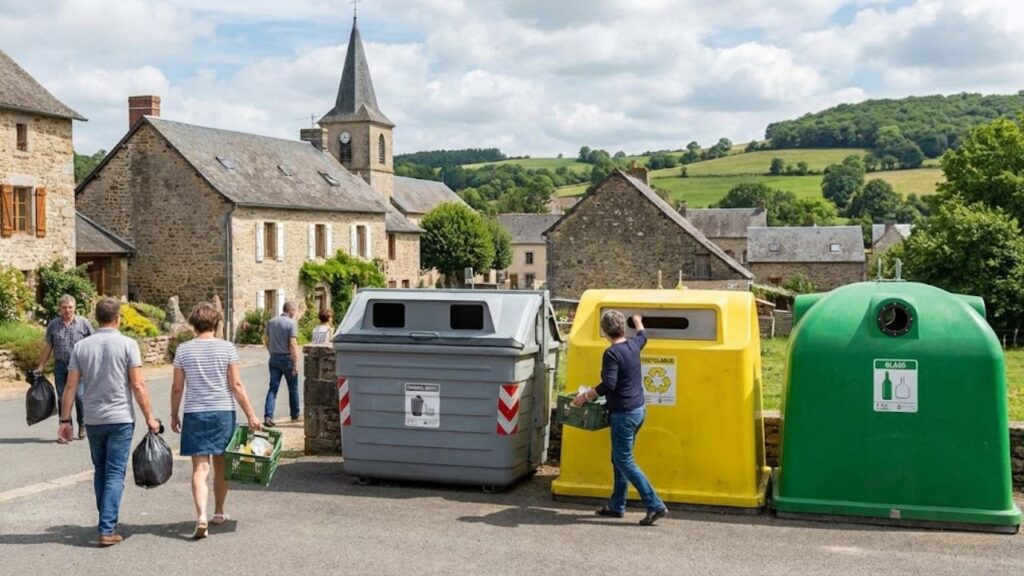
A final exception forced to fall in line
The commune of Aigondigné, home to just under 5,000 residents in the Deux-Sèvres department, had stood apart from its neighbours. Between 2021 and 2023, 61 surrounding municipalities within the Mellois area adopted shared waste containers. Aigondigné alone kept its door-to-door rubbish collection.
That resistance has now come to an end. The administrative court in Poitiers ruled that decisions about waste collection belong to the inter-municipal authority, not individual communes. As a result, from 2025, residents will be required to bring their waste to shared collection points installed around the village.
Fabrice Michelet, head of the wider community of communes, says the ruling clears the way for implementation. His team plans to install the containers in the third quarter of 2025, following the same model already in place across the rest of the territory.
From individual bins to collective drop-off points
The change is straightforward on paper but significant in daily routines. Instead of leaving a personal wheelie bin outside each home, residents will share large communal containers located at designated points.
According to Michelet, this approach is better suited to sparsely populated rural areas. Collection trucks currently travel long distances along narrow country roads to collect relatively small volumes of waste. Centralising drop-off points reduces journey lengths, stops, and ultimately costs for taxpayers.
The inter-municipal authority also points to results from the 61 communes that have already made the switch. There, the amount of non-recycled household waste dropped from 182 kg to 150 kg per person per year. Officials say this indicates improved sorting, with more glass, paper, and packaging ending up in the correct recycling streams.
Legal appeals continue, but installation moves ahead
Aigondigné’s town hall has not abandoned its opposition. The mayor has filed an appeal and sought emergency legal action to halt the rollout. These steps, however, do not prevent the physical installation of the containers.
The court’s decision allows the inter-municipal authority to proceed while the appeal is reviewed. In practical terms, residents will see bin sites installed across the commune over the coming year, regardless of local political resistance. For opponents, the arrival of concrete platforms and green containers represents a symbolic loss of local control.
Rising costs and the promise of lower waste bills
The reform is driven by a broader financial pressure. Across France, the cost of managing household waste is rising sharply. The national tax that funds rubbish services has reportedly increased by around 170% this year, pushed up by stricter recycling rules, inflation, and higher treatment costs.
Gilles Chourré, vice-president responsible for waste within the inter-municipal authority, says better sorting is one of the few remaining tools to control spending. When households separate waste more effectively, less residual rubbish needs to be burned or buried, easing pressure on budgets.
The shared containers will be provided free of charge to residents. Their cost is covered collectively through local budgets and waste-related taxes, rather than individual payments.
Why officials support the shared-bin model
For the inter-municipal authority, several arguments support the change:
- Lower collection costs due to fewer kilometres driven and fewer stops.
- Higher recycling rates through clearer sorting points and standardised instructions.
- More stable budgets as reduced residual waste limits exposure to rising treatment fees.
- Equal treatment across all 62 communes using the same system.
From this perspective, Aigondigné was an exception that needed to align with the rest of the territory for reasons of financial and technical consistency.
Concerns over access, effort, and cleanliness
Many residents see the issue differently. The mayor argues the change represents a downgrading of public service, particularly for older or disabled people.
Where residents once rolled bins a few metres to their gate, they will now need to carry bags to the nearest collection point. Those living along winding rural lanes worry about longer walks with heavy bags, especially in bad weather.
Critics also raise hygiene concerns, warning that shared containers could become dirty or unpleasant if they overflow or are poorly maintained, attracting animals or leaving rubbish piled nearby.
Assurances on distance and maintenance
In response, the inter-municipal authority has pledged that no household will be more than 200 metres from a collection point and that regular cleaning will keep sites usable.
While this distance may be manageable in denser areas, it can still pose difficulties in scattered hamlets, particularly for residents with limited mobility or poorly lit paths in winter.
Officials stress that maintaining hygiene will also depend on residents. Bags must be properly closed and placed inside containers, not left beside them.
How daily routines will change
The shift brings practical adjustments. Households that once put out a bin once a week will now plan regular trips to shared containers, changing habits around storage and disposal.
- Old system: Individual bin at each home, truck stopping at every property.
- New system: Shared containers, residents walking to collection points.
- Impact: More visible sorting behaviour and lower fuel and labour costs.
A local dispute reflecting wider European trends
The situation in Aigondigné echoes debates across Europe. Local authorities face rising waste-treatment costs while regulations push them to recycle more and landfill less. Shared containers are one response, alongside other models such as pay-as-you-throw systems or underground bins.
All aim to reduce mixed, non-recyclable waste. In that context, Aigondigné’s transition is part of a broader shift rather than an isolated case.
Key concepts and everyday scenarios
Two terms often cause confusion: residual waste and sorting. Residual waste is what remains after recyclables and organic material are removed. Sorting means separating those categories before disposal.
For example, a retired couple may now walk 150 metres to shared bins, encouraging them to reduce heavy black bags by rinsing jars, folding cardboard, and using recycling containers. For households with limited mobility, informal neighbourly help may develop, sometimes supported by local services.
The system also interacts with separate bio-waste collection. As food scraps are diverted or composted, residual bags become lighter and less odorous, making the walk to shared bins more manageable.