Within just a few breeding seasons, that discreet operation triggered one of the most striking wildlife recoveries seen in recent years: a critically endangered pigeon rebounded faster, and more strongly, than genetic theory said should be possible.
From silent forests to a sudden return of wings
The Ogasawara Islands sit in the Pacific Ocean, about 1,000 kilometres south of Tokyo. Often called the “Galápagos of the East”, they hold a wealth of species found nowhere else on Earth.
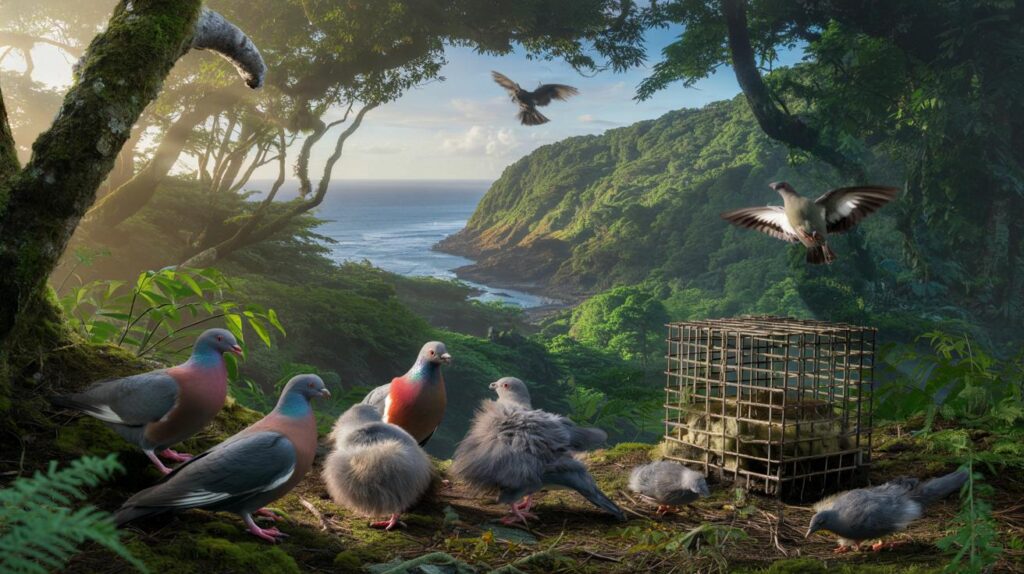
Among them is the red-headed wood pigeon of Ogasawara, a forest bird that had been pushed to the edge of extinction. The main culprit was not habitat loss, logging or climate change. It was cats.

Domestic cats were brought to the islands by people and, as often happens, a portion escaped or were abandoned. Over time, those animals formed feral populations. Agile, nocturnal and efficient, the cats hunted nesting birds and chicks, including the pigeons that nest on low branches or on the ground.
By the 2010s, only a tiny population of red-headed wood pigeons remained. Ecologists feared that even if the birds stopped declining, their gene pool might be too small to sustain them in the long run.
When 131 stray and feral cats were finally removed from key islands, few researchers expected much more than a slow, fragile recovery.
The reality was startlingly different. Over roughly three years, adult pigeon numbers jumped from 111 to 966, while juveniles rose from 9 to 189. That is nearly a tenfold increase in adults and a twentyfold surge in young birds.
Why the removal of 131 cats mattered so much
The cat cull was part of a wider conservation effort led by Japanese authorities and researchers from Kyoto University. Feral cats were captured using baited cages, monitored, and either rehomed or humanely euthanised, depending on health and behaviour assessments.
Once those predators vanished from key nesting grounds, the entire balance of risk changed for the pigeons. Eggs and chicks that would once have been picked off on nightly patrols now stood a much higher chance of reaching adulthood.
Ecologists monitoring the islands tracked several rapid shifts:
- More nesting attempts per pair each season
- Higher survival of eggs and chicks
- Adults living longer and breeding in multiple seasons
- Pigeons expanding back into forests they had largely abandoned
Predator removal does not always deliver such clean results. In some places, removing one predator allows another to dominate, or causes prey populations to crash for unrelated reasons, such as disease or food shortages. On Ogasawara, conditions lined up unusually well: reliable food, remaining habitat and the absence of other major new threats.
The genetic gamble that paid off
Conservation biology has a basic rule of thumb: tiny populations usually mean trouble. When few individuals remain, they tend to breed with close relatives. That can increase the risk of genetic defects, reduce fertility and weaken immunity, a process often called inbreeding depression.
Scientists expected the Ogasawara pigeons to follow that script. The population had shrunk so low that, on paper, it should have carried high levels of harmful mutations and very little genetic diversity. Those traits can trap a species in a “doom loop”, where each generation becomes less fit than the last.
The genetic analysis, published in the journal Communications Biology, told a different story. Using blood and feather samples, researchers measured diversity across many points in the pigeons’ DNA. They also checked for signals that inbreeding was damaging the birds’ health.
The pigeons showed surprisingly robust genetic diversity, and only weak signs of the inbreeding problems that conservationists feared.
That resilience suggests two possibilities. First, the population may have been reduced only recently, so it has not yet suffered a heavy loss of diversity. Second, natural selection might have quietly weeded out the most harmful genetic combinations long before the latest crash in numbers.
What the numbers reveal about risk and recovery
The Ogasawara case is now being held up as a model of how fast targeted conservation can work when it removes a single, overwhelming source of mortality. Still, researchers caution against reading it as a universal success template.
| Indicator | Before cat removal | About three years after |
|---|---|---|
| Adult pigeons | 111 | 966 |
| Juvenile pigeons | 9 | 189 |
| Main predator pressure | High (feral cats) | Very low |
Those shifts are huge, but the population is not out of danger. One disease outbreak, a major typhoon season, or the return of even a small number of cats could take a serious toll. The islands’ isolation also means new birds rarely fly in from elsewhere to refresh the gene pool.

Lessons for invasive species and pet owners
The story of the 131 cats is not about blaming individual animals. Cats, after all, were doing what predators do. The deeper issue lies in how people introduce and manage domestic species on fragile islands.
Across the globe, invasive predators such as rats, stoats and cats have devastated seabirds and forest birds that evolved in the near-absence of mammalian hunters. New Zealand, parts of Hawaii and many Mediterranean islands tell similar stories of ground-nesting birds wiped out within decades of predator arrival.
For readers far from the Pacific, the Ogasawara case still has practical echoes. Simple actions by cat owners can reduce wildlife impacts in towns and suburbs:
- Keeping cats indoors at night, when many birds feed or sing
- Using bell collars or bright “bird-safe” collar covers
- Neutering pets to prevent feral populations forming
- Never dumping unwanted animals in parks or countryside
Those steps will not reverse a crisis on their own, but they limit the risk that local bird populations end up on the same trajectory as the Ogasawara pigeons once faced.
How scientists track such a hidden recovery
Counting shy, forest-dwelling pigeons on rugged volcanic islands is not simple work. Teams walk set routes at dawn and dusk, listening for calls and watching for quick bursts of flight between trees. They record every sighting or sound on data sheets or handheld devices, then repeat the routes every year.
In some places, biologists place motion-triggered cameras near likely nesting sites. Microchips or colour leg bands can be used to follow individual birds over time, revealing how long they live and how often they breed. These repeated observations feed into population models that estimate growth rates and extinction risk.
Those models rank different threats and test “what if” scenarios. For example:
- What happens if cat numbers return to half their old level?
- How many breeding seasons of good survival are needed to stabilise the population?
- Would supplementary feeding reduce the risk from bad weather years?
By comparing model predictions with real-world counts, scientists sharpen their understanding of which interventions are truly pulling the numbers up.
Key terms behind the science
Two concepts underpin much of the conversation around the Ogasawara pigeons: genetic diversity and inbreeding depression.
Genetic diversity describes how many different versions of genes exist in a population. High diversity gives species more raw material to adapt to new challenges such as novel diseases, shifting climates or new predators. Low diversity leaves them more exposed to sudden shocks.
Inbreeding depression occurs when closely related animals mate repeatedly, exposing rare harmful gene variants. Over time, offspring may become less fertile, more prone to disease or simply less likely to survive to adulthood. The Ogasawara pigeons appear, for now, to have avoided the worst of that trap.
The case does not overturn those concepts, but it shows they play out on a spectrum. Even species that have passed through a tight genetic bottleneck can sometimes bounce back strongly if their main day-to-day threats are removed.
What this means for future island conservation
For conservation planners, the Ogasawara rebound adds weight to an emerging strategy: rapid, well-planned removal of invasive predators on islands where native species have no built-in defence against them. Combined with ongoing surveillance, strict controls on new introductions and long-term monitoring, such programmes can shift an ecosystem’s trajectory in just a few years.
At the same time, the story carries a warning. The very traits that made the red-headed wood pigeon resilient — isolation, unique evolution, a small range — also leave it vulnerable to the next disturbance that sweeps across the Pacific. Climate shifts, new pathogens or careless reintroductions of predators could unwind the gains nearly as quickly as they appeared.
One quiet decision to remove 131 cats did not just save a bird; it reset the odds for an entire island ecosystem.
As more island nations weigh similar interventions, the Ogasawara experiment will likely become a reference point: proof that, when timed well and grounded in data, targeted action can give even the rarest species a realistic shot at a future.