On a Tuesday night in a small bathroom lit by a harsh LED mirror, a 32-year-old marketing manager is kneeling over her sink, massaging a peppermint serum into her scalp like her life depends on it. Her phone, balanced dangerously on a candle, plays a “scalp spa at home” tutorial: slow, aesthetic shots of glossy hair, glass bottles, jade combs. She pauses, rewinds, copies the movement of the influencer’s fingers, glancing at the widening part line on her own head.
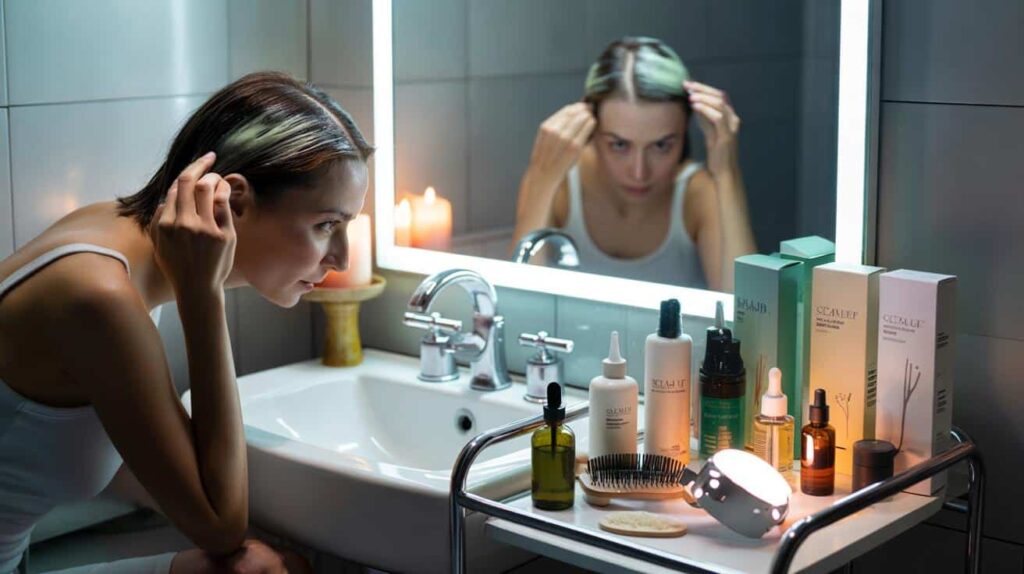
There’s a trolley by the toilet now: scalp scrub, scalp brush, scalp essence, caffeine tonic, rosemary oil. The whole thing cost more than her electricity bill. She laughs at herself, then catches her reflection again and doesn’t laugh at all.
Something quiet and uneasy is happening beneath the foam and bubbles.

The booming scalp spa trend, and the shame hiding under the bubbles
Scroll on TikTok or Instagram for three minutes and you’ll probably hit a “scalp reset” video. Perfect nails, slow-motion lather, captions promising “THICKER HAIR IN 30 DAYS” like a money-back guarantee on your self-worth. It looks so soothing that you almost forget you’re watching someone wash their head.
Brands have jumped on this softness. “Scalp detox,” “follicle awakening,” “microcirculation boosters” – the language suddenly sounds more like a medical brochure than a beauty shelf. It sells a ritual and a diagnosis in the same breath.
One London-based salon reports that its “scalp spa” services have doubled in a year, mostly booked by women under 40. They lie back under cloud-like towels while a therapist photographs their scalp on a tablet, zooming in on every flake, every gap between hairs. The images are then labelled with words like “early thinning,” “congestion,” “miniaturised follicles.”
A 27-year-old client I spoke to described the moment she saw her scalp on screen as “like a breakup text, but for your hair.” She walked out with a £280 at-home scalp kit and the faint panic that doing nothing would be irresponsible.
The logic is seductive: if your face needs serums and devices, your scalp – literal soil for your hair – must need them too. And if your hair is thinner than it was at 18, the implication is that you’ve neglected this “hidden skin” and now need to pay to reverse the damage. The more brands talk about “scalp health,” the more not owning a scalp routine starts to feel like hygiene failure.
*This is how a wellness trend quietly mutates into a moral test you can buy your way out of, one minty exfoliating scrub at a time.*
At-home rituals: care, control… and a very profitable insecurity
A basic at-home scalp spa is simple on paper. You section your hair, apply an oil or serum directly to the roots, massage with fingertips or a rubber brush for five to ten minutes, then shampoo it all out. Do it once or twice a week and you’ll probably feel genuinely relaxed, your scalp less tight, your hair slightly bouncier.
This is the part that’s real: massaging does increase blood flow, gentle exfoliation can help with dandruff, some ingredients like minoxidil and certain peptides have actual clinical data behind them. There is a quiet, grounded joy in taking ten minutes to touch your own head with care.
The story goes sideways when that simple ritual turns into a full-blown project. People start layering scrubs, acids, oils, and serums because an influencer said “stacking actives” is a game-changer. They buy handheld LED helmets, vibrating brushes “inspired by trichology,” and subscription serums that must “never be interrupted.”
Then the anxiety sets in: if you skip a week, was the money wasted? If you use the wrong brush, did you damage follicles forever? Let’s be honest: nobody really does this every single day. The marketing knows that, and still phrases the routine like a moral commitment.
A quiet industry of experts has popped up to reassure you and then re-sell to you. Online “hair coaches” offer video consultations where you tilt your webcam towards your crown while they nod gravely. Some are trained trichologists, some are just good at framing insecurity as a niche.
“I’d say 70% of my new clients arrive already convinced that something is wrong with their scalp,” says Ana, a trichologist in Madrid. “Often their shedding is within normal limits. What’s new is the level of shame. They feel like they failed a secret beauty exam.”

- Scalp photos that zoom in on every pore
- “Early intervention” packages that bundle multiple products
- Fear-based language: “Don’t wait until it’s too late”
- Before/after shots with strategic lighting and styling
- Limited-time discounts that push impulse buying
How to care for your scalp without turning it into a full-time job
There is a middle path between ignoring your scalp and turning your bathroom into a clinic. Dermatologists usually agree on a few simple pillars: keep the scalp clean, avoid harsh physical scraping, and treat actual conditions (like seborrheic dermatitis, psoriasis, or true pattern hair loss) with evidence-based medicine.
At home, that looks like choosing a gentle shampoo you’ll realistically use, massaging for a minute or two under warm water, and, if you enjoy it, adding a once-a-week oil or treatment. Think of it as brushing your teeth rather than getting veneers – regular, boring, quietly effective.
The trap is thinking that more steps equal more care. Strong acid scrubs, aggressive brushes, and constant product switching can irritate the scalp, trigger more shedding, and create the very “problems” that then need more products. If your head feels sore, itchy, or overly tight after your ritual, that’s not “detox,” that’s your skin complaining.
Be suspicious of anything that suggests your worth is measured by hair density. Feeling emotional about shedding is normal; building your whole evening around trying to stop time is exhausting. You deserve products that fit into your life, not the other way round.
There’s also the question nobody on social wants to touch: genetics. For many women, hormonal shifts, stress, illness, or simple inheritance play a bigger role in thinning than any shampoo ever will.
“I wasted two years buying scalp gadgets before a doctor calmly said, ‘You have androgenetic alopecia, it’s common and it’s not your fault,’” says Marie, 35. “I cried in the car, then felt oddly free. I still use a nice scrub sometimes, but it’s self-care, not a rescue mission.”
- Talk to a GP or dermatologist if shedding is sudden or dramatic
- Use at-home rituals as comfort, not as a cure-all
- Take before/after photos under the same light if you really want to track change
- Set a budget for hair products and stick to it
- Allow yourself to stop a routine that’s stressing you out
Beyond the foam: what our scalp rituals say about us
The scalp spa boom isn’t just about hair; it’s about the feeling that our bodies should be optimised, managed, upgraded like apps. Thinning hair clashes head-on with the promise that if we eat right, buy right, and “show up for ourselves,” we’ll stay frozen at 25. When the part line widens, it’s read less as biology, more as a personal failure.
In that context, at-home scalp rituals become a kind of silent language. “I am trying. I am not giving up. I am doing something.” There’s tenderness in that, but also a quiet violence when every ad whispers that “doing something” must always mean “buy more.”
The plain truth is that some women will do every single scalp treatment and still see their hair thin. Others will barely remember to shampoo and keep every strand. Both deserve peace. The question isn’t whether scalp care is good or bad – it can be genuinely soothing, sometimes medically helpful – but who gets to profit from the gap between what hair does and what we think it should do.
What if the most radical version of “hair care” is letting your head be seen as it is, while choosing the rituals that feel kind rather than compulsory?
Maybe your at-home scalp spa becomes a once-a-week meditation with one product you actually like. Maybe you swap a pricey serum for a check-up with a doctor who talks to you like a person, not a walking “before” photo. Maybe you still enjoy the minty tingle and the satisfying scrub, but without that sprint of panic that used to sit just beneath the foam.
The booming business of shaming thinning hair isn’t going away tomorrow. But the more we speak frankly about genetics, money, and the stories we’ve been sold, the harder it becomes to sell anxiety in a dropper bottle. That conversation can start in a bathroom just like yours, with wet hair, a towel around your shoulders, and a quiet decision to choose care over fear.
| Key point | Detail | Value for the reader |
|---|---|---|
| Scalp spa is a real trend | Social media and salons are pushing “scalp health” as the new frontier | Helps readers recognise the marketing wave they’re immersed in |
| Insecurity is being monetised | Shame around thinning hair is framed as a solvable “problem” with products | Gives readers critical distance before spending money |
| There is a simple, sane middle ground | Basic scalp hygiene, selective products, and medical advice when needed | Offers a realistic routine that supports both hair and mental health |
FAQ:
- Is a scalp spa at home actually good for hair growth?Gentle massage and certain medicated treatments can support healthier growth conditions, but no scrub or brush can override genetics or serious medical causes of hair loss. Think “supportive environment” rather than magic fix.
- How often should I do an at-home scalp treatment?For most people, once a week is plenty. Oily or flaky scalps might benefit from twice-weekly care, while sensitive scalps may need less. If you notice redness, itching, or soreness, you’re overdoing it.
- Do scalp massagers and brushes really work?Soft silicone brushes can help spread shampoo and dislodge build-up, and massage may increase blood flow. Hard, scratchy tools add more risk than benefit and can irritate follicles.
- When should I see a doctor about thinning hair?If shedding is sudden, patchy, follows illness or childbirth, or comes with itching, pain, or scaling, a GP or dermatologist is worth seeing. They can rule out hormonal, nutritional, or autoimmune causes.
- How can I protect my mental health while dealing with hair loss?Limit time in comparison-heavy spaces like filters and “hair journey” reels, talk honestly with trusted people, and focus routines on comfort, not perfection. If distress is intense or constant, counselling or therapy can be a powerful ally.