Her mum walks three steps behind, whispering instructions that sound more like corrections. “No, not like that, say it properly… don’t stand there… hurry up, we’re late… smile.”
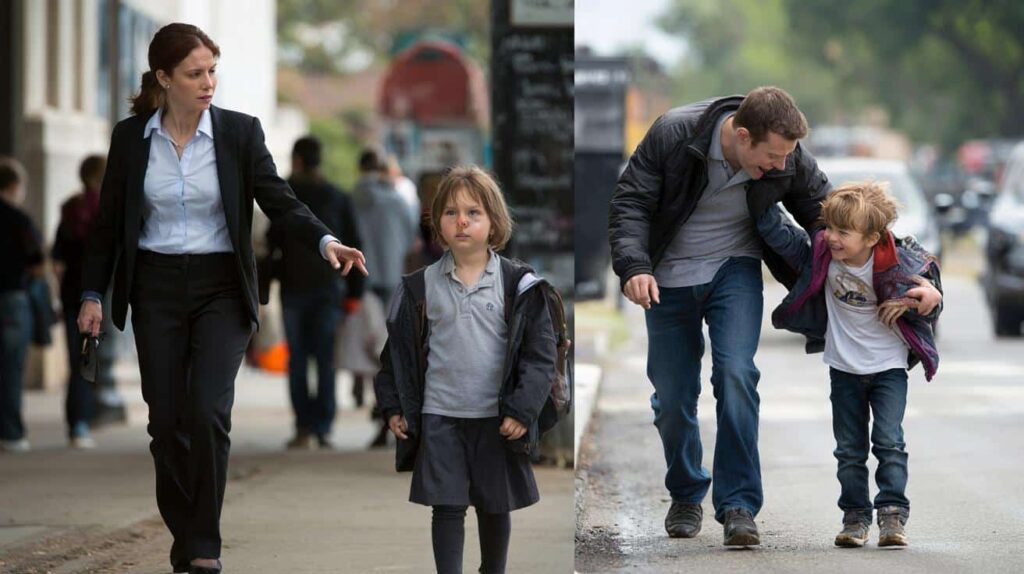
The girl’s face does something strange. She smiles, but her shoulders drop. She looks like a child who has learned the choreography of being “good” in public, and yet something in her eyes has already checked out.
Three minutes later, another family passes. A dad jokes with his son about the mud on his shoes. They’re late too, but there’s laughter, not a running commentary of micro-criticism.

Same morning rush. Same messy reality. Completely different emotional climate.
The gap between those two scenes is small in the moment. Years later, it’s where resentment quietly lives.
When love feels like a list of instructions
Most controlling parenting doesn’t look like shouting or slammed doors. It sounds like, “Are you sure you want to wear that?”, “I’ll just do it for you”, “Say thank you properly.” It’s the soft, constant hand on the steering wheel of a child’s daily life. From the outside, it can even look like dedication. Teachers might say, “Such involved parents.” Neighbours see the tidy homework, the polite greetings, the carefully managed schedule.
Inside the child’s head, another story forms. The world starts to feel like a place where their own impulses are slightly wrong. Not wrong enough to punish, just wrong enough to gently correct… all the time.
Over years, those tiny corrections don’t feel tiny anymore. They feel like a verdict on who you are.
Picture a teenager named Sam. His mum doesn’t scream, doesn’t hit, never misses a parents’ evening. She just quietly re-writes his life. If he chooses clothes, she swaps them before school “so you’re not embarrassed”. When he signs up for drama, she moves him to science club “because it’ll look better later”. He tells her he’s full; she slides the plate back and says, “Just three more bites.”
Sam stops arguing. He goes along with it. At 16, his grades look great on paper, he rarely gets into trouble, and adults say he’s “mature for his age”. Inside, he’s keeping a secret score of every time his choice was overridden. Every time “I love you” came strapped to a “Do it my way.”
By 25, Sam has moved out and barely calls home. He explains it to friends in one short sentence: “They never actually saw me.” The resentment isn’t explosive; it’s cold, tired and very old.
Psychologists have a language for this: authoritarian or “psychologically controlling” parenting. It’s less about strict rules, more about managing thoughts and feelings. Not “Be home by 10,” but “You’re hurting me when you go out.” Not “Do your homework,” but “You’re the only one who disappoints me like this.”
Children raised like this often become adults who doubt their own judgement. They scan other people’s reactions before making a move. They may look “high functioning”, but inside, decision-making feels like walking on glass. That’s where the resentment comes in. It’s not just anger at mum or dad, it’s anger at having never fully belonged to yourself.
The subtle control habits that quietly backfire
Control can wear very polite clothes. One of the most common habits is “emotional weather control”. A parent’s mood rises and falls based on how obedient or grateful the child looks. A slammed cupboard, a sigh, a silent treatment at dinner. No explicit rule, just a tension in the air that tells the child, “Keep them happy or pay the price.” The child learns to manage the adult’s feelings, not their own.
Another subtle habit is chronic “fixing”. A child struggles with a puzzle; the parent reaches over and finishes it. The child stalls in front of a new friend; the parent speaks for them. It saves time in the short term. Over years, it sends a quiet message: your way is never quite enough. Even praise can morph into control when it’s only given for certain versions of the child. The sporty one. The tidy one. The child who makes the parent look good.
On a Tuesday afternoon, a nine-year-old named Aisha sits at the kitchen table with a spelling list. Her dad hovers. Every time she pauses, he jumps in with the correct letter. “No, no, we’ve done this one, remember? Don’t think so long, just write.” She starts hurrying, guessing, shoulders creeping up. By the end, the sheet is flawless. She is not. She walks away feeling stupid and oddly alone, even though her dad never left her side.

Researchers tracking children into adulthood keep finding the same pattern. Those who grew up under heavy psychological control are more likely to report long-term resentment, struggles with independence and low self-worth. They may “succeed” externally but carry an internal script: “I only get love if I perform.”
That script doesn’t disappear when they move out. It just transfers. To partners. To bosses. To their own children. The resentment is often mixed with guilt. “My parents sacrificed so much, why am I so angry?” That dissonance is exhausting. It’s easier to go no-contact or stay on the surface than to untangle it.
The logic underneath is painfully simple. When a child’s choices and emotions are constantly adjusted, they don’t learn that they are a person separate from their parents. Boundaries blur. The parent thinks, “I’m helping them be their best self.” The child feels, “My self isn’t acceptable as it is.” Resentment grows precisely where gratitude was expected.
Turning control into connection without losing your authority
Shifting away from subtle control doesn’t mean letting kids run the house. It means changing the way power shows up in daily moments. One practical move is to narrate, not dictate. Instead of “Wear your coat, you’ll get cold”, try, “It’s chilly. You can bring your coat or carry it in your bag. Your call.” The boundary stays: the coat comes with you. The control eases: the child chooses how.
Another potent tweak is to separate your feelings from their behaviour. Saying, “I feel worried when you cross the road without looking” is very different from, “You’re making me anxious, why do you do this to me?” One invites responsibility. The other heaps blame. Over time, children raised with this kind of honest but contained emotion learn to manage their own feelings instead of constantly scanning a parent’s face for clues.
On those long evenings when everyone is tired and screens are glowing, the old habits come back fastest. That’s why it helps to pick one or two “non-negotiables” and let the rest breathe. Maybe bedtime is firm, but outfits, hair or the exact way homework is done are more flexible. Letting kids own some low-stakes decisions gives their nervous system a regular reminder: “My choices count here.”
Parents often confess that subtle control started from fear. Fear of failure, danger, judgement from other adults. When a child melts down in public, the urge to over-manage is often about avoiding the burning shame in the adult’s chest. An honest internal question can cut through the noise: “Am I doing this for them, or for how this makes me look?” No one likes the answer every time. That’s where the work actually begins.
We all know the moment where a child says, “I can do it”, and every cell in the parent’s body wants to grab the scissors, the knife, the form, the phone. Letting them try, and sometimes fail, feels inefficient and messy. It is. It’s also how confidence is built. *Control keeps things smooth; growth is usually clumsy.*
“I realised I wasn’t parenting my son, I was project-managing him,” one mother in a London support group said. “Everything in his life was optimised… except his joy.”
- Notice your “micro-corrections” for one day and write them down.
- Pick one daily task your child can own completely, even if it’s slower.
- Swap one “Do it like this” for “Show me how you’d do it.”
Letting kids belong to themselves – and still belong to you
Resentment doesn’t usually explode in one big argument. It arrives years later in short, flat messages, cancelled visits, polite distance. The tragedy is that many controlling parents genuinely loved hard. They gave time, money, attention. What was missing was space. Space for the child to be slightly wrong, slightly weird, slightly different – and still safe.
Talking about this can sting. Many adults read about controlling styles and suddenly recognise their own childhood… or their current parenting. The point isn’t to score blame, it’s to name patterns. Once you can see that “helping” has become “shaping”, you get choices you never had before. You can apologise to a teenager. You can change how you speak to a five-year-old tomorrow morning. You can even talk honestly with your own parents about how it felt.
Soyons honnêtes : personne ne fait vraiment ça tous les jours. Real families cycle through stress, old habits, breakthroughs and bad weeks. What matters is the overall direction of travel. Are your kids slowly gaining more ownership of their thoughts, their time, their bodies? Or are you quietly tightening your grip as life gets scarier?
Some of the most healing words an adult child can hear are simple: “I tried to control too much. I was scared. I’m learning to let go.” Those sentences don’t erase years, but they puncture the silence where resentment likes to grow. And sometimes, that tiny gap is enough for a different story to begin.
| Point clé | Détail | Intérêt pour le lecteur |
|---|---|---|
| Subtle control looks harmless | Shows up as micro-corrections, emotional pressure, constant “fixing” rather than overt harshness | Helps readers spot patterns they might otherwise dismiss as “normal parenting” |
| Long-term link to resentment | Children often become adults who doubt themselves and feel unseen, even if they “succeeded” on paper | Explains why relationships with loving but controlling parents can feel strained or distant |
| Small shifts change the climate | Offering choices, narrating rather than dictating, and owning parental emotions reduce control without losing structure | Gives practical, realistic tools to protect connection while still setting boundaries |
FAQ :
- How do I know if my parenting is too controlling?You’ll notice you often feel uneasy when your child makes their own choices, even in low-risk situations, and you frequently step in to correct, direct or “improve” what they’re doing.
- Can subtle control really cause resentment if I’m loving and present?Yes, love and control can coexist; children may feel cared for but chronically unseen, which is a common root of later resentment.
- Is setting strict rules the same as being controlling?Not always; clear, consistent rules with room for discussion are different from rules enforced through guilt, shame or emotional withdrawal.
- What’s one change I can make this week?Choose one small area – clothes, snack choices, weekend activities – and let your child lead, while you stay present and supportive.
- How do I repair if my adult child already pulls away?Start with curiosity, not defence: name what you now see, offer a genuine apology without justifying, and give them time and space to respond.