Germany has just placed a bet that could reset how Europe watches its seas, choosing a high-end American drone that costs more than many fighter jets, and tying its future maritime security to long-endurance, unmanned eyes in the sky.
Germany’s €1.9 billion leap into high-end naval drones
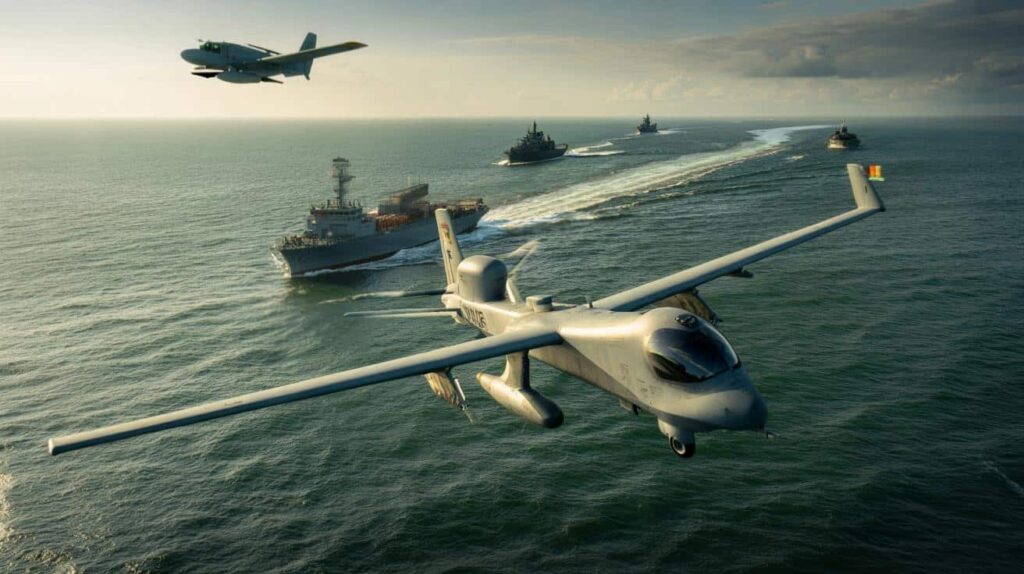
Berlin has confirmed the purchase of eight MQ-9B SeaGuardian drones, built by US manufacturer General Atomics Aeronautical Systems. Deliveries are expected to begin in 2028, with the aircraft operated from the naval air base at Nordholz in Lower Saxony.
The full package reaches an eye-watering €237.5 million per system — more than the price of a latest-generation Eurofighter Typhoon for the German Air Force.

The MQ-9B SeaGuardian is set to become a central pillar of Germany’s maritime surveillance posture, with a price tag that rivals top-tier combat jets.
Berlin’s target is clear: secure key sea lanes in the North Atlantic and Baltic Sea, deter Russian submarines, and guarantee better situational awareness along NATO’s northern flank.
What the money really buys: more than a drone
The sticker shock masks a distinction between the bare aircraft and the complete system. German officials estimate the drone itself at around €68.5 million. The remaining cost comes from everything needed to operate it without gaps.
The contract covers:
- Ground control stations certified for NATO operations
- New infrastructure and hangars at Nordholz naval air base
- Training for pilots, sensor operators and maintenance crews
- Secure satellite and data links for beyond-line-of-sight control
- Initial maintenance, spare parts and support until at least 2030
This “turnkey” approach brings the total investment for the first phase to about €1.9 billion, a sum approved by the Bundestag.
Germany is not just buying airframes; it is buying a full, sovereign surveillance capability intended to run for decades.
A wingman for the P-8A Poseidon, not a replacement
The SeaGuardian will sit alongside, not instead of, Germany’s P-8A Poseidon maritime patrol aircraft. The two platforms serve different roles that mesh together.
The P-8A is fast — close to 900 km/h — and carries a heavy load of sonobuoys, torpedoes and advanced sensors. It is built to rush to a contact, prosecute a submarine and, if needed, attack it.
The MQ-9B works differently. It trades speed and armament for endurance and persistence. It can stay airborne for more than 30 hours on a single mission, orbiting slowly over suspect areas, relaying data to headquarters and to crewed aircraft.
This pairing lets Germany keep a near-permanent watch over key choke points while holding back manned aircraft for moments that require rapid intervention or firepower.
A drone tailored for NATO and northern waters
Germany is not alone in turning to the MQ-9B family. The United Kingdom has ordered 16 SkyGuardian variants. Belgium has opted for four. Japan has reported very similar unit prices to Berlin’s.
This commonality matters for NATO integration. Shared platforms simplify data exchange, joint training and maintenance across allied forces.
The SeaGuardian comes with several features that fit Germany’s geographic reality:
- Satellite-controlled operations “pole-to-pole”, including high latitudes
- Advanced anti-icing systems for harsh, cold-weather conditions in the Baltic
- Multi-domain sensor suites that can watch surface traffic, scan for submarines and track aerial targets
In practice, the drone can patrol sea lanes used by tankers, LNG carriers and military convoys, then cue other assets when something suspicious appears under or on the water.
| Key element | Main data |
| Drone type | MQ-9B SeaGuardian |
| Order announcement | January 2026 |
| Planned deliveries | From 2028 |
| Estimated full-system price per unit | €237.5 million |
| Drone airframe price | €68.5 million |
| Main operator | Naval Air Squadron 3, Nordholz |
| Primary missions | Maritime surveillance, anti-submarine support |
| Other users | UK, Belgium, Japan |
Future upgrades: from eye in the sky to submarine hunter
Germany’s plan does not stop with the 2028–2030 timeframe. Defence officials already talk about a modernisation wave between 2031 and 2032 to give the SeaGuardian more advanced anti-submarine tools.

The next step could include better acoustic processing, new types of sonobuoys operated in concert with the P-8A, and deeper integration into future “collaborative combat” networks that link drones, aircraft, ships and undersea sensors.
Berlin wants the MQ-9B to evolve from a passive surveillance platform into an active player in submarine detection and tracking.
The architecture is being designed with embedded AI in mind. Algorithms could sift through huge flows of radar, electro-optical and acoustic data to flag anomalies faster than human operators alone.
Is the SeaGuardian worth more than a fighter jet?
The programme still comes with sharp criticism inside Germany. Opponents point to the price gap with the Eurofighter Typhoon, which sits around €187.5 million per aircraft in its latest tranche, and argue that Berlin is overpaying for unarmed drones.
Supporters respond that the comparison misses the point. The MQ-9B is not meant to dogfight or drop bombs on front lines. Its value lies in constant presence, high-end sensors and lower risk to human crews.
In a confrontation with Russia, the hardest targets to track are often submarines and low-signature surface vessels. Keeping them under watch for days at a time requires a different kind of asset than a traditional fighter.
The SeaGuardian’s range, sensor integration and long endurance give Germany a platform that can patrol contested regions without crossing political red lines linked to manned flights close to Russian territory.
Why long-endurance maritime drones matter for Europe
Scenario: a tense night in the Baltic
Imagine a tanker reporting unusual sonar contacts near a busy shipping corridor off Sweden. A P-8A Poseidon is scrambled, but flying and operating it is costly. Instead, a SeaGuardian already on station shifts its orbit, quietly scanning the area with radar and electro-optical sensors.
Within hours, it builds a pattern of life: merchant traffic, fishing vessels, naval ships. Anything that does not fit that pattern stands out. The P-8A can then be directed precisely where the anomaly sits, dropping sonobuoys and, if needed, weapons.
This kind of layered response is exactly what NATO planners have in mind for the High North and Baltic, where Russian submarines and undersea infrastructure sabotage have become major concerns.
Key terms worth unpacking
Two concepts sit at the heart of this shift in German strategy:
- Persistent surveillance: keeping sensors in an area continuously, rather than sending short, sporadic patrols. It dramatically raises the chance of spotting unusual activity early.
- Collaborative combat: linking drones, crewed aircraft, ships and land units into a shared digital network, where each platform feeds and receives data in near real time.
In that context, the SeaGuardian acts as a node on a much larger grid, not a lone asset operating in isolation.
Risks, trade-offs and what comes next
The move does carry risks. Germany becomes more dependent on US technology at a time when European leaders speak about “strategic autonomy”. Export controls, software updates and spare parts will remain tied to Washington’s goodwill.
The drones themselves are also vulnerable to electronic warfare and cyber attacks. Jamming or spoofing satellite links could disrupt operations, though both Germany and the US are investing in hardened, resilient communications.
On the other hand, the benefits for NATO are tangible. Common platforms cut costs for training and support. Shared tactics between UK, Belgian, Japanese and German crews can speed up operational learning.
For Germany, the SeaGuardian decision signals a clear choice: rather than waiting for a hypothetical European maritime drone that might arrive years later, Berlin is buying a proven system now, betting that upgrades and software will keep it relevant in the contested seas of the 2030s and beyond.