Fresh analysis of satellite data is reshaping that picture yet again, pointing to a northern ocean on Mars comparable in size to the Arctic Ocean and deep enough to swallow skyscrapers.
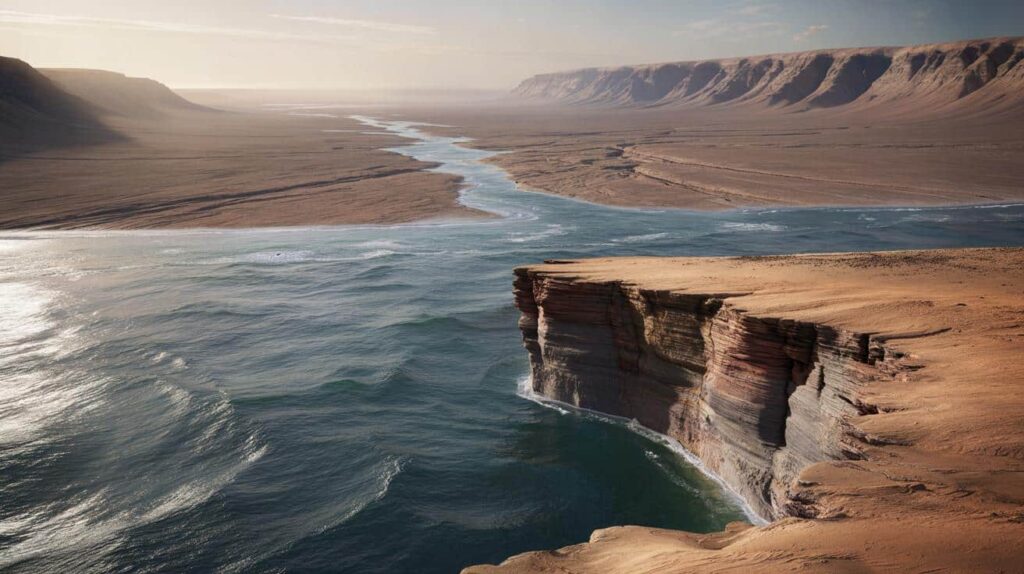
A fossil shoreline carved into the red planet
The case for an ancient Martian ocean has been building for years, but new high-resolution maps from European and US orbiters give it a striking level of detail. Scientists have stitched together measurements from spacecraft such as Mars Express and Mars Reconnaissance Orbiter to trace features that look remarkably like coastal landscapes on Earth.
These structures appear at almost identical altitudes over hundreds of kilometres, forming what looks like a ghostly, planet-scale bathtub ring around Mars’s northern lowlands. For geologists, that kind of altitude “plateau” is a powerful clue that liquid water once pooled there for a long time.
Researchers now argue that Mars once hosted a northern ocean reaching depths of around one kilometre, rivaling the surface area of today’s Arctic Ocean.
The most striking evidence sits inside Valles Marineris, a canyon system so vast it would stretch from New York to Los Angeles. Hidden in one of its branches, Coprates Chasma, scientists see formations shaped like fans, spreading out at the foot of ancient slopes. On Earth, such fans usually form where rivers empty into a larger body of water, losing speed and laying down sediment in broad, flat deltas.
The telltale geometry of ancient deltas
These Martian “fan” deposits, formally called scarp-fronted deposits, show a distinct pattern: a relatively flat surface that ends abruptly in a steep drop. That break in slope lines up at elevations between about –3,750 and –3,650 metres. The same pattern shows up again and again, from Coprates Chasma all the way to regions like Capri Chasma and Hydraotes Chaos, up to 500 kilometres away.
On a map, those repeating heights mark out what would have been the shoreline of a sprawling ocean in the planet’s northern hemisphere.
The consistent altitude of these fan-shaped deposits suggests a stable sea level that persisted long enough to sculpt a clear coastal profile.
Branching valleys and channels feed into these deposits, just as river systems on Earth funnel water and sediment towards seas and lakes. Rather than a frozen wasteland, this part of ancient Mars seems to have been an active fluvial landscape, with rainfall or snowmelt carving river basins and transporting mud, sand and gravel downhill.
An ocean as wide as the Arctic, and a kilometre deep
Put together, the data outline a body of water that would have spread across the vast northern plains of Mars, filling the planet’s lower half like a basin. The estimated depth reached about one kilometre in places, enough to cover many city skylines and easily deeper than most coastal seas on Earth today.
- Estimated period: roughly 3.0–3.5 billion years ago
- Location: northern lowlands, fed by canyons such as Valles Marineris
- Depth: up to around 1,000 metres in some regions
- Extent: similar surface area to Earth’s Arctic Ocean
Timing is crucial. The ocean appears to have formed near the end of the Noachian and the start of the Hesperian, two major chapters in Mars’s geological history. During that era, water still flowed openly on the surface, eroding highlands and dumping sediments into the lowlands that would become the seafloor.
A large, stable ocean also hints at a thicker atmosphere than Mars has today. A denser blanket of air would have trapped more heat, keeping water liquid at the surface for long periods instead of locking it away as ice or bleeding it into space.
What this means for possible ancient life on Mars
A global-scale ocean changes the stakes in the hunt for past life. On Earth, deltas and coastal shelves are biological hot spots, rich in nutrients and sheltered habitats. They trap fine sediments that gently bury and preserve organic material, making them prime territory for fossils.
If life ever gained a foothold on Mars, these ancient shorelines may offer the best chance of finding its traces.
That is why scientists eye these former coastal zones as priority targets for future landers and rovers. The layered sediments inside scarp-fronted deposits could record subtle changes in climate, water chemistry and perhaps even microbial activity across millions of years.
Today’s missions already work with that idea in mind. NASA’s Perseverance rover is collecting samples in an old lake-delta system in Jezero Crater, another site linked to the once-wetter Mars. A future mission could attempt something similar in or near Valles Marineris, where the ocean’s edge appears written into the rock.
How you rebuild a vanished ocean from orbit
The story comes together thanks to a mix of imaging and topography. High-resolution cameras capture the shape and texture of the ground, while laser altimeters and stereo images measure elevation with surprising precision. When fans, terraces and channels all line up at the same vertical level in widely separated regions, it points to a shared waterline.
| Clue | What it suggests |
|---|---|
| Fan-shaped deposits | River deltas forming at a coastline |
| Consistent altitude band | Stable sea level over large distances |
| Branching valleys | Surface runoff feeding into a larger basin |
| Layered sediments | Long-term deposition in a watery environment |
These features alone do not guarantee an ocean; vast lakes or inland seas could, in theory, produce something similar. What pushes scientists toward the ocean scenario is scale. The mapped shoreline wraps much of the planet’s northern hemisphere and sits inside a natural topographic bowl, just where an ocean would be expected if Mars ever held enough water.
Where did all that Martian water go?
An ocean comparable to the Arctic raises a blunt question: if Mars was once that wet, why is it so dry today?
Several processes likely acted together. The planet’s weak gravity makes it easier for light molecules, including water broken into hydrogen and oxygen, to escape into space. Mars also lost its global magnetic field early on, exposing the upper atmosphere to a constant battering by the solar wind. Over hundreds of millions of years, that wind can strip away gases, thinning the air and making liquid water unstable at the surface.
Some water may have sunk into the crust, locked up as hydrated minerals or buried ice. Radar measurements and lander data suggest huge reserves of frozen water still lurk beneath the soil, especially in the polar regions. What once formed waves in the Martian Arctic may now sit as solid reservoirs under layers of dust and rock.
Key terms that help make sense of Mars’s ocean story
The science around Mars can feel dense, but a few terms go a long way:
- Noachian period: An early Martian era more than 3.7 billion years ago, marked by heavy impact cratering and abundant surface water.
- Hesperian period: The following era, when volcanic activity and widespread lava plains reshaped the planet while surface water gradually declined.
- Delta: A wedge-shaped deposit of sediment laid down where a river slows and meets a standing body of water, such as a lake or sea.
- Scarp-fronted deposit: A sediment body with a sharp cliff or scarp at its front, similar to the edge of a submerged delta on Earth’s continental margins.
What future missions could find along the ancient coast
Looking ahead, scientists imagine a new generation of missions aimed directly at these ancient shorelines. A lander touching down on one of the fan-shaped deposits could drill into the layers, scanning for subtle chemical patterns or microscopic structures left by past microbes.
Robotic helicopters, building on the success of NASA’s Ingenuity, might one day hop from outcrop to outcrop along the suspected coastline, quickly mapping sediment layers and sniffing for organic signatures. Combined with sample-return missions, such surveys could turn the idea of a Martian ocean from a geological inference into a detailed environmental history.
For now, the picture emerging from orbit is already changing how scientists think about Mars. Instead of a permanently frozen rock, the planet starts to resemble a world that once had clouds, rain, rivers and a restless northern sea roughly matching our own Arctic in scale. The traces of that lost ocean remain etched on the landscape, waiting for closer inspection from the next wave of missions.