It usually starts with something tiny.
A receipt you might “need later”, a birthday card too nice to toss, a cable that belongs to some device you no longer own but “could be useful”.
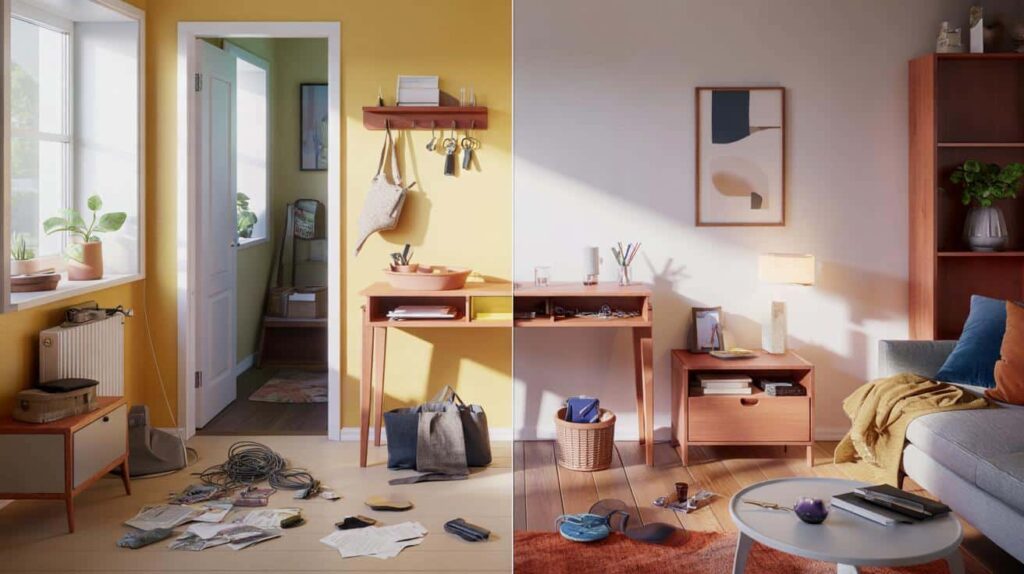
You stack them on a corner of the dresser.
They migrate to the kitchen counter, then the coffee table, then the chair where guests are supposed to sit.
You’re not a hoarder. You’re just… normal.
You like your stuff. You don’t want to throw it away.

One evening you catch yourself standing in the middle of the living room, turning slowly like a confused robot, wondering where you’re supposed to put your laptop, your keys, your bag, your mail.
And then you realise: the problem isn’t what you own.
It’s that nothing seems to have an actual place.
The everyday trick: give every single thing a “home”
The simplest decluttering move you can use daily doesn’t involve a trash bag or a dramatic purge.
It’s this: decide that every object you keep must have a clear, specific “home”.
Not “somewhere on the shelf”.
Not “around the desk area”.
A real home. A single, visible, repeatable spot where that thing lives when it’s not in use.
Keys live in the bowl by the door.
Glasses live on the nightstand.
Charging cables live in the top drawer, left side, in a small pouch.
Once you see your stuff this way, your home stops being a storage unit and starts acting like a city map.
Everything has an address.
A friend told me she used to “clean” by scooping everything into pretty baskets.
It looked fine for a few days. Then, every time she needed something, she had to dig through three boxes and a drawer.
She wasn’t decluttering, she was just hiding chaos.
One weekend she tried this “home” trick in her tiny hallway.
She added a narrow shelf, a small tray for mail, and a hook just for her work bag.
That was it. No big makeover.
Within a week, the hallway stopped being a dumping ground.
Her keys landed in the same tray every time.
The bag always hung on that hook.
She said it was the first time in years she wasn’t late because she couldn’t find something on her way out the door.
The logic is almost boringly simple.
When an object has no home, your brain has to renegotiate its location every single time you touch it.
That negotiation costs energy.
You think, “Where do I put this?” and your mind throws up ten options.
So you drop the thing in the nearest empty-ish space, promising Future You will “sort it properly”.
When each item has a fixed home, there’s no negotiation.
The question isn’t “Where does this go today?” but “Will I walk five extra steps to put it back where it lives?”
That tiny difference changes everything.
Clutter stops being this mysterious fog and becomes a simple yes-or-no: is the thing at home, or not yet?
How to set up “homes” without throwing anything away
Start small.
Pick one hotspot: the kitchen counter, the coffee table, the bedside area, the entryway.

Look at what constantly piles up there.
Not the random stuff. The repeat offenders.
Keys, coins, mail, chargers, headphones, pens, hair ties, reusable bags.
Then assign homes right next to where you naturally drop them.
If you always toss your keys on the counter, don’t fight that habit. Put a small bowl or tray exactly there.
If your backpack lives on the floor, add a hook right above that spot.
You’re not redesigning your personality.
You’re building tiny parking spaces for the items that already crowd your daily route.
The biggest mistake people make with this trick is going too big, too fast.
They decide that from now on, every book, every paper, every sock will have a hyper-organised, colour-coded, Pinterest-level home.
Two days later, the system collapses.
Why? Because life happened.
You came home tired, dropped your things where you were standing, and your “perfect” plan didn’t survive contact with reality.
Let’s be honest: nobody really does this every single day.
The real win isn’t perfection; it’s friction.
Place homes where they reduce friction between “I’m tired” and “I’ll put this away anyway”.
If you constantly leave mugs near the sofa, consider a small side table or a tray right there.
Is it architectural genius? No.
Does it stop the slow mug invasion across your living room? Pretty often, yes.
*There’s also that emotional weight tied to stuff that has no clear place.*
Guilt objects. Aspirational objects. The jeans you’ll “fit into again”, the craft supplies for a hobby you haven’t actually started.
Sometimes giving something a home is the first honest conversation you have with it.
A reader once told me:
“I realised my yoga mat was always in the hallway because I wanted to ‘see it and be inspired’.
But all it did was trip me every morning.
The day I rolled it up and gave it a real spot in the bedroom corner, I used it more.
It stopped being a nag and became a tool.”
So where do you start when you feel overwhelmed?
Try this simple list of “home zones” and pick just one today:
- Entry zone: keys, mail, bag, shoes
- Bedside zone: phone, book, glasses, water
- Sofa zone: remote, blankets, chargers, magazines
- Desk zone: laptop, notebook, pens, headphones
- Kitchen zone: coffee gear, daily spices, lunch boxes
Living with less chaos, without owning less
Sooner or later, something interesting happens.
You stop asking, “Do I need to throw everything away?” and start asking, “Where does this actually live?”
You notice that some things never quite earn a home.
They float. They annoy you. They get moved from pile to pile like nomads.
Those are the items you eventually feel ready to let go of, not because a minimalist guru told you to, but because your home system quietly voted them out.
That’s the second layer of this trick: it doesn’t force you to declutter.
It gently shows you which objects belong in your daily life and which are just squatting in your space.
You’re still keeping almost everything.
You’re just no longer giving your attention to what doesn’t serve you.
| Key point | Detail | Value for the reader |
|---|---|---|
| Assign “homes” to objects | Each frequently used item gets one clear, fixed spot | Reduces decision fatigue and daily mess without purging possessions |
| Start with hotspots | Focus on entryway, bedside, sofa, and desk zones first | Quick visual impact and immediate feeling of control |
| Let the system reveal excess | Items that never find a home become obvious clutter | Decluttering becomes natural, not forced or guilt-based |
FAQ:
- Question 1What if I live in a very small space with almost no storage?
- Answer 1Use vertical and “edge” spaces. Hang hooks behind doors, add narrow shelves above light switches, place trays on top of dressers, and give every surface a job. The rule is the same: one clear home per item, even if that home is just a small bowl on a window ledge.
- Question 2How long does it take before this feels natural?
- Answer 2The first week feels like a tiny chore, the second week feels neutral, and around week three your hands start moving on their own. Your body remembers where things live long before your mind feels “organised”.
- Question 3Do I need to buy organisers or special containers?
- Answer 3Not necessarily. Use what you already have: jars, shoe boxes, lids, old bowls, small trays. The function matters more than the aesthetic. You can always upgrade once the system proves it works for you.
- Question 4What about sentimental items I don’t use but can’t throw away?
- Answer 4Give them a respectful home too: one box, one drawer, one shelf. Label it clearly, and decide that anything sentimental must fit in that boundary. You’re not deleting memories, just preventing them from spilling into every corner.
- Question 5How do I get family or roommates to follow this?
- Answer 5Keep it simple and visible. Use obvious containers and clear spots, and talk in terms of “homes” instead of rules. People of all ages understand “the scissors live here” better than “please tidy up more”. Lead quietly by example; consistency is more convincing than speeches.