The deal itself looks simple on paper: more single-aisle jets, one familiar European manufacturer, one fast-growing Chinese buyer. Behind it sits a fight for influence in a global leasing market that could be worth around €370 billion by 2032.
China’s CALC doubles down on Airbus single-aisle jets
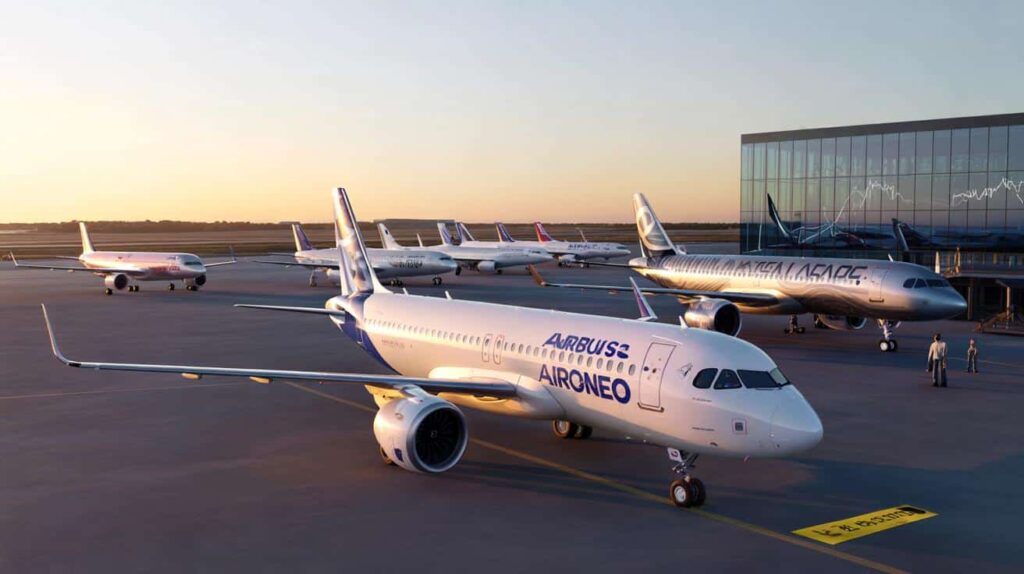
On 30 December 2025, in Toulouse, China Aircraft Leasing Group Holdings Limited (CALC) signed a fresh firm order with Airbus for 30 additional A320neo-family aircraft.
These jets will join an already sizeable Airbus portfolio at the Hong Kong–listed lessor. With this new deal, CALC’s total Airbus backlog reaches 282 aircraft, including 203 from the A320neo family.

Thirty more A320neo jets give CALC extra delivery slots in a market where airlines still face long waits for new aircraft.
The timing matters. Airlines across Asia, the Middle East and Europe are scrambling for fuel-efficient narrowbodies to respond to traffic recovery, launch new routes and replace ageing fleets. Production at both Airbus and Boeing remains tight, and delivery slots into the late 2020s are already largely spoken for.
By locking in more A320neo positions, CALC is not just adding metal. It is buying time on the assembly line, which it can then resell in the form of leases to carriers that missed the earliest wave of orders.
Who CALC is, and why airlines go through a lessor
A financial middleman, not an airline
CALC is not an airline and does not sell tickets. It operates as an aircraft lessor: a specialist that buys new jets from manufacturers, finances them, and then rents them to airlines for long periods, typically eight to twelve years.
Instead of spending hundreds of millions upfront on a fleet, an airline pays a fixed monthly lease. That lease covers the cost of the aircraft and provides a margin for the lessor. At the end of the lease, the jet can be returned, re-leased to another operator, or sold on the secondary market.
- Airlines gain flexibility and preserve cash.
- Lessors bet on residual value and long-term demand.
- Manufacturers secure large-volume orders earlier in a programme’s life.
CALC’s challenge is to choose aircraft types that remain attractive across many markets and economic cycles. A popular, versatile narrowbody is far easier to place and re-place than a niche widebody built for a handful of routes.
The A320neo family has become a sort of global currency for lessors: widely accepted, easily traded and relatively predictable in value.
A growing, but not yet dominant, leasing player
CALC still sits outside the top ten of global aircraft lessors by fleet size, but it has been edging up the rankings. Industry data for 2024 places it around 16th worldwide, with just over 200 aircraft under management and a portfolio heavily weighted towards the A320 family.
That mid-tier position gives CALC an interesting profile. It is big enough to secure slots on Airbus production lines, yet still nimble compared with giants like AerCap or Avolon. The latest order solidifies its access to high-demand assets and signals to airlines that CALC can deliver modern jets on acceptable timelines.
Inside the global aircraft leasing boom
A market racing toward €370 billion
Leasing has shifted from financial niche to core infrastructure for the aviation industry. According to data cited from Fortune Business Insights, the global aircraft leasing market stood at around $183 billion (roughly €170 billion) in 2024. Forecasts point to more than $400 billion by 2032, or about €370 billion at current exchange rates.
Several trends push this growth:
- Rising interest rates make outright aircraft purchases more painful for airlines.
- New environmental rules encourage faster fleet renewal, which leasing can spread over time.
- Low-cost carriers want asset-light balance sheets and capacity that can be adjusted quickly.
- Emerging markets in Asia, Africa and Latin America are adding traffic but lack easy access to capital markets.
Leasing models themselves are fairly straightforward. The most common structure is “dry leasing”, where the lessor provides the aircraft and the airline provides crew, maintenance and insurance. “Wet leasing”, including aircraft, crew and often maintenance, is used more sparingly, usually in peak seasons or to cover unexpected capacity gaps.
Europe’s grip on a global business
Despite China’s rising presence, Europe currently dominates aircraft leasing. In 2023, European lessors controlled more than half of the global market, helped by favourable tax regimes and long-standing expertise in Ireland, where many of the largest players are based.
Data on the 2024 rankings illustrates the landscape:
| Rank | Lessor | Fleet size | Portfolio value ($bn) | Main fleet type |
|---|---|---|---|---|
| 1 | AerCap | 1,669 | 61.99 | A320 family |
| 2 | Avolon | 633 | 30.68 | A320neo |
| 3 | SMBC Aviation Capital | 611 | 15.87 | A320 family |
| 4 | BOC Aviation | 576 | 30.15 | A320neo |
| 5 | BBAM | 562 | 22.92 | 737-800 |
| 16 | China Aircraft Leasing Group (CALC) | 208 | 5.60 | A320 family |
CALC’s Airbus order adds weight to its portfolio and helps China extend its influence in a business still largely structured around European financial hubs.
Why the A320neo sits at the centre of the game
A safe, flexible bet for lessors
On the surface, CALC’s choice is not very original. More than 19,000 A320neo-family aircraft have been ordered worldwide, making it the most popular single-aisle programme in history.

For a lessor, though, that predictability is exactly the point. High demand across many airlines and regions tends to support lease rates and residual values. If one customer fails or changes strategy, there is usually another willing to take a similar aircraft on similar terms.
The family structure matters as well. Between the standard A320neo and the stretched A321neo, airlines can scale capacity or range without retraining pilots from scratch or overhauling maintenance systems. From a leasing perspective, that gives each frame more possible homes over its 20–25 year economic life.
A widely used workhorse aircraft behaves almost like a liquid asset: it can be moved, reconfigured and re-leased with fewer headaches.
Environmental pressure and SAF compatibility
Every A320neo in CALC’s new batch is already certified to operate with up to 50% sustainable aviation fuel (SAF) mixed with conventional kerosene. Airbus aims to make its aircraft fully compatible with 100% SAF by 2030.
For lessors, that technical detail carries financial weight. Stricter climate policies, green taxes and investor pressure are pushing airlines toward younger, more efficient fleets. An aircraft that can accommodate higher SAF blends without modification stands a better chance of staying deployable and valuable long into the 2030s and 2040s.
How this order shifts Airbus–China dynamics
A signal in the Airbus–Boeing balance
China’s fleet plans often draw political attention, as Beijing can tilt major orders toward Airbus or Boeing depending on broader trade relations. When a Chinese lessor rather than a state-owned airline signs a big contract, the move can look more commercial and less geopolitical, but the industrial consequences remain significant.
Each Airbus single-aisle order from a Chinese player nudges the balance slightly away from Boeing in one of the most dynamic air travel markets. For Airbus, CALC’s new commitment reinforces the A320neo’s position as the default narrowbody choice across Asia, from full-service carriers to low-cost operators.
CALC, for its part, gains leverage with Chinese and regional airlines hungry for capacity but facing long manufacturer backlogs. Holding a portfolio of in-demand European jets increases its bargaining power and justifies stronger lease pricing.
What this means for airlines, investors and travellers
Airlines: more flexibility, but also more dependence
For airlines, the growing share of leased aircraft creates a trade-off. On one side, leasing reduces upfront capital needs and lets management respond faster to demand swings. On the other, it locks a large slice of operating costs into long-term contracts, leaving less room to manoeuvre in a downturn.
The pandemic showed both sides. Lessors acted as shock absorbers in 2020, financing around 55% of Airbus deliveries when carriers themselves pulled back. At the same time, airlines stuck in lease commitments had to negotiate deferrals and waivers to avoid a cash crunch.
Investors: betting on residual value and regulation
For investors looking at aircraft leasing stocks or bonds, CALC’s Airbus order sits at the intersection of three moving parts: long-term air travel growth, regulatory pressure on emissions, and fluctuating interest rates.
Higher rates squeeze margins on new deals, but also raise the cost of capital for airlines, pushing them further toward leasing. Stronger climate rules accelerate retirements of older jets, supporting demand for modern types like the A320neo. The risk lies in over-ordering: if too many lessors chase the same model, lease rates can soften, especially in a downturn.
Key concepts behind the numbers
What “residual value” really means for an Airbus A320neo
Residual value is the estimated worth of an aircraft at the end of a lease or at different points in its life. For a new A320neo, lessors project how much the jet could be sold or re-leased for in, say, 10 or 15 years. Those projections drive the rent airlines pay today.
If demand remains strong and fuel prices stay high, efficient A320neos may keep their value better than expected. A sharp technological shift, such as a credible zero-emission narrowbody entering service sooner than forecast, could do the opposite and hit values.
A simple scenario: what a leasing-heavy future might look like
Imagine a medium-sized Asian carrier in 2032 running a 50-aircraft fleet, 40 of which are leased. CALC holds contracts on 15 of them, mostly A320neos. If traffic jumps by 20% after a visa deal or tourism boom, the airline can add three or four more leased jets with limited capital outlay, gaining market share quickly.
But if fuel prices double or a recession bites, that same carrier must still pay lease rates unless it can renegotiate or return aircraft early, usually at a cost. The power of leasing cuts both ways: it speeds growth but hardens fixed costs.
CALC’s latest order suggests that, by 2032, many such scenarios will rest on the wings of Airbus narrowbodies. In a leasing market heading toward €370 billion, control of those delivery slots is starting to look like one of aviation’s quietest, and most contested, strategic assets.