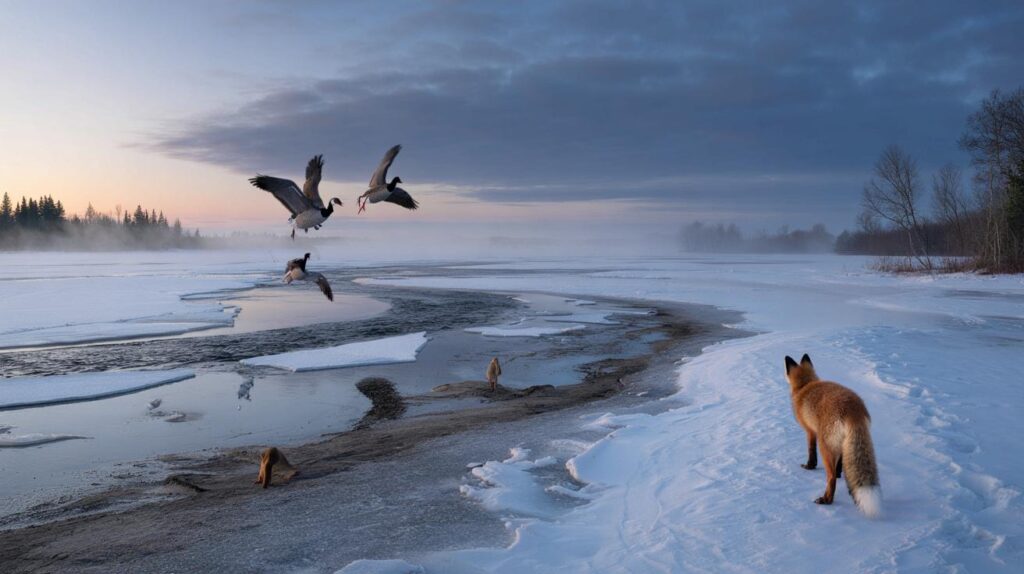
On a gray February morning in northern Minnesota, the silence felt wrong. The air was sharp, the snow crusted and bright, yet the usual soundscape was off by a few beats. Chickadees called from the spruce line like they always do, but a pair of Canada geese circled low over the half-frozen river, honking in confused loops, as if they’d arrived at a party before the lights were switched on. Down by the bank, fresh otter tracks stopped abruptly at a patch of bare mud where ice should still be locked in place. A thaw had come early, then vanished overnight.
When winter behaves like a flickering light switch
Ask any meteorologist right now and you’ll hear the same phrase on repeat: *the Arctic is unstable this year*. Sudden stratospheric warming events, meandering jet streams, cold air diving south for a few days then snapping back toward the pole. Early February, which used to be a fairly predictable deep-winter stretch, now feels like a roulette wheel of freeze, thaw, fog, and strange half-light.
For humans, that means weird commutes and chapped lips.

For animals that time their lives to temperature and light, it means something closer to disorientation.
You can see it play out on the ground. In coastal Maine this week, wildlife officers reported gray squirrels already stripping buds from maple branches, a behavior usually seen weeks later. A warm spell in late January nudged sap flow and woke up insects beneath loose bark. Then an Arctic blast dropped nighttime temperatures below -20°C again, flash-freezing that brief flush of life.
One ranger described watching a red fox zigzag across a snowfield that alternated between glare ice and wet slush. The animal paused at the edge of a cattail marsh where muskrats should be active under the ice, cocked its head, and moved on. The cues that used to line up—smells, sounds, snow cover—no longer quite match the script its instincts are reading from.
Meteorologists and ecologists are starting to connect those daily forecasts to deeper biological misfires. Animals don’t just rely on the calendar; many are tuned to a blend of light length, ground temperature, and snow depth. When Arctic air dives south and retreats in rapid pulses, that blend gets scrambled.
Birds may get a misleading warm signal that suggests migration can start early. Amphibians may crawl out of hibernation during a soft spell, only to be hammered by the next cold plunge. **The weather map looks dynamic; the food web looks confused.**
What used to be a gentle seasonal dimmer switch is behaving more like someone flicking the lights on and off in a crowded room.
How early February shocks ripple through wild calendars
One of the most sensitive groups right now: early migratory birds. Many species use daylight length as the main trigger to move north, yet they refine that timing based on air temperature and wind patterns. This year, meteorologists tracking Arctic oscillations have warned of a “yo-yo” effect—mild air surging north, then sudden Arctic outbreaks following behind.
A warm pocket over central Europe in early February, for example, can tempt some starlings, larks, or thrushes to push their journeys a bit earlier up the map. Then a fresh Arctic tongue of cold air slides down from Scandinavia and turns that hopeful head start into an icy trap. The birds have already burned precious fat reserves just staying aloft.
There’s a similar risk tucked into ponds and ditches that barely draw our attention. Frogs and salamanders lie buried in mud or leaf litter, in a carefully balanced metabolic pause. When soils thaw from an early warm burst, that pause eases. You might not see them, but some begin subtle movements, shifting position, adjusting body chemistry for spring.
Then a fresh Arctic blast slams the door. Shallow wetlands can freeze right through, killing eggs laid too soon or stressing adults that can’t simply “rewind” their hibernation. Biologists in parts of the Midwest already reported wood frogs calling on freak-warm nights in late January, then falling silent as windchills roared back down. Those calls burned energy, and in nature every calorie spent has a cost.
Underpinning all this is the way Arctic shifts have changed the tempo of seasons, not just their temperature. The jet stream, which steers storms and cold air masses, can stall into wavy patterns that lock in weird weather for days, then snap into the opposite extreme. Animals evolved to handle a late frost or an early thaw, but not a sequence of four or five whiplash swings in the same month.

**Meteorologists talk about “blocking patterns”; ecologists talk about “phenological mismatch.”** That’s the dry term for when the timing of life cycles drifts out of sync: flowers blooming before pollinators arrive, insect hatches peaking after migratory birds have already blown through hungry. Early February used to be a quiet stretch on this biological calendar. Now, it’s keeling into a high-stakes shuffle.
What we can actually do when winter goes sideways
You can’t nudge the jet stream with a garden rake, but you can soften the shock for the animals sharing your neighborhood. Start close to home. If you have a yard, balcony, or even a strip of scruffy ground behind the building, think of it as a tiny “buffer zone” where the rules of the wider climate roller coaster are cushioned just a bit.
Leave some leaf litter under shrubs instead of clearing it to bare soil. Those leaves hold pockets of more stable temperature and moisture, letting insects and amphibians ride out sudden cold snaps. Delay heavy pruning until late winter really has passed instead of chasing the first warm weekend in February with shears in hand.
Feeding birds is another place where the new winter patterns quietly ask more of us. When Arctic air plunges south after a warm tease, songbirds that moved around confidently in the thaw can find themselves suddenly desperate for high-energy food. If you hang feeders, consistency beats perfection. Once birds learn your spot as a reliable source, abrupt breaks can hit them hard during a snap-freeze.
Let’s be honest: nobody really does this every single day. Life gets hectic, trips happen, seed runs out. The plain truth is that even partly reliable support—a feeder mostly kept stocked, a water dish kept ice-free on the worst days—can tip the balance for a few exhausted migrants hovering at the edge of survival.
Meteorologists I’ve spoken to are surprisingly personal when they talk about this.
“We issue warnings for people, but I’m constantly thinking about wildlife too,” says Dr. Karen Ellis, a climate scientist who tracks Arctic air intrusions over North America. “When I see a 20-degree swing in 24 hours on the models, I know there are birds halfway across a field, frogs shifting in the mud, mammals leaving dens because they think winter blinked. These are not abstract lines on a map. They’re signals that bodies out there are going to be confused.”
On the ground, that concern translates into simple, practical moves you can try this week:
- Keep at least one corner of your outdoor space “messy” for shelter and insects.
- Offer fresh water during both thaws and freezes, using shallow bowls or heated dishes.
- Delay mowing or cutting back seed-bearing plants until early spring proper.
- Turn off unnecessary outdoor lights at night so migrating birds can rely on the sky, not glare.
- Pay attention to local forecasts, and add extra support (food, water, shelter) before big Arctic drops.
The quiet question early February is asking us
If you step outside on one of these strange February days and listen closely, there’s a subtle tension in the air. The angle of the sun already whispers “spring,” yet the bite of Arctic air still owns the ground. Animals are trying to read these mixed messages in real time, using instincts tuned over thousands of years to a rhythm that’s now glitching. We’re watching that play out in awkward migrations, risky awakenings from hibernation, and food chains that feel just slightly off.
The big question sneaks up quietly: how do we live inside a season that no longer behaves like itself, without letting that disorientation swallow everything? Maybe the starting point is simply noticing, then adjusting our own reflexes. Slowing our rush to tidy, leaving some rough edges in our gardens and parks, treating weather alerts as hints about more than just our commutes.
These Arctic shifts won’t stop next year or the one after. What can change is how actively we choose to become gentle co-authors of this new seasonal story, rather than distant spectators staring at a strange forecast on a glowing screen.
| Key point | Detail | Value for the reader |
|---|---|---|
| Arctic shifts scramble animal cues | Rapid freeze–thaw cycles confuse signals based on light, temperature, and snow cover | Helps you understand why wildlife is behaving oddly around you |
| Local actions soften climate whiplash | Messy corners, steady food and water, and less light pollution create micro-refuges | Shows concrete ways to support birds, insects, and small mammals |
| Monitoring forecasts becomes a tool | Watching for incoming Arctic blasts lets you time extra support for stressed species | Turns everyday weather apps into a simple wildlife protection tool |
FAQ:
- Question 1How do early February Arctic blasts actually “disorient” animals?
- Answer 1Many species rely on a mix of day length, temperature, and snow or ice cover to decide when to migrate, mate, or wake from hibernation. When Arctic air masses surge and retreat quickly, those cues no longer line up. Animals may move or breed too early, waste energy, or emerge when food isn’t available yet.
- Question 2Are some animals more vulnerable than others?
- Answer 2Yes. Early migratory birds, amphibians in shallow wetlands, and insects with narrow breeding windows are especially at risk. Larger mammals often have more fat reserves and flexibility, though young or pregnant individuals can still be hit hard by sudden swings.
- Question 3Can feeding birds really make a difference during these cold snaps?
- Answer 3It can, especially when temperature drops are extreme and short-lived. Consistent high-fat food sources, like sunflower seeds or suet, help small birds maintain body heat when the Arctic air dives south and natural food is locked under ice or refrozen snow.
- Question 4Should I avoid cleaning my garden until spring is fully settled?
- Answer 4Delaying heavy cleanup until late spring is kinder to wildlife. Dead stems, leaves, and seed heads shelter insects and provide food for birds during unpredictable February and March swings. You don’t need to leave everything, but keeping at least one “wild” corner goes a long way.
- Question 5Is this kind of February weather the new normal?
- Answer 5Climate trends suggest that more variable, “wavier” winters are becoming common as the Arctic warms faster than mid-latitudes. That doesn’t mean every year will look the same, yet the pattern of rapid warming and sudden cold returns is likely to appear more often than it did a few decades ago.