The first time I saw a pool noodle in a kitchen, I honestly thought my friend had lost it. This bright green foam tube was sliced up and wedged in every corner: against cabinet doors, under cutting boards, even on the edge of the fridge shelf. It looked like a craft project gone too far.
Then I spent an afternoon cooking there.
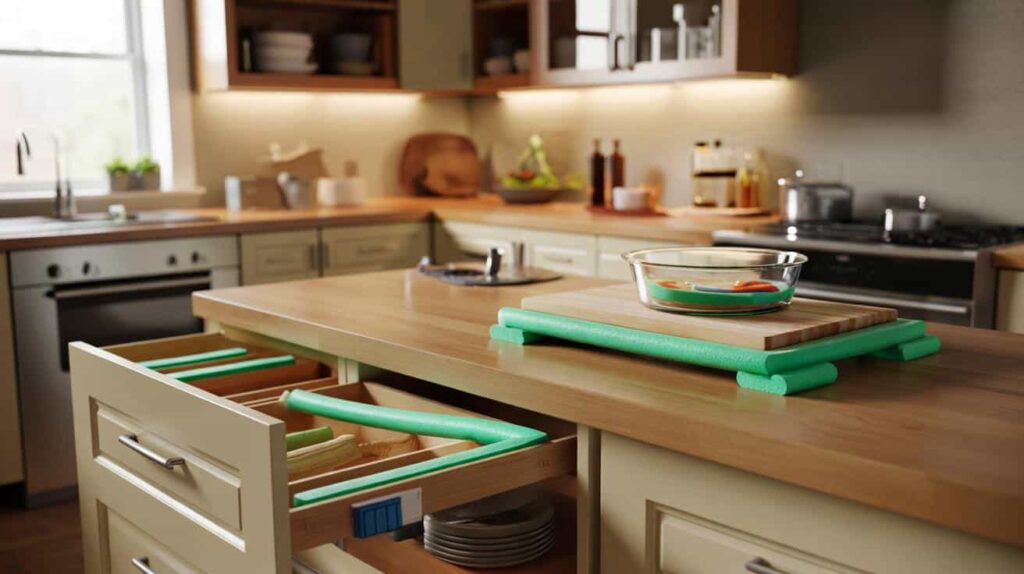
The drawers closed without slamming. The chopping board didn’t slip once. My glass baking dish survived a fall that would have shattered it in my own kitchen.

I went home that night, opened a cupboard, heard the usual clack of dishes and winced.
The next day, I bought a pool noodle.
That silly foam tube changed how my kitchen feels. Literally.
Why a pool noodle suddenly belongs in your kitchen
You probably think of pool noodles as summer clutter, the kind of thing you trip over in a damp garage in November. In a kitchen, though, that same foam tube becomes a quiet bodyguard. It softens noise, prevents accidents, and turns chaotic cupboards into calmer spaces.
One cheap piece of foam can sit between your fragile dishes and the brutal laws of gravity.
The magic is in its shape. Long, hollow, flexible. You can slice it, bend it, wedge it, and it forgives every rough cut. It doesn’t rust, it doesn’t break, it just sits there doing a simple job: protecting your stuff from your everyday rush.
Picture one of those rushed weekday evenings. You’re unloading the dishwasher, scrolling your phone with one hand, stacking plates with the other. A bowl slips, hits the edge of a drawer, cracks. Tiny shards everywhere, dinner delayed, mood ruined.
Now imagine the same scene with a strip of pool noodle lining that drawer edge. The bowl bumps, bounces, and survives. No crack, no sweep-up, no swearing under your breath.
Parents use it to pad the inside of pan drawers so little hands don’t get pinched. Renters wedge it at the back of wobbly shelves so jars stop sliding into the void. A two-dollar tube suddenly saves you from ten-dollar annoyances, over and over again.
There’s a simple reason this goofy object works so well in a serious room. Kitchens are full of hard surfaces: wood, glass, tile, metal. Energy has nowhere to go, so it travels as noise, impact, breakage. Foam changes that equation. It absorbs the shock.
That’s why **you instantly notice** less clatter when you start lining noisy spots with foam. Drawer slams become gentle thuds. Heavy lids land with a soft stop instead of a jolt that wakes the whole apartment.
We don’t think about it much, but the way a kitchen sounds affects how we feel in it. A pool noodle doesn’t just protect objects. It quietly lowers the tension you didn’t know you were carrying between your cabinets and your ears.
Unexpected ways to use a pool noodle in the kitchen
The simplest trick: cut the noodle lengthwise and clip it onto sharp or hard edges. Along the front of a low cupboard where you always bump your shin. On the side of an island where kids run past. Along a pull-out trash drawer that loves to slam into bare toes.
For shelves, slice thinner rings and slide them over glass bottles on a noisy rack. They stop the clinking every time you open the door.
One surprisingly useful move is under cutting boards. Cut a few short strips, lay them in a rectangle, board on top. No more sliding, even when you’re chopping fast. *It feels almost suspicious the first time you dice onions and nothing budges.*
Then there are the “I can’t believe this works” fixes. A small piece wedged between fridge shelves turns that wobbly panel into something solid. A strip along the backsplash behind your mixer stops it from rattling and walking forward when you use it.
Parents often slip a cut noodle along the top of oven doors when they’re cooling (while still supervising, of course), so a curious toddler head doesn’t bang directly into scorching metal. People who batch-cook line the trunk crate with noodle pieces before loading glass containers, so nothing knocks together on the drive home.
Let’s be honest: nobody really reorganizes their entire kitchen every single day. These tiny foam wedges are shortcuts. They let you adapt to your real habits without a full makeover.
One thing: this works only if you treat the noodle like a tool, not a toy you abandon. Don’t use pieces near open flames, don’t block ventilation, don’t cram them into the oven “just for now”. Foam burns, melts, and releases fumes. Common sense beats clever hacks every time.
If you share your kitchen, talk about it. Your partner or roommate will be confused the first time they see random colored foam everywhere. Explain where it is and why, especially around drawers and lids. Confusion causes more accidents than clutter.
And stay light about it. Your kitchen doesn’t have to look like a kindergarten. You can choose neutral colors, cut neat, narrow strips, tuck them out of sight. You’re not decorating with noodles, you’re quietly upgrading your daily life.
“I thought the pool noodle thing was ridiculous,” laughs Ana, a 34‑year‑old nurse who works nights. “Then I realized I wasn’t waking my kids every time I put away pots at 11 p.m. Now I have one in almost every drawer, just hidden.”
- Line noisy drawers with slim strips to soften the slam and protect dishes.
- Clip a lengthwise-cut piece onto sharp or painful edges at shin or hip height.
- Wedge small sections behind wobbly shelves or appliances to stop rattling.
- Create a non-slip base under cutting boards with four short pieces in a rectangle.
- Use rings as bumpers around fragile bottles or jars in crowded cupboards.
Living with a “noodle-proofed” kitchen
After a few weeks, you almost forget the pool noodle exists. What you notice instead is the absence of certain tiny stresses. Glassware lasts longer because it doesn’t bang into bare wood and metal. Kids can help unload the dishwasher without you shadowing their every move. Drawers close quietly when someone gets a snack at midnight.
You start to see other places where a thin cushion would calm things down. Behind the trash can so it stops denting the wall. Along the edge of a metal step stool that always cuts into your ankle. Around the rim of a baking dish when you pack it to lend to a neighbor so it comes back in one piece.
This kind of tweak doesn’t turn your kitchen into a Pinterest fantasy. It does something smaller and more honest: it respects the way you really live. You cook when you’re tired. You rush. You bump into things. You stack a little too high.
A foam tube will not solve your life. But it can remove a handful of annoying frictions: the clangs, the knocks, the “oh no, not that bowl”. And strangely, that’s what often changes how a room feels. Not a new appliance, not a big remodel. Just a few quiet, almost invisible details that finally work with you instead of against you.
Next time you pass a bin of pool noodles by the checkout, you might see them differently. Not as plastic clutter, but as raw material. As permission to hack your kitchen gently, cheaply, imperfectly.
You don’t have to explain it to anyone. Cut one up, tuck it where it matters, listen to the difference when the first drawer closes. Sometimes a tiny, silly object is all it takes to shift the mood of the room where your days actually happen. And maybe that’s the real revolution.
| Key point | Detail | Value for the reader |
|---|---|---|
| Softens impact and noise | Foam strips on drawer fronts, shelves, and lids absorb shocks | Less breakage, quieter kitchen, fewer stressful clangs |
| Stabilizes and protects | Non-slip bases under boards, bumpers around jars and bottles | Safer cooking, fewer spills, longer life for fragile items |
| Cheap, flexible hack | One noodle can be cut into dozens of custom pieces | Low-cost upgrade that adapts to any kitchen layout |
FAQ:
- Question 1Can I use a pool noodle near the stove or oven?
- Answer 1No, avoid placing foam close to open flames, burners, or inside the oven. Use it only on cool, external surfaces away from direct heat.
- Question 2Will a pool noodle absorb smells or stains in the kitchen?
- Answer 2It can pick up some grease or dust over time. Cut pieces small, place them where they don’t contact food, and replace them every few months if they look dirty.
- Question 3Is it safe if my kids play with the noodle pieces?
- Answer 3For older kids, yes, as long as they don’t chew on them. For toddlers, avoid small pieces that could be a choking hazard and keep them out of reach.
- Question 4How do I cut a pool noodle cleanly for kitchen use?
- Answer 4Use a sharp kitchen knife or a craft knife on a stable surface. Cut slowly, in straight motions, and trim any rough edges that could crumble.
- Question 5Won’t a pool noodle make my kitchen look messy?
- Answer 5You can choose neutral colors and tuck pieces out of sight: inside drawers, behind shelves, under boards. Used discreetly, **nobody will notice** until they feel the difference.