When scientists finally hauled it up from the North Atlantic, it looked like any other clam. Only later did they realise they were holding a life that had begun before Shakespeare was born – and that had just ended in the most mundane way imaginable: in a laboratory freezer.
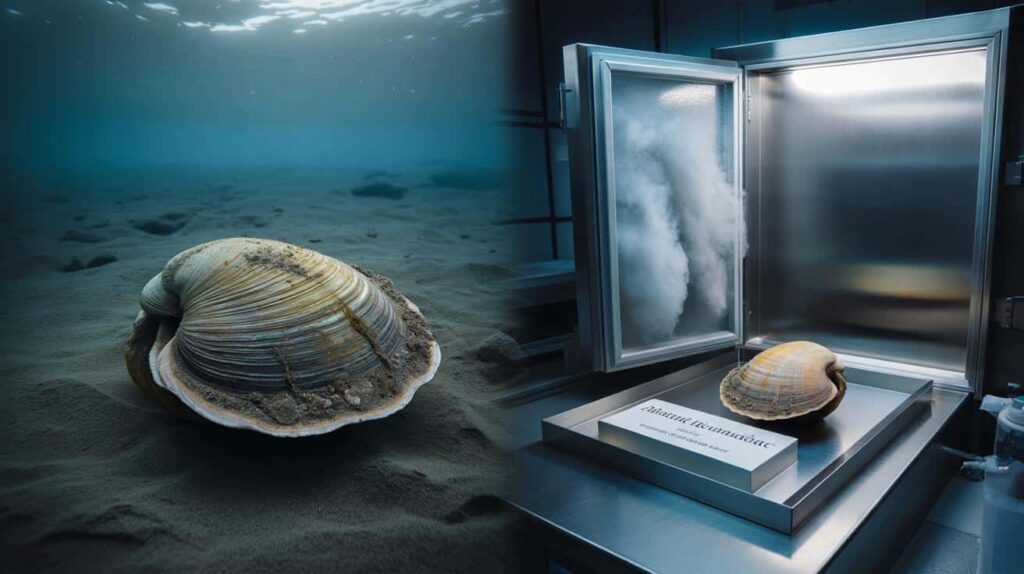
A five-century-old clam hiding off Iceland
The animal at the centre of this story was a small, thick-shelled bivalve called the Icelandic quahog, or Arctica islandica. It lived buried in the seabed off the coast of Iceland, half a metre under the sediment, filtering passing water and quietly building a record-breaking lifespan.
In 2006, during a scientific survey of North Atlantic marine life, researchers used dredging gear to collect shellfish from the deep, cold waters. Among dozens of clams, they picked up one individual that would later be nicknamed “Ming”, after the Chinese dynasty ruling when it was born.

At first sight, Ming did not stand out. It was not gigantic or oddly shaped. It was just a clam. The real story was written not on the outside, but in the fine structure of its shell.
Shell rings that outlive dynasties
Bivalves such as the Icelandic quahog grow a new layer on their shells every year. Under a microscope, these layers show up as narrow rings, a bit like the growth lines in a tree trunk. Marine scientists use this pattern, known as sclerochronology, to work out age and past environmental conditions.
When the team started counting the rings, they quickly realised this was no ordinary animal. Initial counts suggested more than 400 years of life. A closer analysis, combining ring patterns with carbon-14 dating, pushed the number further back.
Ming is now estimated to have been born in 1499, making it around 507 years old when it was collected.
That date puts the clam’s birth at a time when Europe had barely started transatlantic voyages, the printing press was still a new technology, and the Ming dynasty commanded vast territories in Asia. Through wars, pandemics, industrialisation and modern climate change, this single animal stayed put on the seabed, surviving in near darkness.
The confirmed age turned Ming into a scientific record-holder: one of the oldest known non-colonial animals ever dated with precision. Unlike corals or sponges, which live as colonies of many connected individuals, Ming was a single organism, carrying more than five centuries of biological history in its tissues.
What Ming revealed about ageing cells
The real value of Ming and its species lies not only in its age, but in how its body handles time. Researchers studying Arctica islandica have been particularly interested in its cellular machinery: what stops its cells from breaking down the way human cells do?
A body that barely wears out
Ageing is strongly linked to damage caused by reactive molecules, often called oxidative stress. These molecules can harm DNA, proteins and fats inside cells, gradually undermining their function. In most organisms, this damage piles up with each passing year.
Studies of Icelandic quahogs suggest a very different picture. When scientists compared young and old clams, they found that key structures inside the cells stayed surprisingly intact. Proteins remained stable. Cell membranes, built from lipids, continued to function well even in centuries-old animals.
Cell damage in these clams appears to build up incredibly slowly, pointing to an unusually efficient system of cellular maintenance.
Only the genetic material – the nucleic acids – showed a modest increase in oxidation with age, and even that rise seemed more closely tied to biological condition than simply to time lived. In other words, what mattered was how “old” the body was in functional terms, not the number of calendar years.
Researchers suspect that a very slow metabolism plays a major role. In icy, stable waters, Icelandic quahogs live at a low energetic pace. They expend less energy, produce fewer damaging molecules and have more chance to repair what does go wrong. That combination may be one reason they can last for centuries without succumbing to the normal wear and tear of life.
Challenging familiar ideas about ageing
These findings unsettle some long-held ideas about how living things age. A widely accepted view has been that oxidative damage is unavoidable and steadily accumulates in most species. But Ming and its relatives show that biology can find ways to slow that process to a crawl.

This does not mean clams hold a magic formula for human longevity. Our bodies have very different demands: we are warm-blooded, highly active and rely on fast, flexible organs such as the brain. Still, the Icelandic quahog offers a natural experiment in how life might stretch out its lifespan while keeping cells in workable condition.
- Extremely slow metabolism reduces production of harmful molecules.
- Efficient repair systems limit long-term cell damage.
- Stable, cold environments reduce environmental stress.
- Simple body plan focuses resources on maintenance rather than complexity.
A living archive of the ocean’s past
Ming’s shell carried a second kind of record, beyond its biological age. Each growth ring also stored information about the sea itself: temperature shifts, changes in food availability, and even variations in the chemistry of the water column.
By matching patterns of wider and narrower rings with known environmental events, scientists can reconstruct past ocean conditions across hundreds of years. They can compare shell records from several individuals to build continuous timelines that track how the North Atlantic has changed since before industrial emissions began.
In a single clam shell, researchers can read both the story of an individual life and a long climate archive.
This makes ancient bivalves powerful tools for understanding slow processes such as ocean warming, circulation changes and shifts in marine productivity. Combined with ice cores, tree rings and sediment layers, they help fill in missing pieces of Earth’s recent climate history.
A record-breaker lost in a freezer
The most uncomfortable part of Ming’s story is how it ended. Shortly after collection, the clam was frozen as part of normal lab procedures. Only when scientists went back to the sample to study it in detail did they grasp its extraordinary age.
By then, the animal was dead. The decision was not careless by the standards of routine fieldwork: researchers often freeze specimens to preserve tissues for later analysis. Still, knowing what Ming represented, the incident has become a cautionary tale about the tension between collecting data and protecting exceptional individuals.
Paradoxically, the act that killed the clam also made detailed study possible. Freezing preserved its tissue in a state that allowed careful analysis of cellular damage, and its shell could still be sectioned and dated. The cost was that a five-century-long life, which had dodged storms, predators and human fishing for generations, ended in a steel box humming in a laboratory.
What this means for human ageing research
Long-lived animals are attracting intense interest from biologists who study ageing. Besides Icelandic quahogs, researchers focus on Greenland sharks, naked mole-rats and certain turtles – all species that show unusually slow decline.
| Species | Estimated maximum age | Key trait |
|---|---|---|
| Icelandic quahog | 500+ years | Very slow metabolism, low cellular damage |
| Greenland shark | ~400 years | Slow growth, cold deep-sea habitat |
| Naked mole-rat | 30+ years | Low cancer rates, stable underground life |
By comparing their biology with that of shorter-lived species, scientists hope to better understand which mechanisms truly keep tissues functioning over time. Even if humans cannot copy these strategies directly, they hint at targets for future therapies, such as reducing protein damage, boosting cellular recycling processes or stabilising cell membranes.
Just as relevant is the lesson about pace of life. Many of the longest-lived animals share a combination of slow growth, low reproductive rate and calm, predictable habitats. They trade speed and flexibility for endurance. That trade-off differs from human priorities, but it raises questions about how lifestyle factors – stress, energy use, exposure to pollutants – might influence our own ageing trajectories.
Some terms and ideas worth unpacking
The concept of oxidative stress often appears in discussions of ageing, but it is frequently oversimplified. Oxygen-based molecules are not just harmful; they are vital for normal cell signalling. The challenge for any organism is keeping their levels in balance. Long-lived species like Arctica islandica seem to be exceptionally good at keeping that balance under tight control.
Another helpful term is “biological age”. This tries to describe the condition of tissues and organs rather than counting birthdays. Two animals with the same chronological age can have very different biological ages, depending on damage, repair and lifestyle. In Ming’s case, the body’s condition for most of its life appears to have stayed “younger” than the date on its internal calendar would suggest.
Thinking about such creatures can shift how we look at time in ecosystems. If a clam can live for five centuries, removing a single individual from the seabed is not just catching one animal, but ending a story that began before many modern countries existed. For conservationists and policymakers, that adds weight to arguments for protecting deep, stable habitats where these long-lived species persist.