The alert hit Scandinavian meteorologists’ screens late at night, a flat line on the graph suddenly plunging like an elevator cable cut loose. In the upper atmosphere, 30 kilometers above the Arctic, temperatures spiked by nearly 50°C in a matter of days, flipping the polar vortex on its head. Down below, cities were still glowing with Valentine’s hearts and supermarket strawberries, as if February had agreed to behave. Yet the sky was quietly reloading the dice.
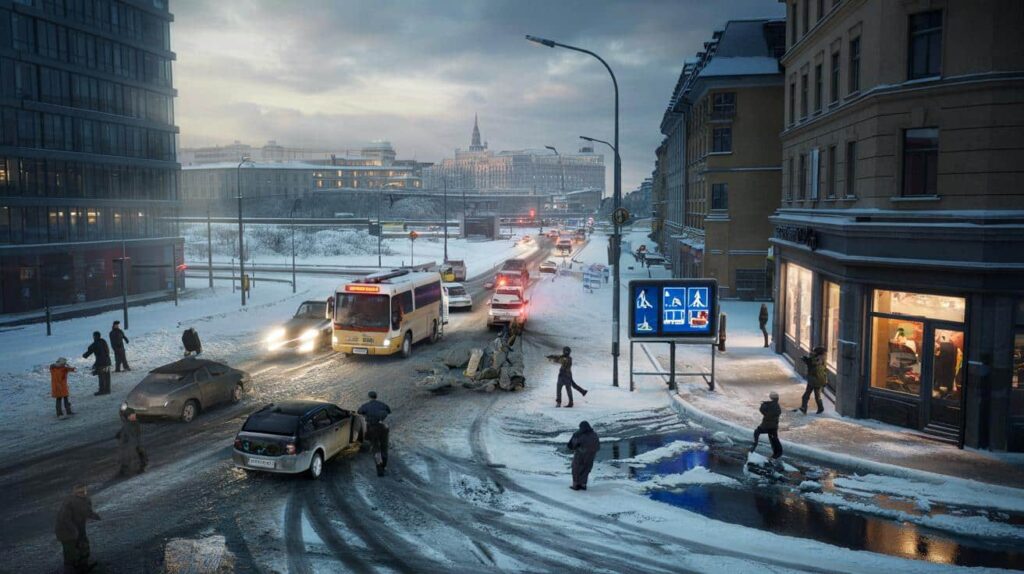
A week later, trains stalled in snow they weren’t forecast to get. Highways in southern Europe turned into rivers. Gas demand surged in one country while wind turbines froze in another.
One technical phrase linked all these scattered scenes: “major sudden stratospheric warming.”
It sounds distant.
It isn’t.
When the polar vortex snaps, the bill lands in your street
Think of the polar vortex as winter’s seatbelt around the Arctic. Most years it stays tight, trapping the worst cold over the pole. This February, the belt didn’t just loosen; it tore. The breakdown was among the strongest events in the satellite record, a kind of atmospheric jailbreak.
Meteorologists watched the vortex split and wobble, cold air spilling into mid-latitudes like water sloshing out of a broken bowl. Weather models scrambled to catch up, issuing new maps every few hours. Meanwhile, people on the ground did what they always do: went to work, dropped kids at school, ordered takeaway, assuming the forecast app was roughly right.
The atmosphere had other plans.
In 2021, a similar polar vortex disruption helped drive the Texas freeze that killed hundreds and knocked out power for millions. That event cost the state an estimated $195 billion, more than many hurricanes. This February’s breakdown ranks in the same league in upper-atmosphere terms, yet you wouldn’t know it from most political speeches.
Picture a mid-sized European city during a vortex-disrupted cold snap. Road salt runs out after three days because procurement contracts assumed “average winters.” Ambulances need snow chains they don’t have. Farmers watch frostbite creep across blossoming orchards, having been told to “adapt” without any real financial cushion.
The stories don’t make the front page for long. But the repair invoices, the insurance hikes, the busted municipal budgets — those linger.
What’s actually happening up there? The polar vortex lives in the stratosphere, a fast-moving ring of west-to-east winds circling the Arctic. When tropical waves and planetary-scale disturbances punch upward, they can disrupt that ring, warming the stratosphere suddenly and flipping winds into reverse.
That reversal ripples downward over days and weeks, nudging the jet stream into wild shapes. Instead of a smooth west-to-east flow, you get loops and kinks: polar air plunging south, subtropical air surging north, stalled weather patterns that won’t move on.
*Climate change loads the dice by adding energy and moisture into this system, but the exact links between warming and vortex breakdowns are still being argued in labs and conferences.* What isn’t debated is the visible outcome: swings from freak blizzards to freak thaws that smash systems designed for a gentler, more predictable past.
How governments keep mispricing climate chaos — and what could actually help
If you want to see how unprepared our institutions are, don’t start with the science. Start with the spreadsheets. Most governments still plan as if yesterday’s climate is tomorrow’s best guide. Budgets for winter road maintenance, disaster relief, and grid resilience are built on “return periods” — the idea that a certain type of extreme event happens once every 10, 50, or 100 years.
But what happens when your “once-in-50-years” polar outbreak shows up three winters in a row, mingled with record heat waves? The models behind those return periods break. So do the contracts, the insurance risk pools, and the “we’ve got this under control” speeches.
Real preparedness starts with rewriting these financial assumptions, not just buying a few more snowplows.

We’ve all been there, that moment when your local authorities clearly didn’t get the memo from the sky. In one Central European town this February, a sudden temperature crash turned wet roads into black ice within an hour. The weather service had warned of a vortex-linked pattern shift days earlier. The municipality waited for the “official” national alert that arrived too late.
School buses slid sideways on hills. Elderly residents fell walking to the pharmacy. The mayor went on local radio to say, “No one could have predicted this.” Yet the prediction was literally on public websites used by hobby weather nerds.
This disconnect — between high-level atmospheric science and low-level decision-making — is where a lot of the damage actually happens.
Let’s be honest: nobody really updates their risk plans every single year. Governments certainly don’t. Climate risk assessments are treated like formalities, reviewed every five or ten years, ticked off, then shelved. By the time a report calling for better winter energy backup or more flexible housing codes is published, the atmosphere has already moved on to a new flavor of chaos.
What would a saner approach look like? For starters, permanent “climate operations rooms” at regional and national levels, staffed year-round, not just during disasters. Teams that blend meteorologists, data scientists, and logistics planners, sitting in the same room as budget officials.
Instead of planning around average winters, they’d plan around ranges and cascading failures: what happens to health services if power, roads, and broadband all take a hit in the same 48-hour window?
As one frustrated Nordic forecaster put it to me recently, “We don’t lack warnings. We lack the political imagination to act on them before voters are standing in the snow asking why the lights are out.”
- Fund weather-resilient infrastructureNot just seawalls and solar farms, but insulated grid components, flexible heating systems, and backup power in hospitals that can run longer than a few hours.
- Build climate literacy into public service jobsFrom transport officials to school principals, people making day-to-day decisions need a basic grasp of jet streams, risk probabilities, and what “sudden stratospheric warming” really implies on the ground.
- Use real-time data, not dusty averagesLink contracts, emergency staffing, and resource allocation to live risk dashboards instead of last decade’s climate normals.
- Support households directly before crises hitSubsidies for home insulation, heat pumps, and flood protections are cheaper than bailing out whole regions after each “unexpected” event.
- Hold leaders to measurable resilience targetsNot just emissions goals, but concrete metrics on grid downtime, response times, and avoided losses after extreme events.
The polar vortex is a warning light, not the main story
The polar vortex breakdown makes for eye-catching graphics: swirling blue and purple blobs sliding over continents, social feeds filling with dramatic maps. Yet the real story hides in the quieter failures. The apartment building whose pipes burst because construction codes never envisioned ten days of subzero air in that region. The hospital that cancels surgeries after a power surge fries equipment. The worker who loses wages when a logistics hub shuts down for a week.
Each time, officials call it a “one-off” or “freak event,” brushing past the pattern. People are left wondering if they’re just unlucky or if the system was simply not built for this new mood of the planet.
Climate scientists argue in journals about the fine print: how Arctic amplification might be weakening the jet stream, whether vortex disruptions will become more frequent or just more damaging. Those debates matter, but everyday life moves faster than peer review. What people feel is the whiplash.
A February that yo-yos from T-shirt weather to lethal windchill in a few days tears at routines. It stresses power grids, reduces road life, wrecks crops, and strains mental health. That mental load is rarely counted in the balance sheet.
Yet when you add it up — the chronic anxiety, the sense that seasons can’t be trusted — you start to see a hidden cost of climate chaos that doesn’t fit neatly into GDP.
The plain truth is that we’re still treating climate as a background issue when it has moved into the foreground of everything. Energy policy, housing policy, public health, education — none of these make sense anymore if they ignore a world where the polar vortex can buckle mid-winter and reroute reality for weeks.
This doesn’t mean living in permanent fear of the next vortex split. It means something quieter and harder: redesigning normal. Designing cities that can handle wide swings without drama. Budgets that assume surprises. Politics that stops framing every extreme as a bolt from the blue, and starts speaking honestly about shared risk and shared responsibility.
The February breakdown, almost off the charts in the upper air, is just one flare in a much larger shift. The question is not whether the atmosphere will keep sending these messages. It’s how long our institutions will pretend not to read them.
| Key point | Detail | Value for the reader |
|---|---|---|
| Polar vortex breakdowns are no longer rare curiosities | February’s event ranked among the strongest in modern records, driving extreme weather far from the Arctic | Helps you understand why your local winter now swings violently between mild and brutal |
| Governments are planning with outdated climate assumptions | Budgets, contracts, and risk models still lean on “average” winters and old return periods | Explains why services feel caught off guard even when forecasts exist |
| Real resilience starts before the crisis | Investing in infrastructure, climate literacy, and live risk monitoring reduces damage and stress | Gives you concrete levers to demand from local and national leaders |
FAQ:
- Question 1What exactly is a polar vortex breakdown?It’s a disruption of the strong westerly winds high in the stratosphere over the Arctic. During a breakdown, those winds can weaken or reverse, often after a sudden stratospheric warming event, which then alters weather patterns in the lower atmosphere.
- Question 2Does a broken polar vortex always mean extreme cold where I live?No. It increases the chances of more blocked and wavy jet stream patterns. Some regions get brutal cold, others get unseasonal warmth or storms. The key is higher volatility, not a guaranteed freeze.
- Question 3Is climate change causing more polar vortex disruptions?Scientists are still debating the exact link. Some research suggests Arctic warming can destabilize the jet stream and vortex, but other studies are more cautious. What’s clear is that when these events happen in a warmer, wetter world, the impacts are amplified.
- Question 4Why do governments seem surprised every time?Policies, budgets, and infrastructure were designed around a more stable climate. Updating risk models, contracts, and construction codes is politically slow and often pushed aside by short-term priorities.
- Question 5What can individuals realistically do about something this big?You can’t fix the polar vortex, but you can push for local resilience: better building standards, grid upgrades, and social safety nets. You can also adapt at home — insulation, backup heat plans, and staying informed via reliable weather sources — while voting and organizing for systemic change.