On a tray: vitamin D, a sleeping pill from last night, a half-eaten yogurt. Nearby, a woman who hasn’t stepped outside in weeks, her cancer silently spreading. Her daughter turns to the nurse and asks, “Does she still need all of this?” The nurse shrugs gently. “They’re prescribed. We continue.”
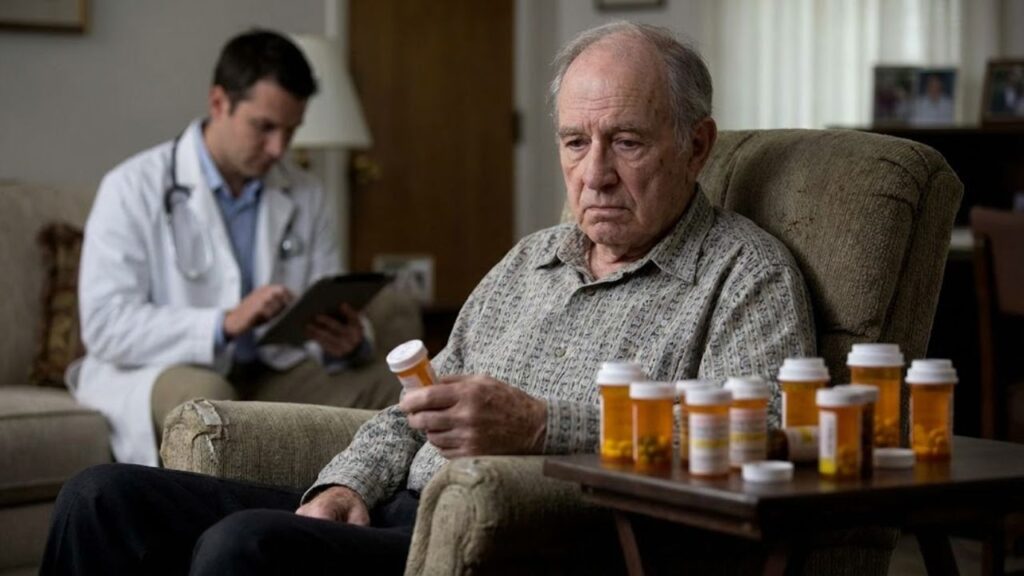
Yet inside, everyone knows the unspoken truth: half of these drugs no longer change anything.
Why Treatments Persist Long After Life Changes
In oncology wards and nursing homes, this scene quietly repeats. Older patients with advanced cancer often keep taking long-term medications, even when their prognosis has shifted. Statins for a heart attack that will never happen. Preventive pills meant for a future that no longer exists.
The body slows, but prescriptions often do not. A French study found that over half of older cancer patients continued at least one “preventive” medication with no expected benefit within their remaining lifespan — statins, osteoporosis drugs, strict diabetes treatments. Some even began new chronic medications after being diagnosed with incurable cancer.
Families rarely question it. Doctors rarely stop it. The result: a quiet theatre where the pharmacy cart rolls on while the clock is unmistakably ticking.
This inertia partly stems from the way modern medicine works: no single person feels responsible for stopping a drug. The cardiologist prescribed the statin. The GP added a blood thinner. The oncologist focuses on chemo. Each specialist hesitates to remove something that might be vital.
Deprescribing: A Simple Idea That Feels Hard
Deprescribing — stopping unnecessary medication — seems simple on paper. In reality, it feels like acknowledging that priorities and expectations have shifted.
How to Discuss Stopping Medications Without Giving Up
The most effective step is surprisingly straightforward: sit down with the full medication list and ask aloud, “What does this pill do for this person now?” Not what it did years ago, or theoretically prevents, but what it actually contributes in the coming weeks or months.
Palliative care teams handle this routinely, sorting drugs into three categories: essential for comfort, possibly useful, and clearly unnecessary. They taper or stop the last group one by one, monitoring real effects rather than imagined risks.
Families often fear that stopping medications means giving up. Doctors, anticipating this, avoid the topic. The silence can be heavy, yet the conversation can be simple: “Life expectancy is shorter now, so our goal shifts from long-term prevention to feeling as well as possible today.”
Common Medications That Can Be Reassessed
- Blood pressure pills: Can often be reduced if the patient experiences dizziness, fatigue, or low blood pressure.
- Cholesterol drugs: Offer minimal short-term benefit when life expectancy is measured in months.
- Strict diabetes regimens: Relaxing targets can prevent dangerous hypoglycemia, falls, and confusion.
- Vitamins and supplements: Rarely impactful at the end of life, yet may cause nausea or discomfort.
- Comfort-focused drugs: Pain relief, anti-nausea medications, laxatives, and anxiety treatments deserve full attention and energy.
Choosing Clarity Amid Silence
The unspoken reality: many older cancer patients die still taking drugs meant for a future they would never see. Not out of neglect, but because continuing feels neutral, while stopping feels like an active decision.
Yet these pills have costs: side effects, interactions, confusion, and time spent managing tablets instead of memories. One simple question can cut through the fog: “If this were my own mother, would I still insist on this pill?” Many doctors ask themselves this privately, few voice it aloud.
For families, starting the dialogue can be as simple as: “Could we review all her medications and see which still matter at this stage?” That single request shifts the team from autopilot to intentional care. Some welcome it with relief; others resist out of habit or fear.
The outcome is not abandonment, but focus on what genuinely improves comfort: less dizziness, less nausea, better sleep, fewer pills to swallow. Not a miracle, just a quieter, kinder way to live the days that remain.
Key Takeaways
| Key Point | Detail | Value for the Reader |
|---|---|---|
| Ask what each pill does “now” | Shift from long-term prevention to short-term comfort and function | Provides a clear lens to evaluate chronic medications near end of life |
| Invite a full medication review | Request a meeting with the oncologist, GP, or palliative-care team | Reduces unnecessary drugs while keeping those that truly help |
| Reframe “stopping” as caring | Fewer pills can mean fewer side effects and better remaining days | Helps families feel they are prioritizing quality, not giving up |