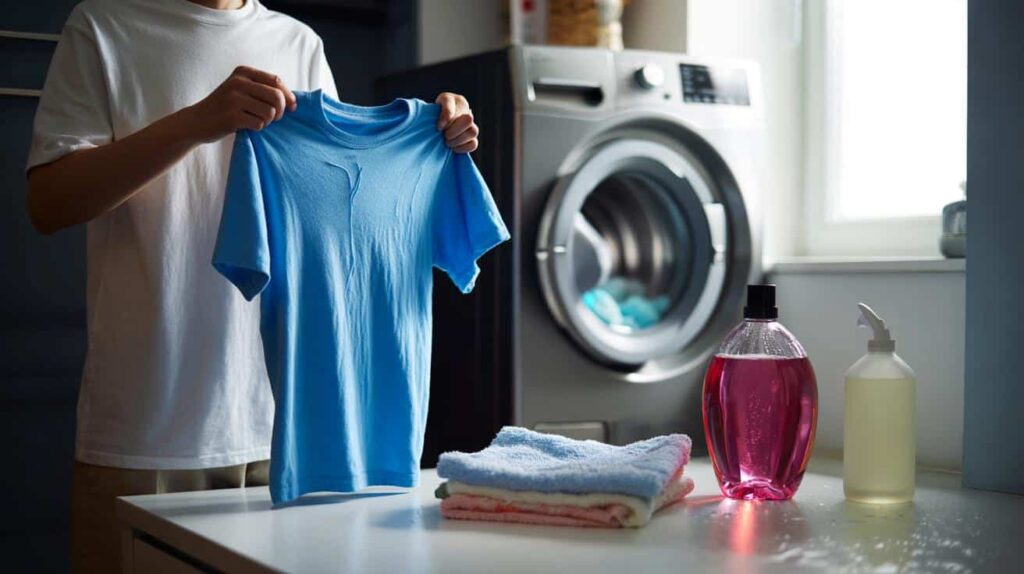
The T-shirts came out of the machine looking perfect. Bright colors, no stains, everything smelling like a TV commercial. You grabbed one, ready to fold, and then… crunch. The fabric felt stiff, almost cardboard-like, like it had aged ten years during a 40-degree cycle. You flexed the sleeve between your fingers, a little annoyed, wondering if the washing machine was dying or if the water had suddenly turned into chalk dust.
You may have changed detergents. You may have blamed your hard water. You may even have considered buying a new machine.
But there’s a far more ordinary suspect hiding in plain sight.

The sneaky product that turns soft laundry into cardboard
Let’s get straight to it: that mysterious stiffness often comes from one product we pour in without thinking — fabric softener. The very thing that promises fluffy towels and cloud-like T-shirts can, over time, do the exact opposite.
Softener doesn’t just “vanish” in the rinse. It coats the fibers with a thin, waxy layer meant to smooth them out. When that layer builds up, the fabric starts feeling heavy, less breathable, oddly rigid. The result: clothes that look clean but feel strangely tired when you touch them.
Picture this. A busy parent, three loads of laundry in a row on a Sunday. They top up the softener each time, a generous glug “just to be safe”. The towels come out smelling like a field of synthetic flowers, but when the kids use them after a shower, they don’t absorb water properly.
The towels feel crunchy when dry, almost squeaky when you fold them. After a few weeks, the same parent notices the wash cycle doesn’t seem to rinse fully. The machine drum smells slightly off, like stale perfume. They think the machine needs a deep clean. In reality, the fabric softener has quietly taken over everything.
There’s a simple logic behind this. Most fabric softeners are oil-based or contain cationic surfactants that cling to textile fibers. On the first use, you barely feel it. On the tenth, the layer is thicker. On the thirtieth, your clothes start to lose their natural flexibility.
That build-up traps detergent residues, dust and even minerals from hard water. The mix dries into that stiff, “crispy” texture on T-shirts, towels and bed sheets. It can also block the microfiber in sportswear and cleaning cloths, which explains why your “magic” cloth suddenly smears instead of wiping. The softener didn’t disappear; it just stayed and stacked.
How to rescue stiff laundry without throwing everything away
The good news: stiffness from softener isn’t a curse, it’s a build-up you can undo. Start with a reset wash. Run your stiff clothes and towels through a cycle without softener and with half the usual detergent. Add a cup of white vinegar in the softener compartment. Vinegar helps dissolve the residues and rinse the fibers more “bare”.
Don’t worry about the smell; it evaporates as the laundry dries. When the load is done, feel a towel between your fingers. It may already feel lighter. If the stiffness is really old, repeat the process once or twice on future washes to gradually strip that film and let the fabric breathe again.

Then comes the real habit change. Try skipping softener completely for a few loads. Use a gentle detergent and choose a slightly lower spin speed so the fibers aren’t wrung to death. Shake each garment when you hang it to dry, or fluff it briefly in the dryer with wool dryer balls.
We’ve all been there, that moment when you just throw “a bit more” of everything in the drawer, hoping for extra cleanliness. Let’s be honest: nobody really measures every cap exactly as shown on the bottle. That’s where things drift. Overdosing softener won’t give you clouds, it just gives you coated, stiff fabric and a washing machine that starts sulking.
“I thought my towels were worn out,” admits Laura, 37, who lives in a hard-water area. “I was ready to replace them all. I stopped using softener for a month and did a couple of vinegar rinses. Suddenly they were soft again, and my sports leggings stopped feeling like plastic.”
- Switch to less or no fabric softener: test half a dose, then every other wash, then see if you even miss it.
- Use white vinegar as an occasional rinse helper: about one cup in the softener slot on stubborn loads.
- Clean your washing machine drawer and rubber seals monthly to avoid residue building up again.
- Dry smart: use dryer balls, shake clothes before hanging, avoid overloading the dryer so air can circulate.
- Reserve softener for specific items only (like some cotton bed sheets) instead of every single load.
Rethinking “soft” laundry and what fresh really feels like
Once you notice this link between softener and stiffness, it’s hard to unsee. You start comparing an old towel “treated” for years and a newer one washed with less product. The new one may smell less intense, but it dries you faster and feels more alive under your hands.
*There’s a quiet shift when you realize that true freshness isn’t a chemical perfume, it’s the feeling of fabric that moves easily when you touch it.*
This might even change the way you shop. You look twice at labels promising “extra softness” and “intense fragrance”. You wonder what that actually means for the fibers, your skin, and the inside of your washing machine over time. You might try simpler routines, or old-school tricks that your grandparent used before big-brand softeners took over the TV screens.
You test, you adjust, you listen to the sound and texture of your clothes again. Less crunch, more flow. Less coating, more fabric.
**The stiffer your laundry feels, the more it’s telling you a story about what it’s been coated with.** Once you hear that message, you start treating your clothes less like disposable objects and more like everyday companions that need to breathe.
You may still choose to keep a favorite softener for certain pieces. Or you may move to vinegar, dryer balls, or nothing at all. Either way, the small decision at the detergent drawer has real effects on how your clothes age, how your towels behave, and how your home smells when you pull freshly washed laundry from the drum. That’s where your experiment starts — with the next load.
| Key point | Detail | Value for the reader |
|---|---|---|
| Softener causes stiffness | Build-up of a waxy or oily layer on fibers makes fabric rigid and less breathable. | Helps identify the real cause of “cardboard” laundry without blaming the machine. |
| Reset and strip the fibers | Use softener-free washes, reduced detergent and white vinegar rinses to dissolve residues. | Gives a practical, low-cost way to recover softness in existing clothes and towels. |
| Change long-term habits | Use less softener, clean the machine, rely on drying methods and simple routines. | Prevents future build-up, extends garment life and improves comfort day to day. |
FAQ:
- Question 1Can fabric softener really make towels less absorbent?Yes. The coating it leaves on fibers can block tiny spaces that normally soak up water, so towels may feel “soft” at first but absorb less over time.
- Question 2Is white vinegar safe for my washing machine?Used in moderate amounts (around one cup in the softener compartment), white vinegar is generally safe and can help dissolve residues, especially in the rinse cycle.
- Question 3Should I stop using fabric softener on all my clothes?You don’t have to stop completely. Many people avoid it on towels, sportswear and microfiber, and reserve small doses for cotton clothes or bed sheets if they like the feel.
- Question 4Why do my clothes smell strong but still feel stiff?A strong scent usually means a lot of product stayed on the fabric. That scented layer can include detergent and softener residues that make the fabric rigid.
- Question 5How long does it take to reverse the stiffness?Sometimes one or two “reset” washes are enough. For heavily coated items, it can take several cycles with less product and occasional vinegar rinses to fully recover softness.