On a grey autumn morning in Prague, the kind where tram bells echo off damp cobblestones, it doesn’t feel like the birthplace of a new European defence giant. Office workers queue for coffee, students hunch over their phones, and just a few kilometres away, Czechoslovak Group’s headquarters hum quietly behind tinted glass. Nothing glamorous. No red carpets. Just engineers, spreadsheets, and a family-owned company getting ready for the financial leap of its life.
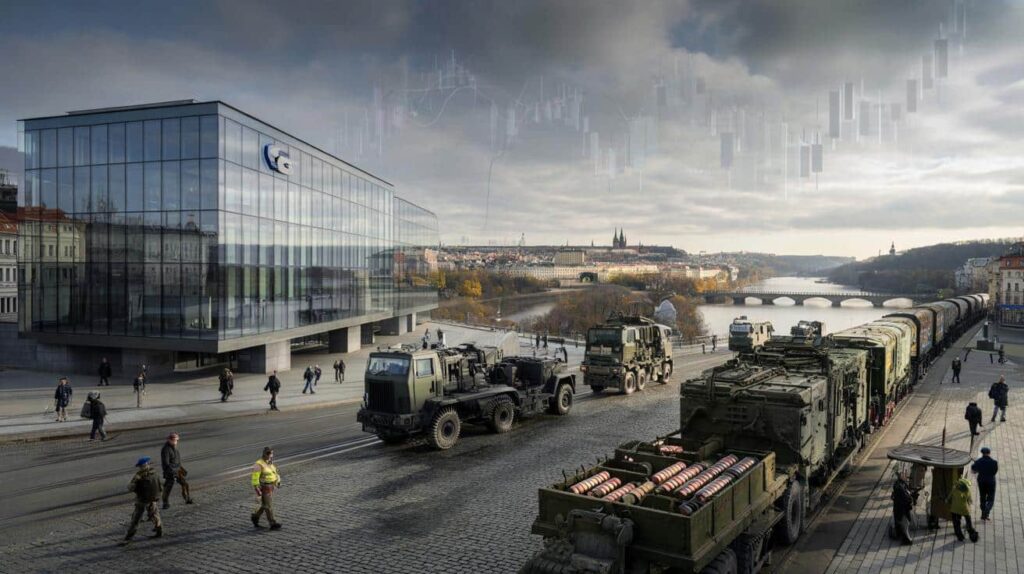
Outside, Europe is nervous. War has returned to the continent, NATO is scrambling to refill stockpiles, and smaller countries are suddenly being asked to play bigger roles. Amid all this, a Czech defence group is preparing a landmark IPO that could shift the balance of industrial power away from Berlin and Paris.
The centre of gravity is wobbling.

From obscure supplier to central player in Europe’s rearmament
A decade ago, most people in Western Europe had never heard of Czechoslovak Group, usually shortened to CSG. Even in Prague, the name floated in that vague space between “arms dealer” and “industrial group with some tanks somewhere”. Today, the company has become a quiet backbone of the continent’s rush to rearm. It refurbishes Soviet-era armour, produces artillery shells, and owns Tatra Trucks, the heavy-duty vehicle maker that shows up in almost every NATO exercise photo.
The war in Ukraine didn’t create CSG, but it pulled the company into the spotlight faster than anyone expected.
A telling example unfolded in early 2023. As Ukraine pleaded for ammunition, big European capitals argued, drafted communiqués, and held late-night summits. Meanwhile, CSG’s factories in the Czech Republic and Slovakia ramped up shifts, churning out 155mm shells and refitting howitzers at a pace few Western primes could match. Trains rolled east with Czech-made or Czech-modernised hardware that Ukraine could actually use right away, because it still fits the Soviet-derived systems on the front line.
These weren’t shiny flagship projects for glossy brochures. They were practical, rushed, often noisy solutions that Ukrainian soldiers actually asked for. *That’s where CSG started to look less like a regional contractor and more like a critical node in Europe’s security network.*
The logic behind the group’s rise is brutally straightforward. Western Europe let its land-based defence industry thin out in the years of “forever peace”, while Central and Eastern Europe kept a mix of Soviet legacy gear, repair plants, and heavy engineering know-how. When war came back, that old industrial muscle suddenly mattered again. CSG sits right at that junction: it speaks both “NATO-standard high-tech” and “we still know how to fix a 40-year-old howitzer so it shoots tomorrow morning”.
As the Czech company edges toward a landmark IPO, that hybrid identity is turning into its biggest strategic asset – and a quiet challenge to the traditional dominance of German and French defence champions.
Why a Czech IPO could redraw Europe’s defence map
The plan on the table is simple on paper: CSG wants to float a significant stake on the stock market and use the proceeds to grow into a fully-fledged European defence group. Behind the scenes, it’s anything but simple. That IPO means moving from family-controlled discretion to public-market scrutiny; from backroom defence deals to quarterly earnings calls; from local champion to contender in a club long dominated by **Rheinmetall, Airbus, Dassault** and their friends.
For investors, the appeal is obvious. Defence is no longer a sleepy sector. Countries are raising budgets, NATO membership is expanding, and the uncomfortable word “war” has returned to PowerPoint slides in boardrooms.
We’ve all been there, that moment when a small player suddenly becomes the one everyone calls in a crisis. For CSG, that moment came as Europe realised its ammo depots were almost empty. Germany and France had the prestige programmes and the big contracts, but they often moved at the speed of committees. The Czech group moved at the speed of “how many shells can you ship next month?”
That responsiveness has caught the eye of defence ministries, especially in Central and Eastern Europe. Poland, Slovakia, the Baltics – these countries want suppliers who understand proximity, not just powerpoints. CSG has leaned into that, becoming a go-to partner for rapid deliveries and upgrades, not just grand multi-decade projects.

There is a deeper shift playing out under the surface. The traditional European defence story was written largely in German and French boardrooms, with Italian and British chapters on the side. A successful CSG IPO would signal that high-end defence capital and know-how can cluster in Prague or Ostrava as easily as in Munich or Paris. Let’s be honest: nobody really does this every single day, betting on a mid-sized post-communist industrial group to turn into the next continental champion.
Yet the logic tracks. Central Europe sits closer to the front line, has lower labour costs, and a culture of improvisation in heavy industry that Western Europe partly lost. The stock market listing is not just about money. It’s a test of whether that mix can scale without losing its edge.
Risks, backlashes and the fine print behind the boom
On paper, the method CSG is following is surprisingly clear: consolidate, specialise, and then go hunting for acquisitions. The group has already gathered a cluster of capabilities – artillery, ammunition, vehicles, radar, aerospace – under one roof. The IPO cash would help it buy more niche tech, expand capacity, and maybe pick up distressed assets from less agile competitors. Think of it as a new kind of “industrial Lego”, but built around war, logistics, and deterrence.
The key gesture here is patience. Instead of trying to copy Rheinmetall overnight, CSG is doubling down on what it already does well: land systems, munitions, and support for legacy platforms that are still everywhere on NATO’s eastern flank.
There are traps along this path, and some are easy to underestimate. One classic mistake for fast-growing defence companies is falling in love with prestige projects – futuristic drones, shiny aircraft, big prototypes for trade shows – while neglecting the boring core business that actually pays the wages. Another is letting politics pick winners inside the company, until engineers feel sidelined and good people leave.
CSG also has to navigate a touchy public debate. Defence IPOs can trigger backlash from activists, cautious pension funds, or even governments worried about foreign influence. As the group opens itself up to the market, its leadership will be judged not just on profits, but on how clearly it explains what it builds, who it sells to, and why. An empathetic, transparent tone won’t be a “nice to have” – it will be survival strategy.
“CSG’s listing would symbolise the arrival of Central Europe as a full shareholder in Europe’s defence architecture,” a Prague-based defence analyst told me. “If they pull it off, you’ll suddenly have a Czech company at the same table as the German and French giants – not as a subcontractor, but as a peer.”
- Core strength: land systems and ammunition
Gives CSG a practical, high-demand niche as Europe races to refill stockpiles. - Geography: Central European location
Shorter supply chains to NATO’s eastern flank and Ukraine, plus first-hand awareness of regional threats. - Strategy: IPO to fund acquisitions
Lets the group scale up while staying anchored in Czech ownership and industrial traditions. - Risk: politicisation and public scrutiny
Could dilute agility if the company gets dragged into big-power games between Berlin, Paris, Washington and Brussels. - Opportunity: diversification beyond war
Dual-use tech, heavy vehicles and aerospace skills that can feed civilian markets once the crisis stabilises.
A Czech listing that asks bigger questions about Europe
There’s something quietly symbolic in the idea of a Prague-based group becoming one of Europe’s key defence players. For decades, the narrative was that the “serious” industrial power lived in the West, while Central Europe was the workshop at the end of the supply chain. CSG’s move to go public nudges that story off balance. It suggests that the next generation of European defence power may be written in smaller languages, in cities that used to be footnotes on the margins of NATO maps.
The open question is what Europe does with that shift. Will German and French champions treat CSG as a rival to be contained, or as a partner who makes the whole system more resilient? Will investors accept defence as a legitimate long-term theme, or treat it as a noisy, risky bet tied to a single war? And on a more personal level, how comfortable are Europeans with the idea that a family-owned Czech group might become a standard-bearer for the continent’s rearmament?
This is less about stock tickers than about identity. If a new defence giant really does emerge outside Germany and France, it will reflect a deeper change: a Europe that is shakier, more exposed, but also more willing to share strategic weight with its smaller capitals. The story is still being written on factory floors, analyst calls, and in quiet government meetings. Whether you feel excited, uneasy, or both, the rise of CSG is one of those developments that reveal where the continent thinks its future battles – industrial and military – will actually be fought.
| Key point | Detail | Value for the reader |
|---|---|---|
| Emergence of a Czech defence giant | CSG is preparing a landmark IPO, aiming to join Europe’s top-tier defence players. | Helps readers spot a potential new heavyweight beyond the usual German-French names. |
| Shift in Europe’s defence geography | Industrial power is quietly moving toward Central and Eastern Europe, closer to the front line. | Offers context on why Prague, not just Paris or Berlin, matters for future security. |
| Investor and political stakes | The listing blends financial opportunity with ethical, strategic and public-opinion risks. | Gives a balanced view for anyone curious about investing, policy, or the broader rearmament debate. |
FAQ:
- Question 1What exactly is Czechoslovak Group, and what does it produce?CSG is a Czech industrial and defence holding that owns companies in ammunition, artillery, armoured and logistics vehicles, radar systems, aerospace and heavy engineering. It’s best known for Tatra Trucks, artillery shells, and modernising legacy Soviet-designed equipment used across Eastern Europe and Ukraine.
- Question 2Why is CSG’s IPO considered a “landmark” for Europe?Because it would create a publicly traded defence player based in Central Europe, outside the traditional German and French power centres. That changes who sits at the top table of European defence industry, and it signals that serious capital is flowing into newer regions of the continent.
- Question 3How does the war in Ukraine affect CSG’s growth?The conflict dramatically increased demand for ammunition, artillery and land systems – all areas where CSG is strong. The company’s ability to deliver quickly, and to handle Soviet-era platforms still used by Ukraine, has made it a key supplier in Europe’s emergency rearmament.
- Question 4Are there ethical concerns around investing in a defence company like CSG?Yes, and they’re part of the public debate. Some investors avoid defence on principle, while others argue that credible defence is necessary to protect democracies. CSG’s move to the public market will force clearer disclosures on customers, export rules and long-term strategy, which can help people decide where they stand.
- Question 5Could CSG really compete with giants like Rheinmetall or Airbus?Not across every segment, at least not soon. Its real strength is in specific niches: land systems, munitions and support for Eastern European militaries. If the IPO succeeds, CSG won’t replace the big Western primes, but it could join them as a specialised, increasingly influential counterpart in the European defence ecosystem.