Blue shirt or black jumper. Porridge or toast. Walk or bus. Your phone lights up with notifications, your fridge is full, your wardrobe is full, your head is already tired. And the day hasn’t even started.
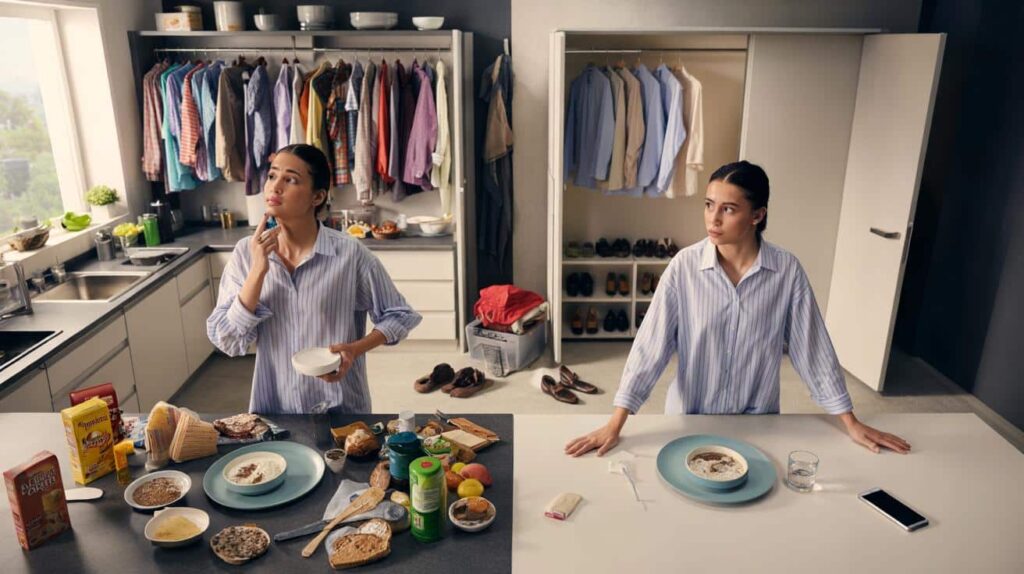
Meanwhile, some people glide through those same hours with a kind of quiet autopilot. Same breakfast. Same shoes by the door. Same route to work. No drama. They’re not boring. They’re just playing a different game with their choices.
You watch them open their laptop at 9:02, fresh, focused, while you’re still mentally stuck on the question of “What should I…?”. They look strangely calm in a world that keeps shouting “pick something!”.

What if the trick isn’t more time at all, but fewer decisions?
The hidden cost of choosing all day long
Walk through any supermarket at 6pm and you can see the exhaustion on people’s faces in the chilled aisle. They’re not just hungry. They’re tired of deciding. Tomato sauce… which one? Twenty brands, six levels of spice, organic or not, discount or luxury. By the time they reach the till, their brain has already run a marathon.
What drains us isn’t only work or stress. It’s the constant low-level demand to choose, again and again, from the second we wake up. Tiny forks in the road that feel harmless, yet slowly eat away at our mental sharpness. Choice is freedom. But constant choice is friction.
On a Tuesday morning in London, a young designer called Mia opens her wardrobe and freezes. She has three minutes before a video call and fifteen outfit combinations spinning in her mind. Her phone pings twice. Her flatmate asks about dinner plans. She grabs something random, already late, already irritated.
A week later, she tries something different: she lines up five simple “work outfits” on Sunday night. No big fashion show, just quick decisions in advance. Each weekday, she reaches out, picks the next hanger, done. No debate. No panic. Within days, she notices she starts work feeling strangely lighter. Nothing else changed. Her mornings just stopped asking questions.
Psychologists talk about “decision fatigue”: the more choices you make, the worse your later choices become. Judges are harsher just before lunch. Shoppers pick more random items near the end of their trip. Managers fall back on “let’s keep it the same” at the end of long meetings. Our brains like to pretend they’re consistent. They’re not.
When everything is open, everything becomes effort. That’s where limiting choices quietly saves time. Not just by cutting minutes, but by removing mental switching. Each small routine is like a ready-made answer. Breakfast? That one. Gym clothes? Those. Email blocks? This time. Suddenly your brain isn’t constantly loading new tabs. It can finally focus on the big stuff.
Simple ways to limit choices and win back time
One of the easiest starting points is the morning. Pick a “default” for the first hour of your day and let it repeat. Same wake-up window, same drink, same type of breakfast, same first task. It doesn’t need to be perfect or worthy of Instagram. It just needs to be predictable.
You can also create tiny “menus” instead of open fields. Three go-to lunches. Two standard gym routines. A short list of cafes where you work well. When it’s time to decide, you’re choosing from three ready options, not from the whole universe. It sounds small. It rarely feels small once you try it for a week.

Many people start by attacking their wardrobe. That doesn’t mean living like a cartoon character with the same outfit every day, unless you want to. It could mean building a micro-uniform: a handful of tops and trousers that all match, or a rail of “workday” clothes and a rail of “weekend” ones.
Soyons honnêtes : personne ne fait vraiment ça tous les jours. Some mornings you’ll stare at everything anyway. Still, when most days ask one or two clothing questions instead of ten, you save more than time. You save patience. You avoid that quiet wave of self-criticism that comes with “why did I wear this?” at 11am.
“I stopped choosing lunch every day,” says Tom, a project manager in Manchester. “Now I rotate three easy options from the supermarket. I thought I’d be bored. What really bored me was standing in front of the fridge for ten minutes scrolling Deliveroo.”
There’s a gentle balance here. Limit the choices that drain you, not the ones that light you up. If you love cooking, don’t lock your dinners into a system. Maybe you systemise your admin instead. If you’re into fashion, keep your outfits playful and standardise something dull like breakfast. We don’t all need the same routines.
- Start with one area: mornings, clothes, or food.
- Create small menus: 2–5 options, not 20.
- Test for a week, then keep only what actually feels lighter.
Living with fewer choices without feeling boxed in
The strange thing about limiting choices is that it often makes your day feel bigger, not smaller. When your basics run on rails, your mind has more space for spontaneity in the moments that matter. You notice conversations more. Ideas land more clearly. You feel less rushed, even if your calendar hasn’t changed.
We’ve all lived that moment where the tiniest decision tips us over the edge. Choosing a TV show for the evening turns into a 25-minute scroll and a small argument. Not because the show matters, but because your choice muscle is completely worn out. That’s the real promise of simplifying: cutting the silly friction that ruins good time.
Some people worry that routines will make them robotic. *Truth is, the right routines can feel strangely kind.* You’re not forbidding yourself from choosing. You’re just choosing once, thoughtfully, instead of a hundred rushed times. And if a system stops working, you’re free to change it.
There’s a quiet kind of self-respect in saying: my energy is finite. I won’t waste it on “what sandwich should I get?” for the rest of my life. **Your best decisions don’t come from a tired brain skimming through endless tabs.** They come from a rested one facing a small, clear set of options.
Next time you feel your day slipping through your fingers, don’t look for another huge productivity hack. Look for the places where you can simply stop choosing so much.
| Point clé | Détail | Intérêt pour le lecteur |
|---|---|---|
| Limiter les décisions répétitives | Standardiser matinées, repas simples, tenues et tâches de base | Gagner du temps sans changer de vie ni d’emploi |
| Créer des “menus” personnels | Préparer 2 à 5 options fixes pour les moments fréquents de choix | Réduire le stress quotidien et l’épuisement mental |
| Protéger l’énergie mentale | Garder les choix ouverts pour ce qui compte vraiment | Avoir plus de clarté pour les décisions importantes |
FAQ :
- Does limiting choices mean living a boring life?Not at all. The idea is to cut out the boring decisions so you have more space for the exciting ones. You simplify the background so the foreground can be richer.
- Where should I start if my life already feels chaotic?Begin with one tiny area: just mornings, or just work outfits, or just lunch. Give yourself one simple rule for seven days and notice how it feels before changing anything else.
- What if I love variety and hate routines?Then protect the parts you enjoy experimenting with, and standardise the bits you don’t care about. Variety is great when it’s chosen, not when it’s forced on you all day long.
- Do I need a strict schedule for this to work?No. You only need a few stable anchors: a default breakfast, a usual start to your workday, a small rotation of meals or outfits. The rest can stay flexible.
- How will I know if I’ve limited my choices in a healthy way?You’ll feel lighter rather than trapped. Decisions will feel quicker and calmer. If you start feeling boxed in, it’s a sign to loosen one routine and bring back a bit of choice where you miss it.