The drilling rig groaned softly in the polar night, a thin tower of metal and light in a world of blue shadow. Around it, everything was still: no trees, no birds, only a frozen horizon that had not changed, to the naked eye, for millions of years. The wind cut through the camp like a knife, rattling loose cables and flapping a forgotten glove against a fuel drum.
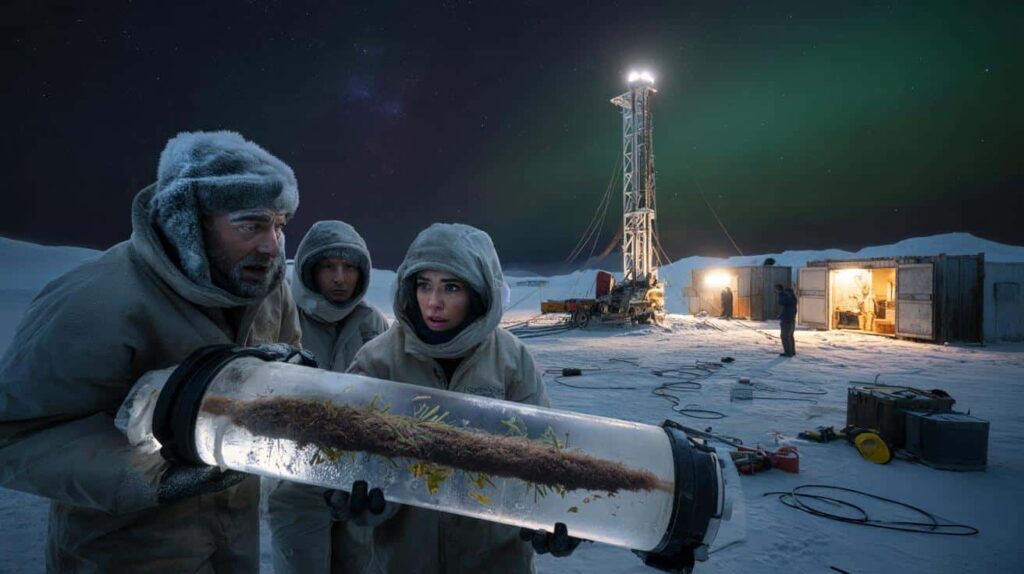
Deep below the scientists’ boots, nearly 2 kilometers under the ice, the drill bit was chewing through time itself. Every meter meant thousands of years stripped away, every core of ice and sediment a memory pulled back from oblivion.
When the first strange fragments appeared in the tube, black against the clean ice, the chatter around the rig stopped.

Something down there did not belong to this world of endless white.
The day Antarctica stopped being just “empty ice”
For the glaciologists on site, the breakthrough started as a minor glitch. The core coming up wasn’t the uniform, milky ice they were used to seeing. Mixed into the frozen cylinder were dark bands, crumbly pieces, and tiny specks that looked almost like soil. One researcher brushed a finger over it, watched the grain stain his glove, and suddenly the cold felt different.
This was not just ice anymore. This was ground.
And not just any ground, but the deep-buried floor of an ancient world, sealed away for 34 million years.
Back in a temporary lab container, under the harsh white light and the whirring of generators, microscopes flickered on. Scientists leaned in, one after another, like people crowding around an ultrasound image. What they saw were fossilized fragments of pollen, bits of ancient leaves, traces of once-living organisms trapped in sediment older than humanity itself.
A field notebook filled quickly with rough sketches and exclamation marks. Temperature readings, isotope ratios, grain sizes — the raw, nerdy poetry of discovery. Someone whispered that they were probably looking at the last snapshot of Antarctica before it froze over for good. Nobody laughed.
Everyone knew that might be true.
The logic behind this “lost world” is brutally simple. Today, Antarctica is a frozen desert, buried under ice up to 4 kilometers thick, but it wasn’t always like this. Around 34 million years ago, at the end of the Eocene, Earth’s climate shifted. Carbon dioxide levels fell, ocean currents changed, and a curtain of ice began to spread over the southern continent.
The sediments now recovered from under 2 km of ice are like a time capsule from the very moment the lights went out on a green, river-threaded Antarctica. By decoding those layers — pollen, minerals, isotopes — scientists can reconstruct a living landscape that once thrummed where nothing moves now.
What they’re really holding in their hands is a before-and-after picture of a planet in transition.
How do you dig up a vanished world under 2 km of ice?
Getting to that buried landscape isn’t a heroic movie sprint; it’s a slow, grinding, technical marathon. Drilling through Antarctic ice means working in temperatures that numb your fingers in seconds, fighting winds that can flip a tent like a napkin, and depending on machinery that absolutely cannot fail. Each section of core comes up in slim, fragile tubes, like cold glass bones.
The team logs every segment, labels it, photographs it. They guard the cores from contamination almost like surgeons in an operating room. A stray breath, a fingerprint, a bit of modern dust could blur the story locked inside.
What they’re chasing is not just “cool fossils”, but a precise, measurable record of how a warm continent died into ice.
Most of us imagine ice sheets as flat, dead slabs. The reality underneath is messier and more alive — not in the “dinosaurs under the ice” sense, but in the way Earth itself keeps moving. The bedrock shifts. Lakes form and drain. Old river valleys still carve ghostly shapes into the buried landscape.

Scientists map these hidden features with radar and seismic waves before they ever start drilling. Only then do they choose the one point on the map where time seems to bend just right: a spot likely to hold sediments from the crucial window 34 million years ago.
We’ve all been there, that moment when you realize the ground under your feet holds a story you never suspected.
*The plain truth is that this kind of work is breathtakingly slow and often mind-numbingly boring.*
Let’s be honest: nobody really does this every single day with cinematic awe. Some days are just endless data sheets, tired eyes, equipment breakdowns, and coffee that tastes faintly of diesel. The emotional high of discovery sits on top of months — sometimes years — of technical grind.
“People see the headline and think we just drilled a hole and found a lost world,” one researcher told me over a patchy satellite call. “What they don’t see is the winter where the rig froze, the seals failed, and we had to re-start from scratch. This isn’t magic. It’s stubbornness.”
- Deep drilling through thick ice using specialized rigs adapted to polar conditions
- Careful core handling and storage to preserve layers just millimeters thick
- Microscopic analysis of pollen, spores, and sediments back in climate-controlled labs
- Isotope measurements to reconstruct temperature and ancient atmosphere chemistry
- Computer models that merge all this into one evolving picture of a former green Antarctica
Why this ancient Antarctic world matters to our future
The most unsettling part of this story isn’t what Antarctica used to be. It’s what that buried world is quietly telling us about where we might be heading. Those 34‑million‑year‑old sediments capture a climate tipping point: the moment Earth flipped from a warm, largely ice-free planet to one crowned by a massive polar ice sheet.
By analyzing CO₂ levels, ocean chemistry, and temperatures from that time, researchers can see the thresholds at which ice either clings on or collapses. **That’s not abstract history — it’s a warning label.**
We’re now pushing CO₂ back towards levels higher than those that existed when that ancient forested Antarctica still breathed.
When scientists compare the lost world under the ice with satellite data from today, the contrast is brutal. The same continent once hosted beech forests, wetlands, and possibly large mammals wandering through cool, misty valleys. Now those valleys lie crushed under 2 km of ice that’s starting, in some places, to thin and crack.
This fossil record doesn’t predict a neat timeline. It’s more like a set of guardrails showing how quickly big ice sheets can grow — and melt — once climate thresholds are crossed. Many readers secretly hope for a comforting twist, but the story buried in those cores is blunt. The planet can change state far faster than our politics usually can.
There’s a more personal way to look at it, too. The lost world of Antarctica lived and vanished without ever writing anything down. No myths, no diaries, no photos of its last autumn. It left us only pollen, dust, and layered mud that had to wait millions of years under crushing ice for someone curious enough — and stubborn enough — to come looking.
That realization can sting a little. Our cities, our noise, our timelines feel huge, but from the view of those 34‑million‑year‑old sediments, we’re a blink. **What lasts is not the rush of the present, but the quiet traces it leaves behind.**
The buried world under Antarctica is less a lost paradise than a mirror held up to our own brief, warming moment.
| Key point | Detail | Value for the reader |
|---|---|---|
| Ancient landscape under the ice | Discovery of 34‑million‑year‑old sediments with pollen and plant remains beneath 2 km of Antarctic ice | Gives a concrete image of how radically Earth’s climate and continents can transform |
| Climate tipping point record | Cores capture the transition from a warm, forested Antarctica to a frozen ice sheet | Helps readers grasp today’s climate thresholds by comparing them with a real event in Earth’s past |
| Method behind the “lost world” | Deep drilling, careful core preservation, and microscopic + chemical analyses | Demystifies scientific discovery and shows the stubborn, human work behind big headlines |
FAQ:
- Is there actual life still living under the 2 km of ice?So far, what’s been found in these deep ancient layers are fossil traces, not active ecosystems. That said, other Antarctic subglacial lakes do host microbes, so researchers stay open to surprises.
- Did Antarctica really have forests and animals 34 million years ago?Yes. Pollen, leaf fragments, and previous fossil finds show that parts of Antarctica once held cool-temperate forests, wetlands, and likely a range of mammals before the ice sheets formed.
- Does this discovery mean the ice sheet could disappear completely soon?No fixed date comes from these cores, but they show that ice sheets can respond dramatically once climate thresholds are crossed. The risk is long-term sea level rise, not an overnight melt.
- How do scientists know the age of the sediments under the ice?They combine several tools: dating of microscopic fossils, radioactive decay in minerals, and matching chemical signals in the cores to known global climate events.
- Why should someone far from Antarctica care about this buried world?Because Antarctic ice locks up enough water to reshape every coastline on Earth. Understanding how it formed — and how it once changed — is directly linked to the future of cities, ports, and communities worldwide.