By late afternoon the sky had already turned that strange, heavy gray that means trouble. In the supermarket parking lot, snowflakes began to drift down, lazy at first, then sharper, denser, stinging cheeks and eyelashes. On car radios and phone alerts, the state’s emergency service repeated the same message: stay home tonight, only travel if you absolutely must.
Yet just a few streets away, outside a logistics warehouse, workers were lining up at the time clock, tugging on cheap gloves, staring at the sky like it was some kind of dare. Their phones were buzzing too, but with a different tone — supervisors reminding them the line can’t stop, that “attendance will be closely monitored.” Nobody used the word threat, but everybody heard it.
Some nights reveal exactly who is expected to take the risk.
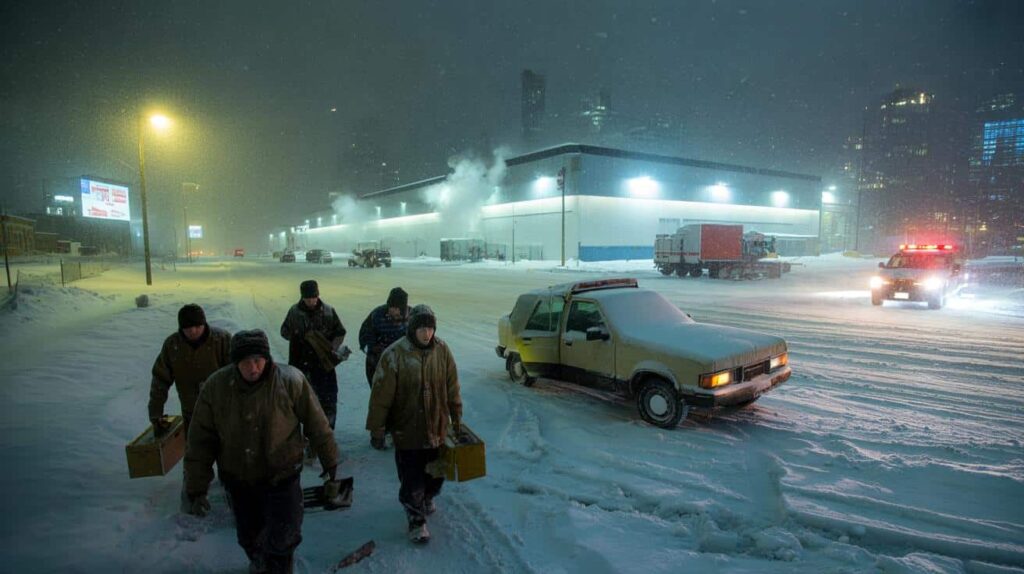
When the snowstorm meets the time clock
The state is sounding the alarm, but the real pressure is happening in parking lots and break rooms. Meteorologists talk about “historic accumulation” and “dangerous travel conditions,” while group chats at big factories fill with messages: “Are we really expected to come in?” “My bus might stop running.” “My manager said we’re open as normal.”
You can feel the split-screen reality. On TV, governors stand in front of maps covered in blue and purple, talking about safety and common sense. On the shop floor, common sense has a badge number and a start time, and the badge has to scan green. A storm warning doesn’t stop the production line.
Ask around in any industrial town and you’ll hear the same sort of story. A nursing assistant who white-knuckled her steering wheel through black ice because calling off meant losing her weekend shift. A warehouse picker whose company texted “your safety is our priority” at 3 p.m., then quietly added “attendance policies remain in effect” at 4. A fast-food worker told by a manager, “If I can get here, you can too,” though the manager drives an SUV and the worker walks.
Sometimes there’s a tragic headline — a crash on a highway, a car spun off into a ditch — and somewhere in the comments you read: “She was on her way to the night shift.” Often there’s no headline at all. Just a few hours of pure fear on an unplowed road, then eight hours under fluorescent lights, hoping the snow eases up by dawn.

This tension is not a misunderstanding, it’s a system. When labor is cheap and margins are tight, the easiest variable to gamble with is the worker’s body. The state speaks the language of public safety; big business speaks the language of uninterrupted operations, and those two dialects collide every time the weather turns dangerous.
Officially, companies talk about voluntary attendance and “employee discretion.” Unofficially, absence points, frozen bonuses and quiet retaliation tell a different story. Let’s be honest: nobody really believes “your safety comes first” when it’s followed by “no exceptions to the attendance policy.”
The snow is just the backdrop. The real storm is power.
How workers actually navigate a deadly choice
On nights like this, survival becomes a set of small, improvised tactics. People leave two hours earlier than usual, creeping along side streets while the plows still chase the main roads. They coordinate carpool chains so that one person with a halfway decent car makes three trips, ferrying colleagues who can’t afford winter tires. Some call the non-emergency police line just to ask which roads are still passable.
Others quietly photograph the weather alerts on their phones, saving screenshots of the governor pleading with residents to stay home, just in case a supervisor accuses them of exaggerating. It’s a strange kind of self-defense: documenting the obvious, in hopes it might one day matter. *This is what it looks like when your life and your paycheck are pulling in opposite directions.*
 Legendary rock band calls it quits after 50 years the hit everyone knows was never really that good
There are mistakes that almost everyone makes the first few storms. Driving because the boss “expects it,” without asking what the actual policy is in writing. Hiding fear behind bravado, telling yourself you’re overreacting while your gut screams no. Not talking to co-workers about options — union hotlines, state hotlines, even anonymous tip lines — because you feel alone and replaceable.
The thing is, you’re usually not the only one scared. We’ve all been there, that moment when your finger hovers over the call button, torn between calling out and suiting up. That silence between workers is exactly what some companies count on. Breaking it doesn’t magically change the weather, but it shifts the balance, even a little, away from isolation and toward something more human.
“Management sent us a text saying, ‘We care about our team’s safety,’” says Carla, who packs boxes at a regional distribution center. “Ten minutes later, my supervisor told us, ‘If you don’t show up, don’t expect your hours next week.’ So which message am I supposed to believe?”
- Document everything
Screenshots of weather alerts, emails, text messages from managers — they all create a paper trail. - Know the real policy
Read the employee handbook, not just what a supervisor claims on the fly during a storm. - Talk to someone neutral
A union rep, legal clinic or workers’ center can tell you if a demand crosses the line. - Travel in pairs when you can
Even sharing a ride with a neighbor cuts both risk and anxiety. - Notice the pattern
If a company gambles with lives during storms, that says something about how they’ll act during any crisis.
What this storm is really telling us
Tonight’s heavy snow will melt. The drifts will shrink into dirty piles at the edge of parking lots, and the headlines will move on to the next crisis. What lingers are the choices made in those few hours when the roads turned white and the orders kept coming. For some, it was one more terrifying commute, forgotten by morning. For others, it was the moment they understood, deeply, what their life was worth to their employer.
These storms expose fault lines we usually step over without looking: who can work from home, who can’t; who gets told to stay safe, who gets told to “do their best”; whose absence is an inconvenience, whose is grounds for discipline. There’s a plain truth tucked inside the blizzard: safety isn’t shared evenly.
Maybe the real question isn’t how high the snow will pile up tonight, but what we’ll demand before the next storm hits — as workers, as neighbors, as people who don’t want anyone’s paycheck tied to a roll of the dice on an icy road.
| Key point | Detail | Value for the reader |
|---|---|---|
| Risk is shifted onto low-paid workers | Businesses maintain normal operations while the state urges people off the roads | Helps readers name and recognize the double standard they may be living |
| Small strategies matter | Carpools, documentation, sharing information and policies | Offers concrete ways to increase safety and reduce isolation during storms |
| Patterns reveal company priorities | How employers act during extreme weather mirrors how they handle other crises | Gives readers a lens to evaluate whether their workplace respects their lives |
FAQ:
- Can my employer legally force me to work during a snow emergency?They usually can require you to work if the business is open, but they can’t physically force you to travel. The gray area is retaliation, which depends on local labor laws and whether there are protections in place, like union contracts or specific state rules for declared emergencies.
- What should I do if roads are unsafe but I’ll be penalized for calling out?Check your written policy first, then document road conditions and official alerts. If you decide not to travel, clearly communicate your safety concerns by text or email so you have a record, and follow up with a trusted advocate, union rep or legal resource if you’re punished.
- Are companies required to pay workers if they close for weather?For hourly workers, most places are not required to pay if they shut down, unless a contract says otherwise. Salaried exempt workers are often treated differently. Local law and your specific agreement make a big difference here.
- How can co-workers support each other during severe storms?Share information openly, coordinate rides, discuss policies together and decide on a common approach to unsafe conditions when possible. Even simple group messages can reduce fear and make retaliation less likely to target just one person.
- What signs show my employer is handling storms responsibly?Clear communication, flexible attendance rules, paid closure or hazard pay, adjusted shifts, and genuine permission to prioritize safety are good signals. If everything is “business as usual” while officials tell people to stay home, that’s a warning sign.