On a damp January morning in the Norman port of Dunkirk, a crowd of workers in orange hi-vis jackets stood in silence, watching a shape emerge from the fog. Not a ship, not a container stack — something stranger. A 500-tonne steel cylinder, taller than a house, suspended in the air by cables so thick they looked like ship’s moorings. Cameras clicked, phones were raised, a forklift beeped furiously in the background.
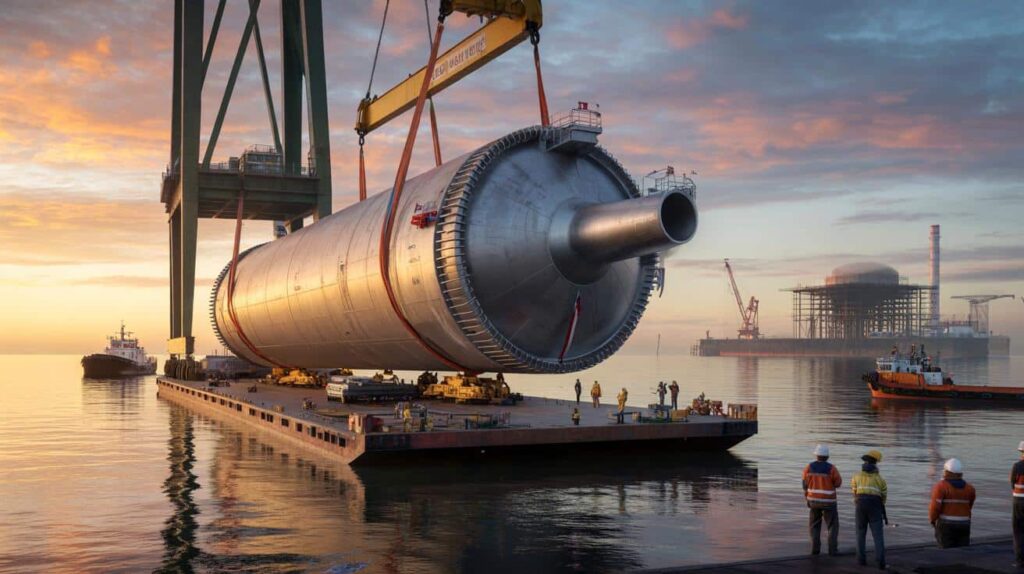
This was France’s latest nuclear export: a reactor pressure vessel bound for Hinkley Point C, Britain’s flagship new power station on the Somerset coast.
The kind of object most of us will never see up close, yet that will quietly decide how we boil our kettles for the next half‑century.
Some people whispered one word as it swung slowly over the quayside.
A colossus.

France’s 500-tonne “colossus” begins its slow journey to Somerset
From above, the scene looked almost surreal. One of the biggest cranes in Europe inching a gleaming grey cylinder onto a custom-built barge, while the tide rolled in and seagulls circled like nothing unusual was happening. On the side, in blue letters, the maker’s name: Framatome. That single piece of French engineering will sit right at the heart of one of Hinkley Point C’s two EPR reactors, the new generation III beasts meant to power around 6 million homes.
It’s roughly 13 metres long, weighing as much as a fully loaded Airbus A380. And it won’t see open water fast. First comes the choreography: lifting, lashing, checking, then crawling out of Dunkirk’s industrial basin into the Channel, timing the journey with the tides like an old‑school merchant vessel.
Picture the route. The vessel leaves Dunkirk tucked inside a heavy-lift ship, crosses one of the busiest shipping lanes on Earth, and slips around the English coast towards Avonmouth or another deep‑water port. Then the awkward part begins. From there, this 500-tonne giant has to be rolled across real British roads, on a multi-axle transporter more like a centipede than a truck.
Villages on the route will see lampposts temporarily removed, roundabouts dismantled, overnight road closures announced. People will share blurry night-time photos in WhatsApp groups: “Did you see that massive thing going past?” It will travel at walking pace, escorted by police, as if a slow, secret parade for the future of UK energy.
There’s a reason all this effort is going into a single steel cylinder. The reactor pressure vessel is the core of the core: the sealed chamber that holds the nuclear fuel and the superheated water that drives the turbines. If anything about it is off — thickness, weld quality, even tiny steel impurities — the whole project falters.
So France, with decades of nuclear manufacturing under its belt, has become the go‑to factory for this kind of “nuclear heart”. The UK, after letting its own large‑scale nuclear supply chain wither, now depends on this cross‑Channel marriage. It’s an odd twist of history: the country that voted for Brexit powered, in part, by one of the most complex French exports you can build.
Inside the steel heart of a generation III reactor
Strip away the headlines and you’re left with a simple, almost physical gesture: making a steel shell that will never, ever be allowed to fail. The pressure vessel for Hinkley’s EPR reactor starts life as a monstrous steel ingot, forged and pressed at temperatures that would melt rock. It’s then machined, bored, polished, inspected again and again, so that its walls can hold water at more than 150 times normal atmospheric pressure, for decades.
Generation III reactors like Hinkley’s are built around this idea of layered safety. Thicker walls. Extra back‑up systems. Passive cooling tricks that keep the core stable even if everything else goes wrong. On paper, it’s nuclear’s version of a modern airliner compared with a 1960s jet.
We’ve all been there, that moment when a blackout hits the street and suddenly the house goes weirdly quiet. No hum of the fridge, no Wi‑Fi, just an awkward silence. Hinkley Point C is supposed to be part of the answer to that vulnerability. Once its two reactors are online, they’re expected to deliver about 7% of the UK’s electricity, running almost constantly, day and night, for 60 years.
French‑built components like this vessel are already humming away in reactors in Finland and China. The Flamanville EPR in Normandy, after years of delay and budget pain, is finally edging towards operation too. Each one is a live technical lesson — and Hinkley’s massive steel core is a direct descendant of those earlier efforts.

From a technical point of view, the logic is clear. Lock in a long‑term, low‑carbon power source that doesn’t depend on sunshine or wind. Pair it with renewables so you’re not constantly burning gas whenever the weather changes. Spread the cost over generations of bill-payers who, frankly, may barely know where their electricity comes from.
Yet that clean logic sits on top of messy realities: cost overruns, political rows, EDF’s strained finances, China’s controversial stake in the project, and a nervous public who still hear “nuclear” and think of disasters, not kettles and phone chargers. *This 500‑tonne hulk from France holds all of those contradictions inside its polished walls.*
What this “nuclear colossus” really changes for everyday life
For people living near Hinkley Point, the nuclear revolution hasn’t been abstract for a long time. It’s been traffic, noise, thousands of workers in branded minibuses, and the strange sight of giant tunnel boring machines being cheered off like local celebrities. The arrival of the French pressure vessel is another step in that very physical story.
One concrete detail: getting such heavy components into the site means special jetties on the Bristol Channel, bespoke cranes, and on‑site assembly areas that look more like aircraft hangars than construction huts. Step by step, the mud of a coastal headland turns into a kind of industrial cathedral dedicated to controlled fission.
For the rest of the UK, the change is quieter but just as real. The power from Hinkley, once it starts flowing, should lower the country’s dependence on imported gas and erratic international markets. It creates a long‑term anchor in an energy system that’s becoming more variable and more digital every year.
Yet many people still feel locked out of the conversation. Nuclear debates can sound like a private language of engineers and campaigners, while ordinary bill-payers just worry about prices and safety. Let’s be honest: nobody really reads 400‑page safety assessments over a cup of tea. That gap between expertise and daily life is where mistrust often grows.
EDF engineer Claire (not her real name), who has worked on both French and British nuclear projects, told me: “People imagine nuclear as something almost mystical or terrifying. But for us, it’s welding checks, thickness measurements, and endless paperwork. This pressure vessel has gone through more tests than most bridges. It’s not a magic object. It’s a very, very controlled one.”
- What the vessel actually does
It houses the fuel assemblies and circulating water where the nuclear reaction happens. Heat from these reactions creates steam that drives turbines, generating electricity for the grid. - Why it comes from France
France invested for decades in heavy nuclear manufacturing, keeping forges and specialist workshops alive. The UK let most of that capability fade, so today it buys the most complex parts abroad, while still handling construction and regulation at home. - How it affects your bills
Hinkley Point C is built under a long‑term “strike price” deal. That means a guaranteed price for the electricity it generates, funded through energy bills. The idea is to trade high upfront costs for long‑term price stability and **low‑carbon baseload power**.
A Franco-British bet that will outlive its critics
Stand on the Somerset coast on a clear evening, and the scale of time involved starts to sink in. On one side, the ruins of Hinkley Point A, a 1960s reactor now being slowly dismantled. Next to it, Hinkley Point B, in the last pages of its operating life. And beyond, cranes over Hinkley Point C, preparing to receive that French steel heart that may still be running when today’s teenagers hit retirement.
No one knows exactly how energy politics will look then. Maybe cheap green hydrogen, maybe home batteries the size of microwaves, maybe something nobody’s quite imagined yet. What’s clear is that this 500‑tonne colossus slots the UK deeper into a nuclear future shared with France, for better or worse. It’s a bet on long horizons in a short‑attention era.
Whether you cheer it as climate‑friendly backbone or fear it as an expensive risk, this vast cylinder of forged steel is now part of the landscape — of Dunkirk, of Somerset, and of a power system we mostly only notice when the lights go out.
| Key point | Detail | Value for the reader |
|---|---|---|
| French-built reactor vessel | 500-tonne pressure vessel manufactured by Framatome and shipped from Dunkirk to Hinkley Point C | Helps understand how international supply chains quietly shape UK energy security |
| Role in generation III reactor | Core safety component housing fuel and high-pressure water in an EPR reactor | Clarifies what “generation III” really means beyond the buzzwords |
| Long-term impact on daily life | Expected to power millions of homes for decades, under a fixed-price contract | Shows how today’s mega‑projects could affect energy bills and blackout risks for years |
FAQ:
- Question 1
What exactly is being shipped from France to Hinkley Point C?
It’s a 500-tonne reactor pressure vessel, the central steel chamber that holds the nuclear fuel and high-pressure water inside one of Hinkley’s two EPR reactors.- Question 2
Why is the UK importing such a critical nuclear component from France?
France kept investing in heavy nuclear manufacturing and specialist forges, so companies like Framatome can build these huge, safety‑critical parts. The UK now relies on that expertise while focusing on construction, regulation, and operation.- Question 3
How will Hinkley Point C affect my energy bill?
The project uses a long‑term “strike price” model that guarantees a fixed price for its electricity. That may feel expensive today, but it’s designed to provide predictable costs and stable, low‑carbon power over several decades.- Question 4
Is a generation III reactor safer than older nuclear plants?
Generation III designs like the EPR include thicker containment, more backup systems, and passive safety features that reduce the risk of serious accidents, especially during loss of power or cooling.- Question 5
When will this French-built vessel actually start producing electricity in the UK?
Once delivered, installed, and tested, the vessel will be part of the first Hinkley C reactor. Current timelines point towards the early 2030s for full commercial operation, though the project has already seen delays.