At 7:15 a.m., right on cue, the kettle clicks off in a small terraced house on the edge of town. In the kitchen, Mary – 100 years old, neatly dressed in a navy cardigan and lipstick slightly outside the lines – is spreading peanut butter on toast like she’s got a train to catch. Her walker stands nearby, ignored. The radio hums low with the morning news. She rolls her eyes at a headline, mutters, “Nonsense,” and bites into breakfast with the appetite of someone half her age.
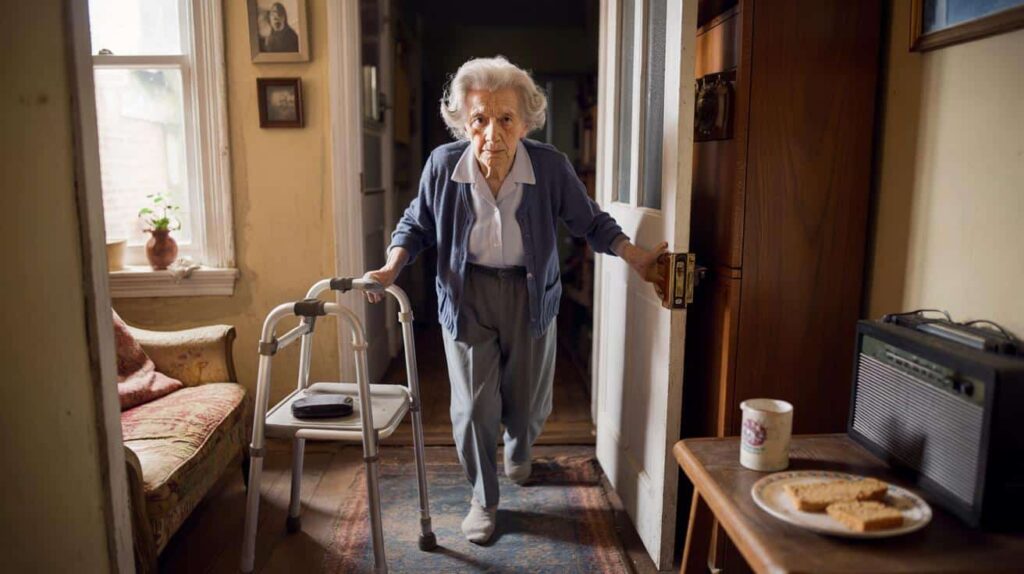
She lives alone. No carer popping in every morning. No plastic pill boxes lined up like a military parade. Just a landline, an emergency pendant she keeps in a drawer, and a fierce conviction that she is not, under any circumstances, “ending up in a home”.
What keeps her going isn’t a miracle supplement.

It’s what she quietly does, day after day.
The stubborn routine that keeps her out of care
Mary calls it her “little march”. Every morning, before she lets herself sit down “properly”, she walks the full length of her hallway ten times. It’s not glamorous. She shuffles a bit. She pauses to steady herself on the door frame when her right knee complains. Yet she does it, counting under her breath, sometimes out loud when she feels a bit wobbly in the head.
Her GP told her years ago: “Use it or lose it.” She took that literally. So the hallway has become her private gym, the faded runner rug her personal track. She doesn’t log steps. She doesn’t wear a smartwatch. She just walks until she feels her breath deepen and her legs warm, then rewards herself with tea.
Ask her why she bothers and she doesn’t talk about fitness. She talks about control.
“When you stop getting up, someone has to start lifting you,” she says, squinting over her glasses. “And once they start lifting you, they never stop. That’s how you end up in care.”
Researchers have a drier term for this: functional independence. Studies on centenarians often highlight the same pattern Mary has created instinctively – short, daily bursts of movement that maintain strength and balance. A 2023 paper on long-lived adults found that those who stayed out of institutional care longest weren’t marathon runners. They were the ones who kept up everyday movement: making their own bed, walking short distances, using the stairs whenever they could.
There’s a quiet logic to it. Muscles don’t understand birthdays. They respond to demand. At 30 or at 100, if you give them something to do, they fight to stay. When you stop challenging them, they quietly vanish.
Mary has unknowingly built a protective fence around her future with this daily “march”. Each lap down the hallway is a tiny vote against dependence, a micro-decision that says: I can still do this myself. **That sense of agency might be as powerful as the exercise itself.**
Her routine doesn’t guarantee she’ll never need care. Nothing does. Yet it keeps the gap between “still managing” and “needing full support” as wide as possible – and that’s where she wants to live.
The micro-habits that quietly build a long life
If you shadow Mary for a day, you won’t see anything dramatic. No green juices. No ice baths. No expensive gadgets humming in the background. What you notice are small, stubborn habits stacked together like bricks. She dresses every day, even if no one is visiting. She opens the curtains in every room, “so the house doesn’t fall asleep”. She eats at the table, never in bed, “because beds are for resting, not for living”.
One habit stands out: every afternoon at 3 p.m., she phones someone. Not a carer, not a helpline. A person. Sometimes it’s her neighbour Sue. Sometimes her grandson in another city. Sometimes the woman from church who now can’t leave her own house. The calls are short, chatty, sometimes slightly nosy. They are non-negotiable. “If I stop talking to people,” she shrugs, “I’ll stop knowing what day it is.”
Loneliness is one of the silent escalators into residential care, and Mary is painfully aware of it. Her husband died 27 years ago. Her closest friend moved into a home after a fall. “She went quiet,” Mary recalls, voice dropping. “Once you go quiet, they forget what you can still do.”
So she fights the quiet with these calls. Once, when her neighbour didn’t pick up for two days, Mary called the daughter, then the building manager, until someone checked in. The neighbour had fallen. The ambulance came in time.
Those small acts of connection aren’t just nice. They are protective. Research from the University College London has linked strong social ties in older adults to lower risk of cognitive decline and delayed entry into care. Mary doesn’t quote studies. She just knows, viscerally, that solitude shrinks your world until you can’t reach the door yourself anymore.
Sponsors of longevity love to sell big fixes: a single pill, a magic diet, a wearable that promises ten extra years. The older people who actually reach 100 with their independence intact tend to talk about something else. Tiny, boring, daily choices.

A glass of water first thing. Real food instead of “bits out of packets”. Walking to the corner shop instead of ordering everything in. Getting dressed, even when it would be easier to stay in pyjamas.
Let’s be honest: nobody really does this every single day. Mary has off-days, too. She naps longer. She grumbles. She skips her hallway march. Yet she returns to her habits as soon as she can, not out of guilt, but out of self-preservation. **That rhythm – not perfection, but return – is what slowly rewires a life toward resilience.** Her micro-habits don’t scream “longevity hack”. They quietly whisper: keep going, keep going, keep going.
Why she refuses the “inevitable” care home
Ask Mary why she’s so determined never to end up in care and she doesn’t give a speech about dignity. She says something much simpler: “I like my chair.” She points to a sagging armchair by the window, the exact spot where the afternoon sun hits at 4 p.m. The idea that someone might move her from that chair “for her own good” fills her with more dread than any birthday.
So she has a system. A small whiteboard on the fridge with three words: “Move. Eat. Ring.” Every day she ticks them off. Move: the hallway march or a slow walk to the garden gate. Eat: three real meals, even if one is just soup and toast. Ring: that 3 p.m. phone call. If all three are done, she tells herself, “I’m still running this show.”
Many families do the opposite without meaning to. Out of love, they start doing everything for their elderly parent. Carrying the washing. Bringing all the meals. Tidying every corner. Slowly, that parent stops bending, stretching, deciding. Their everyday muscles – physical and mental – get outsourced.
Then a crisis hits: a fall, an infection, a confused night. Nurses assess “current function”, not what the person could do six months ago. Suddenly, a care home looks like the only “safe” option.
Mary has watched this happen on her street more than once. She’s sympathetic, not judgmental. Her quiet warning to her own family is clear: “Help me do what I can’t. Don’t do what I still can.” It’s a fine line. Most of us cross it from fear of something going wrong.
“People think a care home is just where you go when you’re very old,” Mary says softly. “No. You go when you stop living your own days. I’m not ready to hand mine over.”
- Get up and dressed every day, even if no one’s coming.
- Keep at least one daily task you fully control – cooking, watering plants, writing a shopping list.
- Protect small rituals (tea time, radio show, crossword) that mark the hours as yours.
- Say yes to help with safety risks, not with every tiny inconvenience.
- Talk openly with family about what “staying at home” really requires – from you and from them.
The quiet contract between age and autonomy
Mary brings out a shoebox from under her bed. Inside: old bus tickets, a dried wedding flower, a postcard from 1952. At the bottom, folded carefully, is a letter she’s written to her future self: a list of signs she’s willing to accept that she really does need help someday. Getting frequently lost in her own house. Forgetting the kettle on. Not recognising her grandchildren.
She doesn’t glamorise independence. She knows there may come a day when staying home isn’t the bravest choice, but the riskiest. What she refuses is the casual assumption that crossing 80, 90, 100 automatically means surrendering her keys. *There is a whole stretch of life between “fully independent” and “needs full-time care” that we rarely talk about.*
That in-between is built on mundane actions: moving, eating, connecting, deciding. Whether you’re 40 worrying about your parents, or 75 worrying about yourself, the question quietly rises: which of those four are you protecting, day after day, even when nobody is watching?
| Key point | Detail | Value for the reader |
|---|---|---|
| Daily movement | Short, consistent walks or “hallway marches” help maintain strength and balance | Offers a realistic, low-bar way to delay frailty and dependence |
| Social contact | Scheduled daily calls keep the mind engaged and reduce isolation | Gives a simple structure to protect mental health and orientation |
| Protected autonomy | Keeping control of small tasks and decisions sustains a sense of agency | Helps families support ageing relatives without unintentionally speeding up loss of independence |
FAQ:
- Question 1Is it really realistic to stay out of care at 100?
- Answer 1
Staying out of care at 100 is not guaranteed, but it’s more common than people think. Many centenarians live at home with varying levels of support. The biggest predictors are mobility, cognition and social ties – all of which can be supported by small, consistent daily habits like Mary’s.
- Question 2What are the most protective daily habits for older adults?
- Answer 2
Research and real-life stories converge on four pillars: gentle daily movement, regular meals with enough protein, meaningful contact with other people, and making personal decisions (even small ones) every day. **These don’t need to be perfect, just regular enough to keep body and mind engaged.**
- Question 3How can families help without making someone more dependent?
- Answer 3
Offer help where safety is at risk – heavy lifting, ladders, complex medication – and resist the urge to “take over” everything. Ask, “What do you still want to do yourself?” and build support around that. Shared tasks (cooking together, tidying side by side) keep skills alive without leaving the person at risk.
- Question 4What if the older person refuses any help at all?
- Answer 4
Start with conversations, not ultimatums. Share your worries in specific terms (“I worry about the stairs at night”) and invite their ideas first. Sometimes small compromises – a grab rail, a personal alarm, a weekly cleaner – can extend independence far longer than a big, unwanted move.
- Question 5Is it ever wrong to resist going into care?
- Answer 5
There comes a point for some people when 24/7 support is genuinely safer and kinder. The key is timing and honesty. If someone is regularly falling, very confused, or unable to meet basic needs even with help, a good care home can protect their dignity rather than take it away. The goal isn’t to avoid care at any cost, but to live fully in your own way for as long as safely possible.