Researchers now say this unremarkable-looking rock, linked to France through its collector and its study, may be one of the most ancient and pristine witnesses of the early Solar System ever put under the microscope.
A meteorite that rewrites the family tree of space rocks
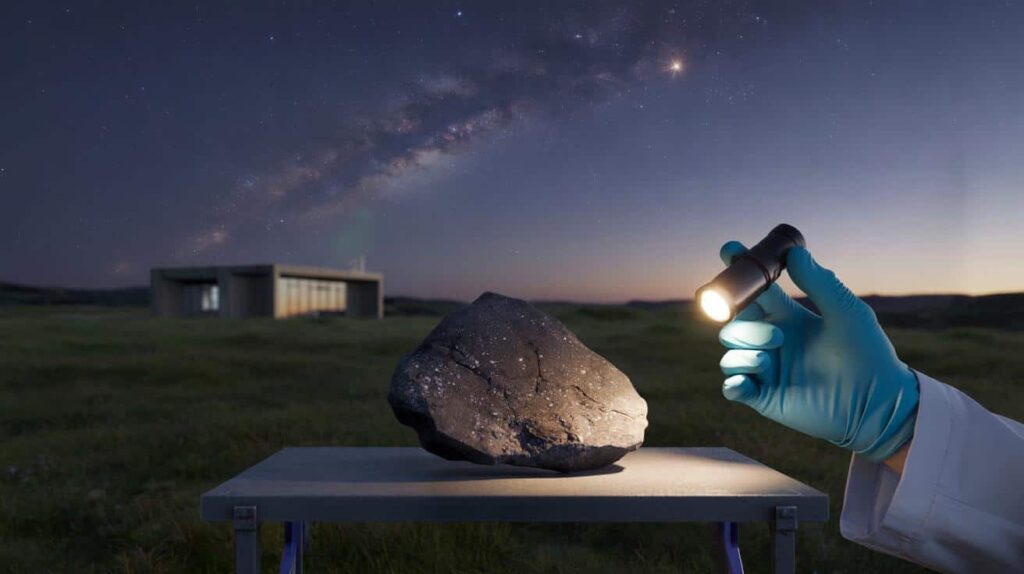
The meteorite at the heart of this story is called Chwichiya 002. It was found in 2018 in Western Sahara, near the village of Haouza, in a locality known as Chwichiya. On the ground, it appeared as many small fragments, some still wrapped in a dark fusion crust left by their fiery passage through Earth’s atmosphere.
The fragments were recovered by teams of Moroccan hunters, then reached French collector and meteorite dealer Jean Redelsperger. Crucially, he returned to the site with local partners and recorded the exact GPS coordinates of the fall area. That field information allowed researchers to formally register and classify the meteorite, turning a private find into a scientific asset.

Chwichiya 002 has been classified as an extremely primitive carbonaceous chondrite, packed with grains older than the Sun itself.
This rock now sits in a brand-new, ultra-rare category known as CT3, a proposed new group of chondritic meteorites. Within that, it is tagged as a C3.00 ungrouped carbonaceous chondrite — a technical label that, in practice, means “as close as we can get to the original material that built the planets”.
What makes Chwichiya 002 so special?
Most meteorites have gone through heating, melting, or chemical alteration inside their parent bodies. Chwichiya 002 is different. Laboratory studies in France and other countries show that it has:
- Very low heating since its formation
- Almost no interaction with liquid water on its parent body
- Extremely high levels of presolar grains (dust older than the Sun)
- Very little organic material, which points to a very primitive state
That combination makes this meteorite a kind of time capsule. It preserves the composition and texture of some of the earliest solid material that condensed in the young Solar System, more than 4.5 billion years ago.
Grains that predate our Sun
The headlining feature is the abundance of presolar grains. These are microscopic mineral particles that formed in the winds and explosions of stars that lived and died long before the Sun existed. They drifted in interstellar space, then became trapped in the cloud of gas and dust that ultimately collapsed to form the Solar System.
Presolar grains are physical relics of dead stars that somehow survived the violent birth of our planetary system.
Most meteorites only hold traces of these grains because early heating, melting or water flow destroys them. Chwichiya 002, barely processed since its birth, retains an unusually high concentration. Measuring their composition lets scientists track the types of stars that contributed material to the nebula that formed the Sun and planets.
Almost no organic matter – and why that matters
Another striking feature is the lack of organic compounds. Many carbonaceous meteorites are famous for holding complex carbon-based molecules, some of which are considered building blocks for life. In Chwichiya 002 those organics are rare.
That does not make the meteorite less interesting. Quite the opposite. The scarcity of organic material suggests that its parent body — likely a small primitive asteroid — never went through the mild warming and water activity that tend to create or concentrate such molecules. That allows researchers to separate two questions:
- What did the very first solid dust look like?
- What happened later, as bodies warmed, altered and produced organics?
By comparing Chwichiya 002 with more altered meteorites rich in organics, researchers can trace the chain of events that led from raw cosmic dust to potentially life-friendly chemistry.
A cousin of Ryugu and Bennu?
Part of the excitement comes from possible links between Chwichiya 002 and two famous near-Earth asteroids: Ryugu (sampled by Japan’s Hayabusa2 mission) and Bennu (visited by NASA’s OSIRIS-REx). Both missions returned pristine material directly from the asteroids’ surfaces.
Early analyses led by Jérôme Gattacceca at the CEREGE research centre in France, and follow-up studies by laboratories worldwide, indicate that Chwichiya 002 shares features with the material from these asteroids. The chemistry and mineralogy point to a potential family resemblance between the meteorite and bodies like Ryugu and Bennu.
| Object | Type | Key feature |
|---|---|---|
| Chwichiya 002 | C3.00 ungrouped (CT3) | Highly primitive, presolar grain–rich, almost no organics |
| Ryugu | Carbon-rich asteroid | Sampled by Hayabusa2, hydrated minerals and organics |
| Bennu | Carbon-rich asteroid | Sampled by OSIRIS-REx, dark, porous, rich in carbon |
If this link holds, Chwichiya 002 becomes a ground-based complement to those space missions. Researchers can carry out experiments on this meteorite that would be impossible or too risky on the precious returned samples.

From deserts to laboratories: how a stone becomes a cosmic archive
The route from Saharan stone to scientific treasure is long. It starts with local hunters scanning vast desert plains for dark rocks that stand out from the sand. Meteorites can fetch significant prices, so this has become a specialised trade.
Once a promising rock is found, collectors such as Jean Redelsperger buy, catalogue, and sometimes help document its find location. Without that documentation, a meteorite may remain an anonymous curiosity. With it, scientists can link it to known meteor streams, or even reconstruct its orbit before it fell.
Each classified meteorite weakens the gap between professional research and dedicated amateurs roaming deserts and ice fields.
In the case of Chwichiya 002, collaboration between Moroccan hunters, a French collector and international laboratories has opened a window onto the first few million years of Solar System history. For planetary scientists, that short period shaped everything: the size of the planets, the distribution of water, and the raw materials from which life eventually emerged on Earth.
What “primitive meteorite” actually means
The word “primitive” can mislead. In meteorite science, it does not mean simple or uninteresting. It describes a rock that has not undergone major transformation since it formed from the solar nebula.
Chondritic meteorites like Chwichiya 002 are made of tiny rounded grains called chondrules, along with fine dust and, in some cases, fragments of older material. When a meteorite earns a score like “3.00” in the classification, that number reflects minimal thermal metamorphism — in other words, it has barely been cooked.
This makes such meteorites particularly valuable for testing models of how dust clumped, heated briefly, then cooled again in the swirling protoplanetary disc that eventually produced the planets.
What scientists do with a meteorite older than the Sun
Once a meteorite like Chwichiya 002 reaches a laboratory, scientists slice off small pieces for analysis. These slivers may be used to:
- Measure isotopes with mass spectrometry to date events in the early Solar System
- Scan the texture and minerals with electron microscopes
- Search for presolar grains using ion probes
- Compare its spectrum with telescopic data of asteroids
By combining these techniques, they can reconstruct the meteorite’s history: how its parent body formed, whether it contained ice, how long it was heated, and how quickly it cooled. The age of individual grains can be tracked back to specific stellar processes, turning the rock into a map of stellar recycling processes in our galaxy.
From cosmic dust to classroom talks
Redelsperger has said he wants to share Chwichiya 002 with the public, not only with scientists. That can mean exhibitions, school visits, and events where people can hold a fragment of material that predates the Sun. Such experiences tend to stick with students far more than textbook diagrams.
Teachers often use meteorites to explain broader topics: plate tectonics, the age of Earth, or the risk from asteroid impacts. A meteorite like Chwichiya 002 adds another dimension: the idea that every breath we take contains atoms forged in ancient stars, some of which can still be touched, polished into small black stones.
Key terms readers may hear again
Several technical expressions linked to this meteorite also appear in missions and scientific news:
- Presolar grains: tiny mineral grains formed around older stars, preserved inside meteorites.
- Carbonaceous chondrite: a dark, carbon-rich meteorite type, generally very ancient and chemically close to the Sun’s composition.
- Ungrouped: a meteorite that does not fit cleanly into established families, hinting at a rare or previously unknown parent body.
- Parent body: the asteroid or object from which a meteorite originally broke off.
As sample-return missions expand and classification schemes refine, meteorites like Chwichiya 002 help link everything together: distant asteroids mapped by spacecraft, micrometre-sized dust grains in the lab, and the broad story of how a bright young Sun lit up a disc of gas and dust 4.6 billion years ago.