The control room lights in Pasadena always feel too bright at 3 a.m. Monitors hum, coffee cups crowd the keyboards, and a wall of screens shows a dusty orange world turning in slow motion. A NASA engineer leans forward, frowning. The rover’s “noon” data just came in… at what should be mid‑morning on Earth.
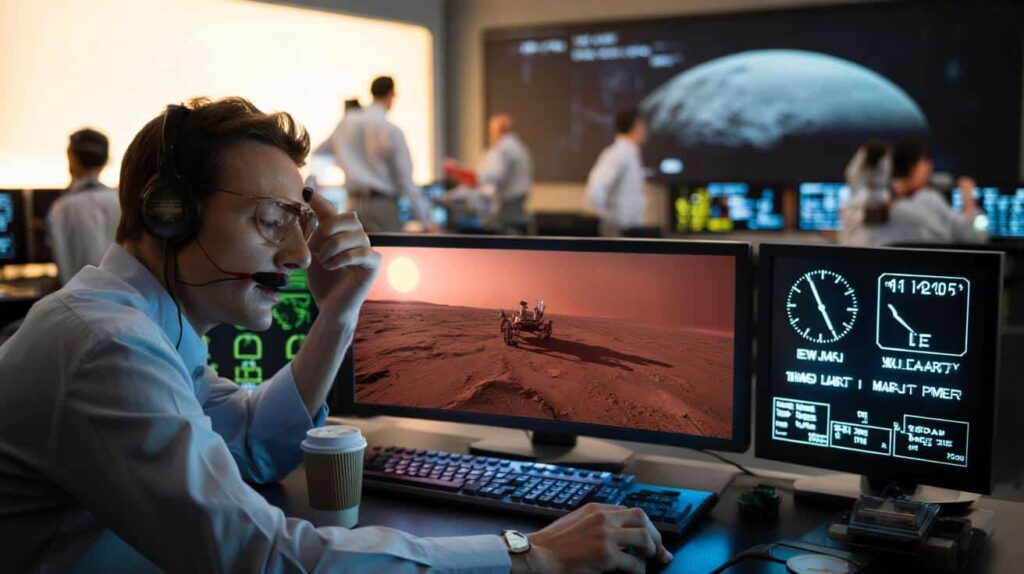
Nobody panics. They’ve seen this before. Yet every new mission makes it stranger: time on Mars refuses to line up with our clocks. The days stretch, the beats slide, the schedules fray at the edges.
Over a century ago, a German physicist with wild hair warned us that time was not what we thought it was.

Now the Red Planet is forcing us to live it.
Einstein’s strange clock and Mars’ stubborn day
Einstein once asked: what if time isn’t absolute, but elastic? Back in 1905, it sounded like pure thought experiment, something you’d scribble on a blackboard and forget before lunch. Today, that idea is quietly running every mission we send to Mars.
Mars has its own tempo. A Martian day — a “sol” — lasts about 24 hours and 39 minutes. Just enough extra time to be annoying, just enough to break every tidy 24‑hour rhythm we’ve ever lived by.
For teams on Earth, that 39‑minute drift is no longer a theory. It’s a work schedule.
When NASA’s Curiosity rover landed in 2012, the mission team did something most companies would never dare: they put hundreds of people on “Mars time”. For weeks, engineers and scientists shifted their sleep schedule by 39 minutes every single day, following the Martian sunrise around the clock.
One week, your “day shift” starts at 9 a.m. A few weeks later, it starts at 2 a.m. Then 5 p.m. Then midnight. Family dinners slip. Kids wonder why mom sleeps with blackout curtains at noon. Friendships survive on apologetic texts.
We’ve all been there, that moment when your body says “bed”, your calendar says “meeting”, and your brain is stuck somewhere in between. Now imagine living that confusion for months — because a planet won’t respect your watch.
Physically, the explanation is simple and brutal. Mars spins slower, so its day is longer. Its year stretches to 687 Earth days. Its weaker gravity and different orbit also nudge the flow of time in subtle relativistic ways that Einstein could write down with equations long before we could measure them on another world.
Psychologically, it hits harder. Our entire civilization is wired to a 24‑hour loop: work shifts, public transport, school, prime time TV, even our hormones. Mars smashes that symmetry. *A 39‑minute discrepancy sounds tiny until you live it day after day, like sand slowly grinding gears.*
This is where Einstein’s prediction stops being philosophy and becomes logistics. Future missions won’t just travel through space; they’ll have to migrate into another rhythm of time.

Living on Mars time: the new rulebook for missions
Mission planners are already inventing quiet tricks to survive this temporal mismatch. One method sounds almost trivial: new clocks. Not just on the spacecraft, but on the desks, phones, and walls of everyone working on the mission. Curiosity and Perseverance teams use special apps that show “Mars local time” right next to Los Angeles time.
Daily plans are written not as “4:30 p.m. meeting” but “Sol 182, 11:00 LMST” (Local Mean Solar Time on Mars). Every task — move the rover, fire a laser, snap a panorama — is pinned to the Martian sun, not ours.
This simple gesture, swapping the reference clock, quietly rewires how people think.
The impact reaches far beyond scheduling. Sleep researchers working with Mars missions warn that living on a 24h39 cycle is like flying across one time zone every single day, without the thrill of airports or holidays. People get cranky. Decision‑making slows. Mistakes creep in during “Martian night” that is actually your 3 p.m.
Let’s be honest: nobody really maintains perfect sleep hygiene while their job keeps sliding around the clock. So current missions are learning to compromise. They spend a few weeks strictly on Mars time at the start, when every decision is critical, then gradually drift back toward Earth time while using smarter automation on the rovers.
The lesson is blunt: if we want to explore Mars safely, our systems must absorb the time difference so our bodies don’t pay the entire cost.
The next step is cultural, not just technical. As agencies plan crewed missions, they’re asking something that sounds almost philosophical: will human settlers live by Martian clocks, Earth clocks, or a hybrid no one has invented yet?
“Einstein told us time is relative,” one mission designer confided off‑record. “On Mars, you suddenly feel what that really means. Two people can talk in real time and still not quite share the same day.”
To navigate this, future missions are sketching new day‑to‑day rules:
- Design “Martian shifts” that change in weekly blocks, not every day, to protect sleep.
- Use AI to handle routine rover actions during “off hours” for human teams.
- Anchor crew routines to local sunlight on Mars, while syncing just key windows to Earth.
- Train families on Earth to understand sol‑based calendars, so personal life doesn’t disintegrate.
- Standardize “Mars time zones” before multiple bases start arguing over what “noon” means.
When one planet’s time no longer fits all
The most unsettling part is not that Mars bends time a little. It’s that we’re starting to accept it. What used to be raw science fiction — “I work on Martian hours” — is now a sentence people say in Los Angeles traffic. That quiet normalization changes everything for what comes next.
As we aim beyond Mars, to icy moons and distant asteroids with even stranger days and years, Einstein’s old insight stops being a curiosity and turns into a survival kit. Every world will impose its own timetable. Our neat, global 24‑hour consensus will crack into a mosaic of local times, drifting slightly out of sync across the solar system.
| Key point | Detail | Value for the reader |
|---|---|---|
| Einstein predicted time’s relativity | Different gravity and motion mean time doesn’t “flow” identically on every world | Helps you grasp why Mars time isn’t just a quirky detail but a physical reality |
| Mars has a 24h39 “sol” | That extra 39 minutes per day slowly wrecks Earth‑based routines and sleep cycles | Shows how a tiny difference reshapes real human lives and mission planning |
| Future missions must adapt | New clocks, schedules, and even family habits will orbit around Martian time | Lets you imagine how everyday life will change when humans finally live on Mars |
FAQ:
- Does time really pass differently on Mars, or is it just about longer days?
Both. The main effect you feel is the longer sol, but Einstein’s relativity also says clocks in different gravity and motion tick at slightly different rates. On Mars the difference is tiny yet real and must be accounted for in high‑precision navigation.- Will astronauts on Mars age slower than people on Earth?
Very slightly, yes, due to relativity and different gravity, but the effect is minuscule — far smaller than the impact of radiation or lifestyle on health. You won’t get a visible “time bonus” from living on Mars.- Why don’t we just force Mars missions to follow Earth time?
Because rovers and future crews must work with Martian daylight, weather and power cycles. Planning from Earth time alone would waste energy, increase risk and miss the best science windows.- Could we create a universal “space time” standard for all planets?
There are proposals for space‑wide time standards based on atomic clocks and GPS‑like systems, yet local “solar time” will still matter on each world for daily life and operations.- What will everyday life be like for colonists living on a 24h39 schedule?
They’ll likely use Martian clocks for work and daylight, adapt sleep and meal patterns to the longer day, and use digital tools to translate between Mars and Earth times when calling home or trading.