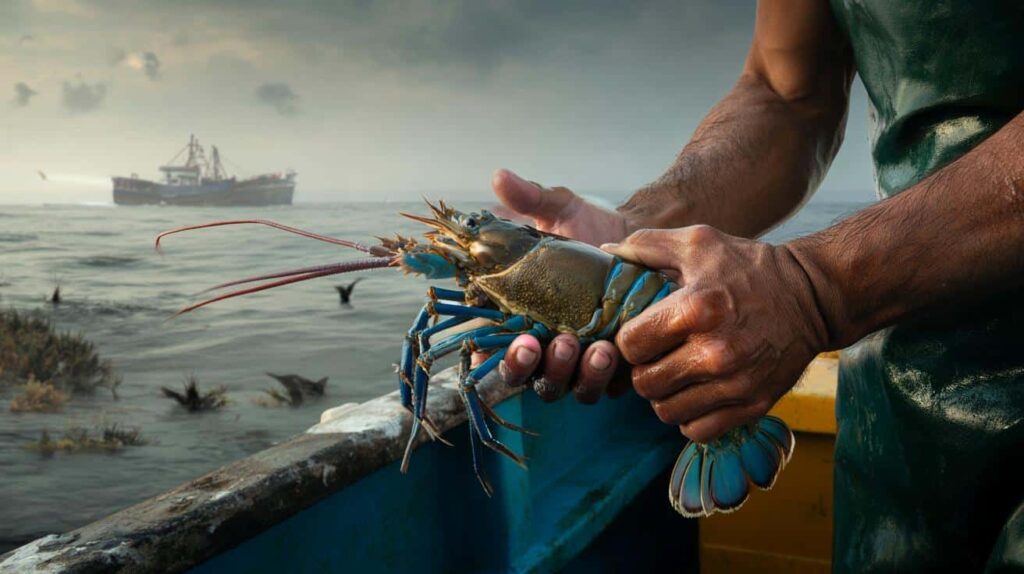
The photo hits your feed before you’ve finished your first coffee. A neon-blue lobster, cradled in a fisherman’s rough hands, its shell glowing like something from a Pixar movie. Headlines shout about “one in two million” odds. Comments flood in with heart emojis, “Omg save it!”, “Nature is amazing”, “Humanity restored”. For ten minutes, maybe an hour, the internet gathers around this tiny crustacean as if it’s a royal baby.
Then you scroll on.
Off-screen, trawlers drag steel across the seafloor. Coral turns ghost white. The ocean warms, acidifies, empties. None of that fits neatly into a single viral frame. A rare blue lobster does.
And that gap, between what we click and what we’re breaking, says more about us than we like to admit.
Why a single blue lobster gets more love than a dying ocean
Scroll back through the last few years of feel-good news and you’ll see the pattern. A barista rescues a squirrel. A town stops traffic for a duck family. A fisherman pulls up a glowing blue lobster and the story jumps from local TV to global front pages in hours.
These moments are touching. They’re also algorithmic catnip. One striking image, one neat headline, one clear emotional reaction. No graphs. No context. Just a tiny, dazzling miracle we can all briefly agree on.
Take that blue lobster story from Maine, Nova Scotia, Cornwall – they all blur into one. A crew hauls in their nets, someone spots a flash of electric blue, and suddenly a normal workday turns into a PR event. The lobster is named Bluey or Lucky. It gets a selfie session, maybe a home in an aquarium, maybe a release ceremony filmed for local news.
Views climb into the millions. Brands jump in with quirky posts. For a 10-second reel, the ocean looks magical, intact, generous.

Outside that narrow frame, reality is rougher. Global lobster populations are shifting north as waters heat up. Some coastal ecosystems are collapsing quietly, one degree and one empty trap at a time. Trawling crushes habitats that took centuries to grow. But there’s no single viral image for “gradual ocean collapse”. No clear villain. No blue shell sparkling like a jewel.
Our brains, and our feeds, cling to spectacle. Incremental damage bores us. Sudden rarity thrills us. **The spectacle wins the battle for our attention, almost every time.**
How to care about the ocean when everything feels abstract
One simple shift changes a lot: treat every viral ocean “miracle” as a door, not a destination. You see the blue lobster? Click, feel the rush, smile. Then pause for 30 seconds and type two more words into your search bar: “lobster climate”, “lobster overfishing”, “lobster habitat”.
Turn the spectacle into a question, not just a feeling.
You don’t have to become a marine biologist overnight. But you can train your attention the way you’d train a muscle. Start with the pretty picture, then pull gently on the thread behind it.
Most of us feel guilty when we realize we shared the cute clip and skipped the hard stuff. That guilt can either shut you down or nudge you forward. Next time, follow one scientist on social media instead of another “wow nature” account. Save one long read about ocean health for your commute.
Let’s be honest: nobody really does this every single day.
But doing it once a week already pushes your feed – and your brain – away from pure spectacle and toward something closer to reality.

“Viral animals are like the ocean’s PR department,” a marine ecologist in Brittany told me. “They open the door. The tragedy is when we never walk through it.”
- Question the headline – Ask: what’s missing from this “miracle” story?
- Follow the experts – Look for local fishers, ocean scientists, coastal communities, not just polished influencers.
- Check the human angle – Who depends on this ecosystem for a living, and what are they saying?
- Balance your feed – For every cute animal account, add one account that shows the less Instagram-friendly side of the sea.
- Link clicks to actions – A petition signed, a seafood choice changed, a donation made, even once, beats a hundred passive likes.
Living with the discomfort of loving beauty in a broken sea
There’s a quiet tension inside anyone who loves nature online. You adore the dazzling shots of whales breaching and lobsters glowing blue, yet you know, somewhere in your chest, that these images are the highlight reel of a planet in trouble. It’s tempting to shut that feeling down. Or pretend that sharing the miracle is the same thing as helping the mess behind it.
What if, instead, we just sat in that discomfort for a moment?
We’ve all been there, that moment when you watch a heartwarming rescue video, then swipe past a dry headline about collapsing fish stocks as if they were from two different worlds. *They’re not.* The blue lobster only exists because a huge, stressed, industrialized system is scouring the sea day and night. The spectacle and the damage are two sides of the same net.
Owning that duality doesn’t kill the magic. It makes it honest.
Maybe the next time a rare creature trends, we let it pierce us a little deeper. We can still gasp, still share, still type “omg” in the comments. But we can also ask: what’s the daily, invisible cost of this one lucky survivor? What would it look like if we cared even half as much about the invisible billions as we do about the one in two million?
Those aren’t questions with quick answers. They’re invitations. To talk, to learn, to act in small, stubborn ways that never go viral – yet quietly shape the ocean our grandchildren will inherit.
| Key point | Detail | Value for the reader |
|---|---|---|
| Viral spectacle skews our empathy | Rare animals like blue lobsters dominate feeds while systemic ocean damage stays invisible | Helps you see how your attention is being steered |
| Curiosity can bridge the gap | Using each viral story as a prompt to dig into context and causes | Turns passive scrolling into active understanding |
| Small, consistent shifts matter | Following experts, changing seafood choices, supporting coastal communities | Gives you practical ways to align your feelings with your impact |
FAQ:
- Why are blue lobsters so rare?They’re usually the result of a genetic mutation affecting pigment, with estimates ranging from one in two million to one in several million, depending on the study and region.
- Is sharing blue lobster stories actually bad?Not by itself. The problem comes when we stop at the “wow” moment and never look at the wider context of fishing pressure and ocean change.
- What does “ocean collapse” really mean?It refers to ecosystems losing their balance: species declining or disappearing, coral reefs dying, food webs breaking, and communities losing their livelihoods.
- What can I do if I’m not a scientist or activist?Shift your seafood choices toward sustainable options, support organizations working on marine protection, and diversify your news sources beyond feel-good clips.
- Do positive animal stories have any real value?Yes, they create emotional connection and curiosity. The key is using that spark as a starting point to learn and act, not as a substitute for deeper engagement.