Temperatures plunged low enough to stun cold‑blooded animals, leaving bright green iguanas motionless on pavements, patios and under palm trees across parts of Florida.
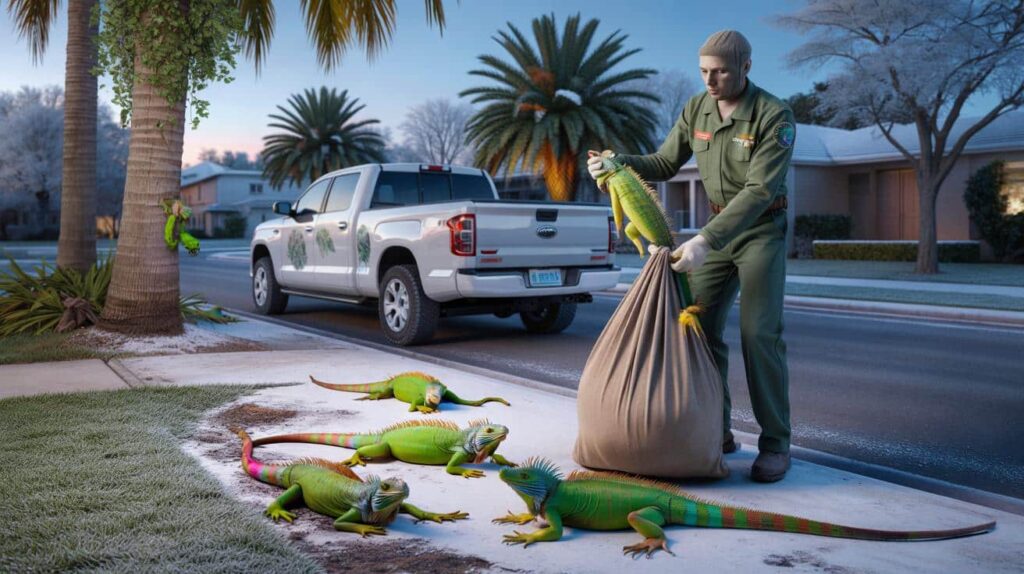
Cold snap turns iguanas into falling “branches”
A sharp winter cold front has swept across the southern United States, hitting North Carolina and neighbouring states and dragging unusually low temperatures into Florida. In Orlando, thermometers dropped to around –4°C, a level rarely seen in the Sunshine State.
For warm‑blooded residents, that meant turning up the heating and scraping frost off windscreens. For Florida’s green iguanas, it triggered a biological shutdown. As the air cooled towards freezing, the reptiles’ bodies began to slow dramatically.
When temperatures approach 0°C, green iguanas can become totally immobile, toppling from branches like fruit shaken from a tree.
Videos shared on social media show what looks, at first glance, like storm damage: “branches” tumbling from canopies during the night. Only on closer look do viewers realise the branches have claws and tails.
Wildlife officials stress that these lizards are not dead. Once the sun returns and the air warms, most of them gradually regain movement and scamper away.
Authorities see an opportunity to control an invasive species
Because the species is considered invasive, Florida officials are treating the freeze as a window to curb their numbers. The Florida Fish and Wildlife Conservation Commission (FWC) issued a temporary executive order giving residents explicit permission to collect stunned iguanas without a special permit.
People who find the animals on the ground can scoop them up and deliver them to one of several FWC offices designated as drop‑off points. From there, the reptiles face two possible outcomes.
According to the FWC, green iguanas surrendered to the state will either be euthanised “humanely” or, in limited cases, transferred to licensed dealers who sell live animals.
Florida law already allows residents to kill green iguanas on their own property all year round, provided they follow humane methods. The emergency order simply streamlines the process during the cold snap by allowing capture in a wider area and formalising where the animals should be taken.
Why Florida wants fewer iguanas
Green iguanas are not native to the United States. They originate from Central and South America and likely established themselves in Florida through a mix of escaped pets and intentional releases.
Over the years, they have multiplied along canals, golf courses and suburban neighbourhoods. Their presence brings a string of problems, according to state officials:
- They compete with native wildlife for food and basking spots.
- Their burrows can undermine sea walls, pavements and canal banks.
- They chew through landscaping, vegetable gardens and ornamental plants.
- They sometimes carry salmonella, which can spread to humans through contact with droppings.
For homeowners, that can translate into cracked patios, collapsed edges of swimming pools and expensive repairs around waterfront properties. For conservationists, the main concern is pressure on native species that evolved without these large herbivorous lizards.
Guidelines for residents handling frozen iguanas
Although a frozen iguana looks harmless, wildlife officers warn that a stunned lizard can spring back to life quickly once warmed. The FWC has issued practical advice for anyone tempted to help with collection.
Residents are urged to wear gloves, trousers and long sleeves, and to place any iguanas they pick up into a secure, escape‑proof cloth bag.
The agency says this reduces the risk of scratches and bites. A stiff, unconscious animal can become alert and defensive in a matter of minutes, especially if placed somewhere warm like a car or garage.
Officials also remind the public that the animals must not be released in new locations. Transport should be directly to a designated office or to a permitted wildlife control operator. Unregulated relocation simply spreads the problem.
Legal status: a protected pest, or just a pest?
In Florida, green iguanas receive no legal protection as a native species would. There is no closed season, and no bag limit, on private land. With the landowner’s consent, residents may euthanise iguanas year‑round.
Other US states treat them differently. In much of the country they cannot survive winters and are mostly seen only in captivity. Florida’s subtropical climate gives them a rare foothold on the mainland United States, which explains the state’s tough approach.
| Aspect | Iguanas in Florida |
|---|---|
| Origin | Introduced from Central/South America |
| Legal status | Invasive, not protected |
| Control methods | Humane euthanasia allowed on private property; trapping with permits |
| Main concerns | Damage to infrastructure, gardens, and risk to native species |
Ethical questions over mass euthanasia
The state’s stance divides opinion. Some residents, especially those near canals or coastal walls, support the aggressive control. After repeated damage, a sudden chance to remove dozens of iguanas in one cold week can feel like relief.
Animal‑welfare advocates see a different picture: sentient creatures stunned by a rare freeze, then rounded up and deliberately killed. Even when officials use the term “humane euthanasia”, critics question whether all methods in practice meet that standard.
Veterinarians generally recommend rapid techniques that cause instant loss of consciousness and prevent suffering. That requires training, equipment and supervision. In reality, enforcement across hundreds of towns and back gardens remains patchy.
The tension reflects a broader debate across the United States: how far to go in controlling invasive species when those animals, through no fault of their own, were introduced by humans.
What “cold‑stunned” actually means
For readers unfamiliar with reptile biology, “cold‑stunned” can sound like a euphemism. In practice, it describes a real physiological reaction. As ectotherms, iguanas depend on external heat to regulate body temperature. When the air cools rapidly, their metabolism slows and muscles lose function.
At certain thresholds, they cannot grip branches or move their legs properly. They become rigid, almost like living statues. This state can last hours. If temperatures drop too low for too long, organs fail and the animal dies. If conditions rise again in time, the iguana often survives.
The same effect appears in sea turtles off the US east coast, which sometimes wash ashore motionless after cold snaps. In those cases, rescue teams typically rewarm and release the animals, because they are native and protected.
How future winters could shape Florida’s reptile problem
Florida’s climate is warming overall, but it still experiences occasional sharp cold fronts. Each one acts like a stress test for tropical species that have moved in. If winters stay mild for decades, invasive reptiles such as green iguanas, tegu lizards and some pythons could continue to expand their range northward.
On the other hand, a series of hard freezes can dramatically reduce populations, at least temporarily. Some biologists see these events as natural checks that slow the spread of non‑native animals without constant human intervention.
State managers face a strategic choice: rely partly on the weather and accept fluctuating numbers, or actively seize each freeze as a chance for intensive culling, as seen in this latest order.
Practical scenarios for residents
For people living in affected areas, a few situations are now common during cold snaps:
- A homeowner finds three rigid iguanas on their lawn at dawn. They can leave them until midday, when many will revive and climb away, or they can capture them in bags and deliver them to an FWC office for euthanasia.
- A gardener spots burrows undermining a sea wall. With the property owner’s consent, they may hire a licensed trapper who uses the cold weather to capture more animals in fewer days.
- A concerned resident wants to help but opposes killing. They may choose not to participate in collection, yet still has to manage potential damage and droppings around their home.
Each choice carries trade‑offs: reduced damage on one side, and ethical unease on the other. Residents are left to decide how they balance animal welfare, ecological impact and their own property concerns, as frozen iguanas continue to fall from Florida’s trees during rare but striking winter chills.