At the electronics store counter, the woman in front of me did something I’d never seen before. The cashier handed her a long, curling receipt. She didn’t fold it. She didn’t crumple it into the depths of a bottomless handbag. She just smiled, pulled out her phone, tapped twice, slipped the paper into a tiny side pocket of her wallet and walked away like this was the most normal thing on earth.
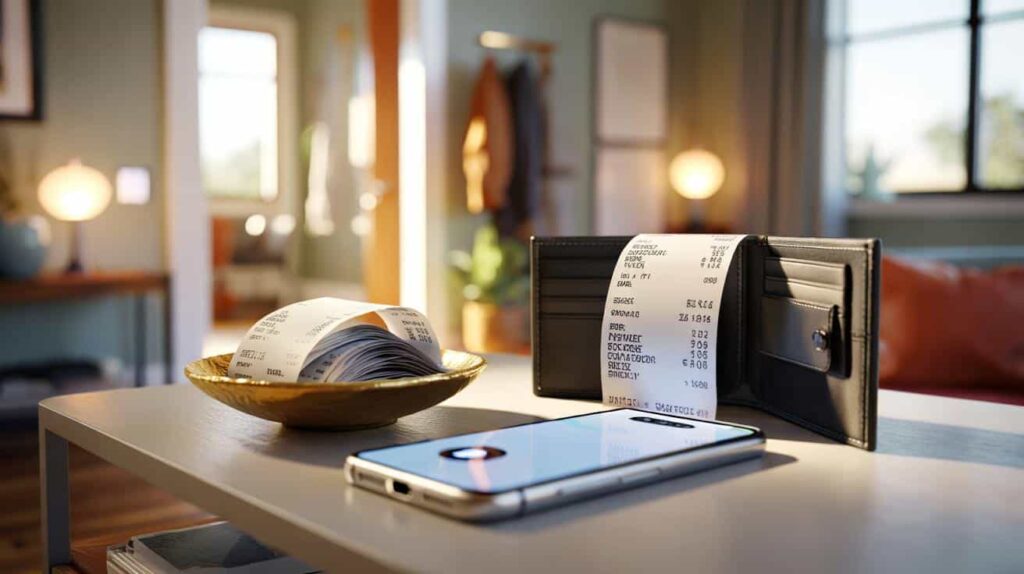
Two years later, when her dishwasher failed, she still had that receipt.
Meanwhile, most of us are tearing apart drawers, blaming the dog, and swearing we “just saw it last month.”
Some people never lose receipts.
Their secret is surprisingly simple.
The quiet habits of people who always find the right receipt
Spend enough time observing super-organized people and one thing jumps out: they almost never talk about “storage.” They talk about flow. Receipts move through their day like passengers in a tiny, very efficient train system. There’s a place for arrival, a place for sorting, and a final destination.
The worst offenders, in their eyes, are those swollen plastic folders that live on top of the fridge. The infamous “receipt graveyards.” They know that once paper disappears in there, the odds of ever finding it again drop to near zero. So they do something else. Something lighter. Something quicker.
Take Marc, 38, freelance graphic designer. He buys a laptop every three years and claims he has every warranty slip since his first iPod. Not in color-coded binders. Not in an accordion folder. His system begins the second the cashier hands him the receipt.
He has a “landing zone” in his wallet: one thin slot where only current receipts live. At home, there’s a small tray by the door. When he empties his pockets, receipts land in that tray, and once a week he spends five minutes scanning the ones worth keeping with a basic app, tossing the grocery and coffee slips. Last year, when his monitor died, he pulled up the PDF copy in under 30 seconds. The original paper? Already gone for months.
What separates people like Marc from the rest of us isn’t a giant organizational system. It’s a couple of small, almost boring rules followed on repeat. Folders fail because they delay decisions. They let us “deal with it later,” and later never comes.
Receipt keepers flip the script. They decide fast: trash, short-term, or long-term. They move important ones from physical to digital as quickly as possible. And they keep physical paper only as a backup, not the main record. It looks low-tech from the outside. In reality, it’s closer to a tiny, personal archive system running in the background of their life.
The real methods: not folders, but micro-routines
Ask them how they “store” receipts and the answers sound almost too simple. One woman I interviewed, a 45-year-old nurse, swears by a three-step ritual she can do half-asleep. Step one: every new receipt goes into a single pocket in her bag, never loose, never mixed with tissues or lipstick. Step two: when she gets home, she empties that pocket into a small ceramic bowl on her hallway table. Step three: once a week, usually with a cup of tea, she sorts the bowl.
The magic is not the bowl. It’s that there is only one in-tray. One place where receipts pile up. Not five. Not scattered between jacket pockets, car doors and kitchen counters. One funnel, one rhythm.
People who never lose receipts also have a very clear “why” for each category. Daily life receipts? They live for a few days then hit the bin. Big purchases, appliances, work expenses? Those go through a tiny promotion: from bowl to phone. They open a scanning app, take a quick photo, tag it with two or three words like “fridge 2024” or “tax fuel,” and save it to the same cloud folder every time.
Then comes the part most of us skip: they add a tiny label in their head. “If I ever need this, I will search this word.” That tiny mental link is what turns a blurry cloud folder into a reliable memory. *They know exactly where their future self will look.*
The honest truth is that the system works because it fits into real life. Let’s be honest: nobody really does this every single day. They miss weeks, they forget to scan, they lose a paper or two. But their structure is forgiving. The bowl still catches the backlog. The weekly scan can become a fortnightly catch-up without collapsing the whole thing.
Physical folders feel safe, but they invite procrastination and bulk. The people who always “magically” have their receipt don’t have more discipline, they’ve simply lowered the friction. One tap on a phone is easier than opening a filing cabinet. One small tray by the front door is easier than remembering which folder goes where. Less drama. More repeatable habits.
From chaos to calm: how to copy what really works
The simplest starting point is to copy the landing zone idea. Pick one small, fixed spot where all receipts will arrive: a narrow wallet pocket, a clip in your car, or a shallow dish in the kitchen. That’s your new “receipt inbox.” From today on, every paper proof of purchase either lands there or goes straight in the bin. No middle ground.
The second step is to choose one digital home. Not five apps. One. The basic scan function in Google Drive, the native Notes app, a free scanner app—any of them beat a fat folder on top of the wardrobe. What matters is that every important receipt ends up there, under a simple name you can actually search.
Most people fall down at the same predictable points. They keep far too many receipts “just in case.” They start three different systems at once. They buy organizing gear before they build habits. That’s when the clutter creeps back in and the guilt with it.
A kinder way is to decide, right now, what deserves to be kept. Big appliances, electronics, anything under warranty, work expenses, rental stuff, medical payments. Everything else can live a short, useful life in your landing zone and then go. That way, when you finally sit with that bowl or pocket full of paper, you’re not asking, “What if I need this?” You’re asking, “Does this fit my rules?”
“I used to feel like a failure every time I couldn’t find a receipt,” a friend told me. “Then I realized the problem wasn’t me. It was that my ‘system’ was just three different plastic folders and a prayer.”
- Create one landing zone for all new receipts: a bowl, wallet pocket, or car clip.
- Pick one digital tool and stick to it, even if it’s basic.
- Set a tiny weekly ritual: 5–10 minutes to scan, tag, and toss.
- Only keep paper long-term for documents that truly require originals.
- Use simple, natural tags like “sofa 2023,” “washer warranty,” or “tax fuel.”
Living lighter when your paperwork stops stalking you
There’s a small, quiet relief that appears the first time you actually find a receipt in seconds. The washing machine leaks, your laptop flickers, HR asks for proof of a course you did six months ago, and instead of that familiar cold panic, your hands move almost on their own. You open one app, type two words, and there it is.
No drama. No self-blame. No upside-down kitchen drawer moment.
What changes, over time, isn’t just how you store paper. It’s how you think about “proof.” You start treating receipts as short-lived tickets that either become part of your story—taxes, warranties, refunds—or quietly leave the stage. You notice you’re less tempted to keep “just in case” clutter. You slowly drop the habit of burying important things under a layer of guilt and postponement.
The people who never lose receipts aren’t secretly born with a label maker in their hands. They just respect their future self enough to make life that tiny bit easier. And once you’ve felt that ease, it’s hard to go back to the shoebox years.
| Key point | Detail | Value for the reader |
|---|---|---|
| Single landing zone | One fixed spot for all incoming receipts | Cuts down searching and scattered paper |
| Digital first | Scan key receipts into one simple app or folder | Fast access when warranties or refunds are needed |
| Weekly micro-ritual | 5–10 minutes to sort, scan, and toss | Prevents build-up and reduces paperwork stress |
FAQ:
- Question 1Do I really need to scan every single receipt?
- Question 2What if I’m terrible at keeping routines?
- Question 3Are digital receipts accepted for warranties and returns?
- Question 4How long should I keep receipts for tax purposes?
- Question 5What’s the best app for storing receipts without getting overwhelmed?