The first time you watch it, your brain almost refuses the scene.
A herd of capybaras, those oversized guinea pigs of South America, lounging by the riverbank like it’s a Sunday pool day. In the water, half-submerged, a jagged silhouette: a crocodilian eye, amber and ancient, tracking every ripple.
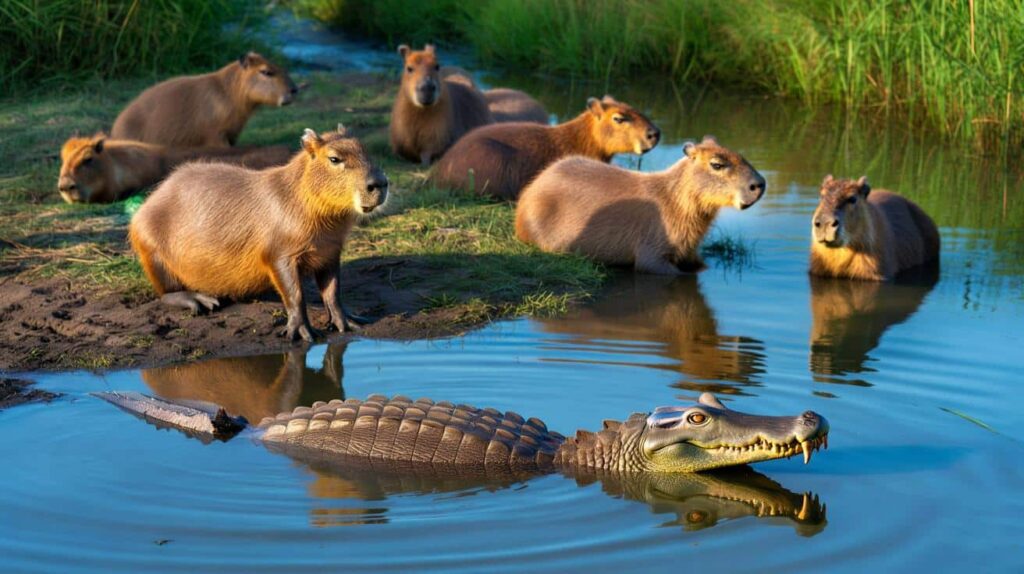
You tense up, waiting for the explosive lunge.
Nothing.
The capybaras shuffle closer, one even wades in, nearly brushing against the reptile’s snout. The predator blinks, twitches… and does absolutely nothing.
It feels like nature has skipped a line in its own script.
Something here is not what we think it is.
Crocodiles, Capybaras… and a Very Strange Peace Treaty
If you hang around the wetlands of the Pantanal or the Orinoco long enough, you’ll notice a pattern that looks almost like a glitch in the food chain.
Caiman — the South American cousins of crocodiles — bask in the sun a few meters away from giant, plump capybaras. Nobody panics, nobody runs, and nobody gets eaten.
From a distance, the capybaras look like walking snacks.
They’re slow, heavy, and not exactly ninjas in the water.
Yet the caimans lie there, prehistoric jaws locked shut, as if they’ve signed some invisible ceasefire with their furry neighbors.
One famous series of wildlife photos from the Venezuelan llanos shows a capybara literally sitting on a caiman’s back, eyes half closed, like it’s tanning on a living float.
Tour guides tell versions of the same story: tourists hold their breath, cameras ready for carnage, and end up filming… a nap.
Of course, predation does happen.
Biologists and ranchers report that young or sick capybaras can occasionally be taken by caiman or crocodiles when conditions line up.
But those viral moments of peaceful coexistence are not fake.
They’re daily life in many wetlands: dozens of capybaras sharing space with heavy-jawed reptiles that could easily crush their bones, and mostly don’t.
So what’s going on?
Part of the answer lies in energy math.
Capybaras are big, yes, but also wary, social, and surprisingly fast in water.
Catching one is risky and requires a lot of energy from a cold-blooded animal that survives by spending long stretches barely moving.
Fish, birds, smaller mammals, even carrion: those are easier calories for a caiman.
Predators are not bloodthirsty movie monsters.
They’re economists.
If chasing a capybara costs more than it brings in, the attack simply doesn’t happen.
Over thousands of years, that trade-off has shaped a kind of uneasy, pragmatic truce between the two species.
The Hidden Rules Behind “Why Crocodiles Don’t Eat Capybaras”
To understand this strange truce, it helps to picture the rules of the river like a quiet traffic code.
Capybaras move in groups, posting sentries that whistle loudly at the smallest sign of danger.
Those whistles matter.
They cut through the marsh like an alarm siren, instantly putting everyone on alert: the herd, the birds, even other potential predators who lose the advantage of surprise.
For a crocodile or caiman that depends on ambush, the whistling, splashing chaos of a fleeing capybara herd can turn a neat hunting opportunity into a messy, wasted effort.
Predators tend to stick with prey that doesn’t scream to the whole ecosystem when something goes wrong.
There’s also a question of timing and menu.
Caimans and crocodiles are opportunists. When water levels drop and fish are trapped in shrinking pools, the reptiles gorge on them like a free buffet.
Fish are easy, dense in calories, and don’t run off squealing to their friends.
During those fat seasons, capybaras become background actors, not targets.
The caiman’s energy budget is already full, and there’s no incentive to risk a chase, an injury, or a failed hunt on a bulky, social prey that sees pretty well both in and out of the water.
It’s like walking past a complicated three-course meal when you’ve already got a pile of hot fries in your hand.
There’s also a more subtle layer: landscape and escape routes.
Capybaras are semi-aquatic. They dive, hide in underwater vegetation, and can stay submerged for minutes with only nostrils poking out like tiny periscopes.
That shared element — water — puts them in the crocodile’s world but also gives them an exit.
When capybaras choose resting spots, they favor banks with quick access to deep water and clear visibility.
Every sunbathing session is planned like a potential evacuation drill.
So the cold reality is this: *the “peace” we see is built on a constant, low-level readiness to run or dive*.
The relationship looks relaxed on Instagram, but it’s held together by risk calculations on both sides.
What This Teaches Us About Predators, Prey… and Our Own Blind Spots
There’s a practical way to read this story: as a reminder that nature is full of invisible rules we only notice when we slow down enough.
If you were to sit by the same riverbank every day, you’d begin to see patterns.
Capybaras and caimans avoid peak conflict times.
They space themselves differently when young are present.
They change positions as light, temperature, and water levels shift.
That calm snapshot — crocodile here, capybara there — is the result of hundreds of micro-decisions, refined over millennia.
Once you start watching for them, the wetland stops being “peaceful” and becomes “precisely negotiated.”
We’ve all been there, that moment when you assume two things are destined to clash, and then… nothing happens.
Peace is awkward, uneasy, but very real.
Predator-prey relationships are like that too.
Caimans are not “friends” with capybaras. But they’re not mindless killers, either.
They are bound by hunger, risk, habitat, and habit.
When we project simple stories — “they don’t eat them because they’re cute” — we miss what’s actually fascinating: the complex, dynamic bargain that keeps both species alive.
Let’s be honest: nobody really thinks about energy budgets and risk ratios when they scroll past a viral animal video.
Yet that’s exactly what’s playing out in the background.
“People imagine wild animals as either savage or gentle,” a Brazilian field biologist once told me on a sticky afternoon in the Pantanal.
“But in the marsh, nothing is good or evil. Everything is just expensive or cheap.”
- Capybaras live in groups, which multiplies eyes and ears and lowers the chance that any one individual will be caught.
- Caimans and crocodiles are energy misers, evolving to minimize effort and injury, even if it means ignoring potential prey.
- Flood cycles, droughts, and human activity constantly shift the balance, sometimes making attacks more frequent, sometimes almost erasing them.
- Those seemingly “cute” interspecies moments are really snapshots of a long, tense negotiation, not a Disney friendship.
- Our urge to read moral lessons into nature often says more about us than about the animals we’re watching.
The Quiet Pact at the Water’s Edge
Once you see crocodiles and capybaras this way, it’s hard to unsee it elsewhere.
Foxes loitering near outdoor cats they rarely attack, sharks cruising through schools of fish that somehow disperse just in time, city pigeons walking between human feet with ridiculous confidence.
What looks like “bravery” or “kindness” is often a fluent calculation: risk, reward, energy, escape.
Caimans don’t “decide” to spare capybaras out of mercy.
Capybaras don’t “trust” them out of innocence.
They coexist because the current equation of landscape, water, prey, and danger makes coexistence cheaper than conflict — most of the time.
Next time a clip of a capybara perched happily beside a crocodile pops up on your phone, you’ll know there’s more going on behind the pixels.
Two ancient survival strategies are meeting at the water’s edge, testing each other, again and again, in silence.
The real story isn’t that the crocodile doesn’t eat the capybara.
It’s that both of them have learned exactly when they can afford not to.
| Key point | Detail | Value for the reader |
|---|---|---|
| Predators are energy economists | Crocodiles and caimans often skip capybaras because chasing them is risky and costly compared to easier prey like fish | Helps you see viral “animal friendships” as survival strategies, not fairy tales |
| Capybaras rely on group vigilance | Herd living, alarm whistles, and fast dives into water reduce the odds of successful attacks | Reframes “relaxed” behavior as carefully managed risk |
| Context shapes coexistence | Seasonal food abundance, water levels, and habitat changes alter how often attacks happen | Encourages a more nuanced view of wildlife and human impacts on ecosystems |
FAQ:
- Do crocodiles and caimans really never eat capybaras?
No. They do sometimes prey on capybaras, especially on young, sick, or isolated individuals. What surprises people is how often they choose not to attack, because the energy and risk don’t always pay off.- Are crocodiles “friends” with capybaras?
Not at all. There’s no friendship in the human sense. What you’re seeing is tolerance and coexistence shaped by ecology: plenty of other food options, group vigilance, and the high cost of a failed attack.- Why do capybaras seem so relaxed around such dangerous animals?
Capybaras are watchful, even if they look chilled. They stick close to water, rely on herd members to spot danger, and know they can dive or dash if needed. Their calm is a survival strategy, not naivety.- Could this behavior change over time?
Yes. If fish stocks collapse, water bodies shrink, or human pressure rises, crocodiles and caimans could turn more often to capybaras as prey. The current “truce” depends on conditions that are already shifting in some regions.- Is it safe for humans to get close when they see capybaras and crocodiles together?
No. Both animals can be dangerous in their own way, especially if stressed, cornered, or defending young. What looks calm from a distance can change in a second, and we’re not part of their invisible pact.