A 12-core Loongson 3B6000 CPU has surfaced in independent Linux testing, and the results paint a mixed picture: encouraging signs of architectural progress on one hand, and a stark performance gap with mainstream Western processors on the other.
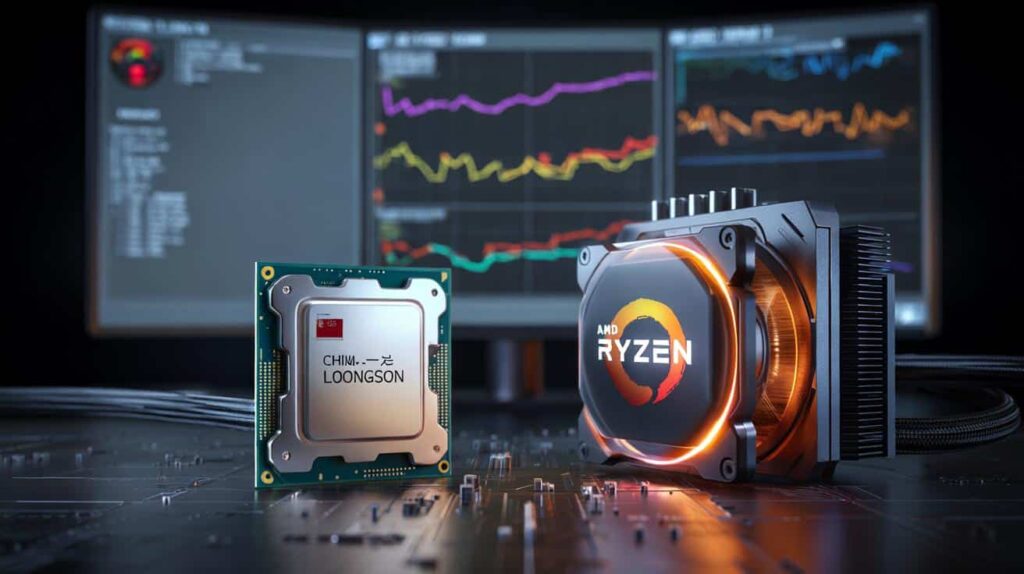
Loongson’s 12-core desktop experiment arrives in the wild
Loongson processors are usually confined to Chinese government systems, state-owned enterprises and specialised industrial kit. Spotting one in a regular enthusiast test bench is unusual.
In this case, the chip reached the Linux performance site Phoronix via the Loongson Hobbyists Community, a group dedicated to tinkering with the company’s hardware. The CPU came pre-installed on a micro-ATX evaluation board labeled 3B6000x1-7A2000x1-EVB.
The board itself is modest by gaming PC standards. It offers two DDR memory slots, a single M.2 connector, two PCIe x16-length slots, and only a small number of USB ports. The platform is clearly aimed at developers, not RGB-heavy showpiece rigs.
The 12-core Loongson 3B6000 landed on a test bench usually dominated by Ryzen and Core chips, providing a rare like-for-like comparison.
Benchmarks show a triple-gap versus Ryzen 5 9600X
Once the silicon left its usual domestic bubble, performance numbers landed quickly. Phoronix ran “dozens” of Linux benchmarks, including workloads with AVX-512 support, against a familiar set of x86 competitors from AMD and Intel.
Across the bulk of those tests, the Loongson 3B6000 fell far behind. When stacked against AMD’s six-core Ryzen 5 9600X, the Chinese chip delivered roughly one third of the performance on average, despite offering double the core count on paper.
In aggregate Linux workloads, the 12-core Loongson was about three times slower than AMD’s six-core Ryzen 5 9600X.
The only processor it reliably beat was a very different kind of chip: the quad‑core ARM-based SoC inside the Raspberry Pi 500. That comparison is more novelty than insight, but it does underline where the 3B6000 currently sits in the performance hierarchy.
Where the 3B6000 unexpectedly shines
The Loongson CPU did have some bright spots in specific workloads, suggesting the underlying architecture is not fundamentally weak.
- C-Ray 2.0: In this ray-tracing benchmark, the 3B6000 matched the Ryzen 5 9600X.
- OpenSSL 3.6: Encryption performance came close to Intel’s Core Ultra 5 245K.
- QuickSilver 20230818: The Loongson slightly edged out the Core Ultra 5 245K and landed in the same ballpark as the Core Ultra 9 285K.
Those cases appear to line up with workloads that either benefit from the chip’s specific instruction set extensions or scale nicely across many cores, even at low frequencies.
Clock speeds drag down a Zen 3-class design
On paper, the Loongson 3B6000 is not entirely out of date. It uses the LA664 core architecture, which Chinese sources claim offers instructions-per-clock (IPC) roughly comparable to AMD’s Zen 3 generation.
The problem lies in how many clocks the chip actually gets. The 3B6000 runs at just 2.5 GHz, while modern Intel and AMD desktop CPUs typically boost anywhere between 4.5 and 5.7 GHz.
A Zen 3-style core at 2.5 GHz is like a sports car stuck in second gear: capable design, but short on revs.
That low clock speed flattens any IPC advantage the LA664 cores might bring, leaving the chip struggling against far fewer but much faster cores in the Ryzen 5 9600X.
| CPU | Cores / threads | Approx. clock speed | Relative performance (Linux tests) |
|---|---|---|---|
| Loongson 3B6000 | 12 cores | 2.5 GHz | Baseline |
| AMD Ryzen 5 9600X | 6 cores / 12 threads | ~5 GHz boost | ≈ 3× faster on average |
| Raspberry Pi 500 SoC | 4 ARM cores | Lower | Slower than 3B6000 |
Thermals, process technology, and power delivery all likely contribute here. Loongson does not yet have access to the same cutting-edge manufacturing nodes used by TSMC or Intel Foundry, limiting both clock speeds and power efficiency.
What Loongson is planning next
Loongson is not standing still. The company is already working on a new CPU architecture called LA864, aimed directly at closing the gap with mainstream x86 chips.
Early information from Chinese sources suggests that LA864-based processors could roughly match Intel’s 13th and 14th Gen “Raptor Lake” Core CPUs in some workloads. Frequency targets sit in the 3.0 to 3.5 GHz range—still shy of the 5 GHz club, but a noticeable jump from the 3B6000’s 2.5 GHz ceiling.
Next-generation LA864 chips are targeting higher clocks and Raptor Lake‑class performance, signalling a more aggressive phase in China’s CPU ambitions.
If those claims hold up under independent testing, Loongson’s future desktop parts could move from “interesting curiosity” to “viable alternative” for a narrow set of users inside China.
Why these benchmarks matter beyond raw speed
On a global gaming PC leaderboard, the 3B6000’s results barely register. The chip is slower, less efficient, and far harder to buy than a basic Ryzen or Core processor. Yet the story takes on a different significance when viewed through the lens of geopolitics and supply chains.
China has been pushing for greater self-reliance in critical technologies, including CPUs, amid export controls and trade tensions. Loongson is one of the flagship projects in that push, building MIPS- and LoongArch-based designs that can slot into domestic PCs, servers, and embedded systems without relying on US-designed x86 cores.
The 3B6000’s performance gap shows that closing decades of CPU development within a largely separate ecosystem is a slow process. At the same time, its presence in independent Linux benchmarks signals growing confidence that the chips are ready for broader scrutiny.
How this translates to real-world use
For a typical home user in the UK or US, a Loongson 3B6000 system makes little sense. Software compatibility is limited, retail availability is tiny, and performance trails far cheaper x86 options.
Inside China, the picture shifts. A government workstation running office tools, web apps, and secure communication platforms might be perfectly serviceable on a 3B6000, especially if the software is compiled and tuned for LoongArch. The chip’s stronger showing in tasks like cryptography could also be appealing in security-focused deployments.
Developers working on cross-platform Linux software might use such hardware for porting and testing. For them, the question is less “is this the fastest CPU?” and more “can my codebase run reliably here?”
Key terms and context for non-specialists
A few concepts help make sense of why a 12-core chip can lose to a 6-core competitor:
- Instruction per clock (IPC): A rough measure of how much useful work a CPU can do each cycle. Higher IPC means more work at the same GHz.
- Clock speed (GHz): The “tempo” of the processor. Two chips with similar IPC but different clock speeds will see the faster one win most tests.
- Architecture: The internal design of the core. LA664 and LA864 are Loongson’s own designs, while Zen 3 and Raptor Lake are AMD and Intel’s.
- Instruction set: The language the CPU speaks. Loongson’s LoongArch is different from x86, so software often needs recompiling.
When performance headlines mention “three times slower,” they usually refer to a set of benchmarks, not every possible workload. Certain niches, like specific scientific codes or encryption tasks, can behave very differently, as the 3B6000’s isolated wins demonstrate.
For readers watching broader tech trends, Loongson’s results offer a useful mental model. Expect domestic Chinese CPUs to lag the gaming PCs on Western store shelves for some time, yet steadily close in for carefully chosen, government-backed workloads. The 3B6000 is not a rival to your Ryzen 5 today, but it is a signpost for where that competition wants to go next.