The first thing you notice is the sound. A low, sticky suction as a farmer in central Ukraine digs his boot heel into the earth and lifts. The soil rises almost like a slice of cake: thick, dark, astonishingly crumbly. He rubs the black grains between his fingers, and they stain his skin the way charcoal does. You can smell something faintly sweet and humid, as if a forest floor had been compressed into a single handful.
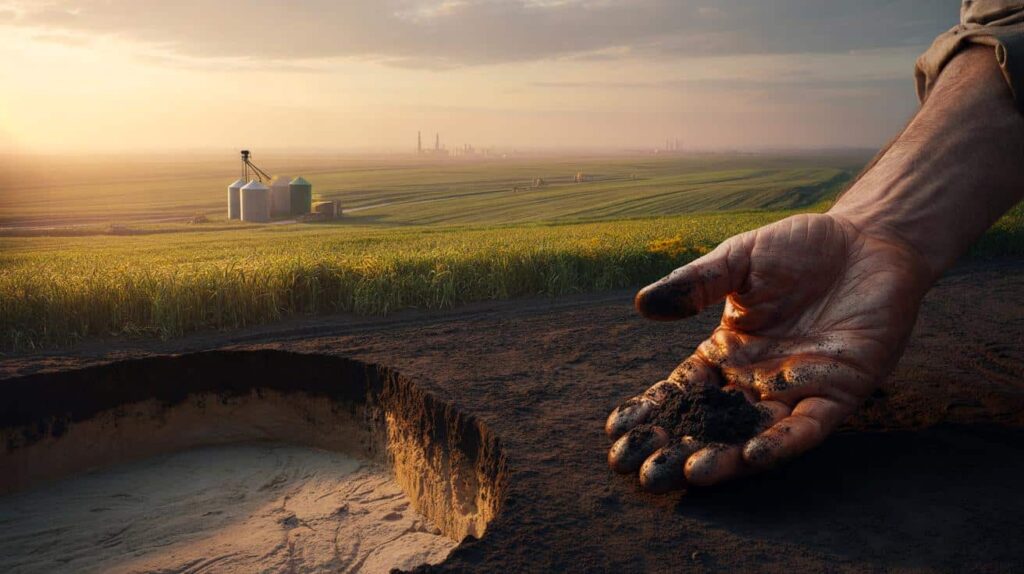
From the roadside, the field looks almost unreal. A horizon of black that seems to drink in the low autumn light, cut only by the pale stalks of harvested wheat. Somewhere in the distance, a combine harvester growls. Here, beneath this sky, lies the quiet power that shaped empires and now fuels geopolitical fears.
Locals have a simple name for it: black earth.
The world knows it as chernozem.
The “black gold” that feeds half a continent
On a map, the chernozem belt is just a shaded strip stretching across Ukraine, Russia and Kazakhstan. On the ground, it feels like standing on a vault. This soil can reach one meter deep, a continuous layer of chocolate-black earth rich in humus and nutrients. It formed over thousands of years under grasslands, as endless cycles of roots grew, died, and decomposed.
Farmers walk their fields with a kind of quiet awe. They know that in many places, just a few centimeters of topsoil are all a crop gets. Here, it’s as if nature gave them an overfilled pantry. One that still draws hungry eyes from far beyond the village.
Take central Ukraine, often called Europe’s breadbasket. A single hectare of chernozem can produce wheat yields that farmers in drier or sandier regions can only dream of. You hear stories of sunflowers taller than a person and wheat heads so heavy they bow in the wind.
During harvest, grain trains line up like a steel river at the edge of the fields. Silos fill, then overflow. The numbers are dizzying: before the war, Ukraine alone was feeding hundreds of millions of people worldwide with its exports of grain and oilseeds. Behind each cargo ship leaving the Black Sea is that same dark, sticky soil under someone’s boots.
The secret sits in the structure. Chernozem is packed with organic matter, sometimes up to 15% in the top layers, and full of tiny pores that hold both water and air. That means roots can breathe and drink even in dry spells. The black color absorbs sunlight, warming faster in spring and stretching the growing season.
This mix turns the region into a vast natural factory for biomass. Multiply that by thousands of square kilometers, spread across Ukraine, southern Russia and northern Kazakhstan, and you get one of the largest continuous fertile zones on Earth. No wonder agribusiness giants, governments, and investors all quietly track what happens here.
From breadbasket to battlefield: why this soil became strategic
Ask an older farmer near Kharkiv or Kursk what changed in his lifetime, and he might not talk first about tractors or yields. He’ll talk about borders. How the value of the land under his feet slowly shifted from local pride to global bargaining chip.
The grain that grows on chernozem doesn’t just supply nearby towns. It flows through Black Sea ports, railways, pipelines of logistics that link these black fields to bakeries in Cairo, markets in Lagos, and supermarkets in Paris. Food security ministries in distant capitals have spreadsheets tracking rainfall over Ukrainian steppe like others track oil prices. When this soil is threatened, so are food bills on the other side of the planet.
You could feel it in 2022 when missiles and tractors suddenly shared the same horizon in Ukraine. Fields were mined, harvests disrupted, grain silos hit. Satellite images showed burning crops. On paper, it was one more line in the daily news cycle. On the ground, it was farmers driving combines in bulletproof vests, trying to salvage what they could before the next strike.
Global wheat prices spiked. Countries dependent on Black Sea grain scrambled for alternatives. Talk of “food weaponization” surfaced at UN meetings. All of it traced back, in a way, to that one-meter-deep black layer that made these plains so vital. Soil had become a strategic asset, and not in a metaphorical sense.
Geopoliticians like to sum it up bluntly: control the breadbasket, and you hold leverage over those who eat its bread. Czarist Russia understood this when it pushed south into steppe lands. The Soviet Union turned these chernozem zones into collective farm powerhouses. Today, state companies and oligarchic agribusiness groups lease or own huge swaths of this dark earth.
The logic is simple and ruthless. A fertile hectare here can generate recurring export revenue year after year, without the finite limits of oil or gas wells. That’s why maps of chernozem often overlap with maps of strategic interest, investment, and tension. *You don’t need to be an expert to sense that when soil becomes power, peace becomes fragile.*
How you “manage” soil that almost seems too good to be true
Standing in a freshly plowed chernozem field, the instinct is to think: nothing can hurt this. You press your boot into it, watch it crumble softly, and assume it will always bounce back. Agronomists know better. Good soil is like a strong athlete; it can do wonders, but it still needs rest and care.
Farmers in the region increasingly talk about conservation tillage, cover crops, and smarter rotations. Not out of fashion, but from necessity. Plowing this black earth too deep, too often, speeds up the breakdown of organic matter. Letting fields lie bare for months invites erosion from wind and heavy rain. Rotation with legumes, roots, and oilseeds helps the soil keep its structure and nutrient balance. On such rich land, the “recipe” is not to push harder, but to work cleverly.
There’s a paradox that many local farmers confess quietly: the better the soil, the easier it is to abuse. When yields stay high even with lazy practices or heavy chemical use, bad habits can linger for years. Drain wetlands a bit too much, flatten hedges to widen fields, skip organic amendments because “the soil is good enough”.
We’ve all been there, that moment when abundance tricks you into thinking it’s endless. Then comes a dry year, or a series of brutal heatwaves, and the weaknesses appear. Cracks in the surface. Yields that drop faster than expected. Let’s be honest: nobody really does this every single day, walking the fields, testing shovel-fulls of soil, listening to agronomists’ warnings. That’s why so many specialists keep repeating the same slightly annoying message: treat chernozem like a treasure, not a machine.
“People think black soil is indestructible,” sighs Olena, an agronomist working between Poltava and Dnipro. “But it can be exhausted. It can be compacted by heavy machinery, washed away by sudden storms, poisoned by careless inputs. Its strength hides its fragility.”
- **Rotate wisely**: alternate cereals with legumes, oilseeds and forage crops to keep the soil biologically alive.
- Use **cover crops** between main harvests to protect the surface and feed the underground ecosystem.
- Limit deep plowing and heavy passes that **compact the soil** and break its natural structure.
- Add organic matter when possible: manure, compost, crop residues left on the field rather than burned.
- Preserve tree lines, shelterbelts and small wetlands that anchor the land and slow down erosion.
What black earth says about power, hunger and the future
Spend a day on the chernozem plains and you start to realize you’re not just looking at soil. You’re looking at one of the quiet engines of the global economy and a mirror for our priorities. This dark layer under Ukraine, Russia and Kazakhstan feeds bread lines, shapes trade balances, and nudges diplomatic conversations in rooms far from any tractor.
It also exposes a contradiction that’s hard to ignore. The world relies on a few key regions for its grain, yet those same regions sit on geopolitical fault lines. One drought, one war, one blocked shipping lane and the ripple hits the price of flour in a neighborhood bakery thousands of kilometers away. For all our talk of innovation, we still live at the mercy of a one-meter-thick band of earth.
There’s another, more personal question hiding in that black soil. How do we value what we don’t see? We praise yields, exports, and GDP, but the slow making of chernozem took centuries of grasses and roots, invisible microbes, patient climate cycles. We treat it as a resource; in reality, it’s a living community.
When young farmers here talk about the future, they often sound both proud and tired. Proud of working on what many call the best soil on Earth. Tired of feeling like they’re standing between global markets, local politics, and a climate spinning out of balance. Their fields are no longer just a local matter. They are a global question.
Next time you spread butter on a slice of bread or watch wheat sway in a video clip from some distant steppe, there’s a quiet story underneath. It’s the story of black earth that remembers mammoths and ancient grasses, yet is now run over by GPS-guided combines and tracked by satellites.
That story can go many ways. Maybe towards more care, more regional diversity in food production, fewer single points of failure. Maybe towards deeper extraction and sharper conflicts over who controls this “black gold of agriculture”. The one certainty is unsettling and strangely humbling: for all our technologies and strategies, a big part of our future still lies in a dark, crumbly layer of soil you can hold in your hand.
| Key point | Detail | Value for the reader |
|---|---|---|
| Why chernozem is unique | Deep (up to 1 m), humus-rich black soil across Ukraine, Russia and Kazakhstan | Helps understand why this region is a global breadbasket |
| Strategic and geopolitical role | High-yield grain exports tied to food security and international tensions | Connects soil health to food prices and political stability |
| How to protect such fertile land | Rotations, cover crops, reduced tillage, organic inputs, landscape features | Offers a practical lens for any reader interested in sustainable farming |
FAQ:
- Question 1What exactly is chernozem soil?Chernozem is a very dark, humus-rich soil that forms under grasslands. It has a deep, almost black top layer, high nutrient levels and excellent structure, making it one of the most fertile soil types in the world.
- Question 2Why are Ukraine, Russia and Kazakhstan so closely linked to chernozem?These three countries sit on the main “chernozem belt”, a vast zone of black earth stretching across the Eurasian steppe. That belt is the foundation for their huge grain and oilseed production.
- Question 3Is chernozem found anywhere outside Eastern Europe and Central Asia?Yes, but in smaller pockets. Parts of the Canadian Prairies, the American Midwest, and some areas in Argentina and China have soils that are classified as chernozem or very similar steppe soils.
- Question 4Can chernozem soil be destroyed or lost?It can be degraded, eroded or depleted. Heavy plowing, overuse of chemicals, compaction from machinery, and climate extremes can reduce its organic matter and structure, making it far less productive over time.
- Question 5What can ordinary consumers do about something that feels so far away?Support diversified, sustainable farming where you live, pay attention to where staple foods come from, and follow policies and debates on food security. The more spread out and resilient our food systems are, the less pressure falls on a few fragile breadbaskets.