Your shoulders notice before your mind does.
At 9:13 a.m., you’re already hunched over your screen, jaw tight, thumb bouncing between email and messages like a nervous metronome. Toast plate still on the desk, half-drunk coffee going cold, your brain quietly bracing for impact from a day that hasn’t really started yet.
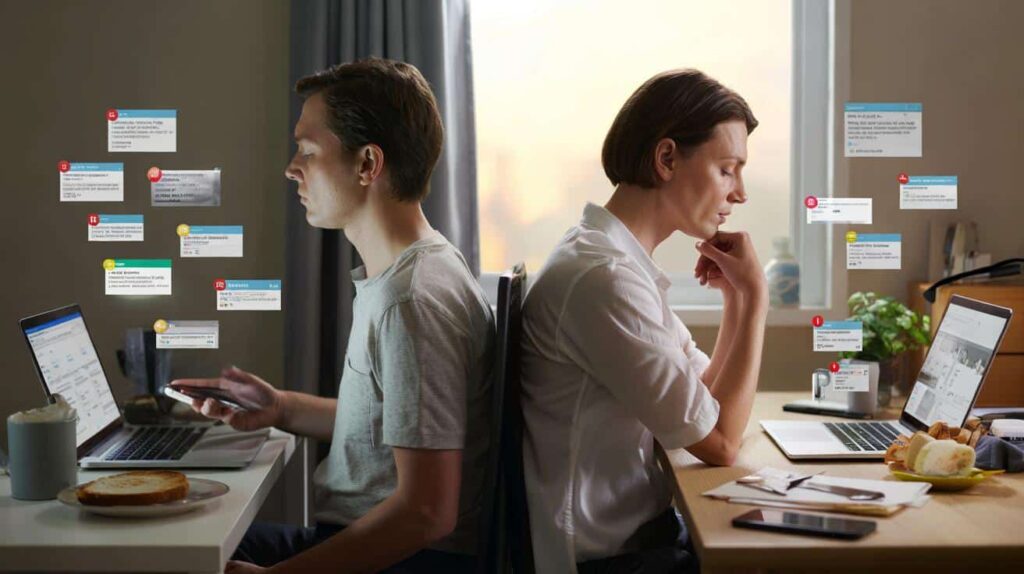
By lunchtime, your neck is stiff, your breathing shallow. Not because anything truly awful happened, but because every little thing asked for a tiny piece of you. Notification by notification, sigh by sigh.
You lie in bed at night and think, “Why did such a normal day feel like a battle?”

There’s a different way to move through the same day.
It starts with noticing where the tension really lives.
The silent tension tax of an ordinary day
Most days don’t explode, they drip.
The tension isn’t usually one giant drama, it’s twenty-seven micro-moments that stack up on top of each other. The email that comes in with “Quick question” in the subject line, the colleague who types “Can we talk?”, the family group chat pinging while you’re already on a call.
Your body reacts first.
Your shoulders lift a few millimeters. Your stomach tightens. Your jaw clenches so quietly you don’t even register it. By 4 p.m., you’re not just tired, you’re braced.
That bracing becomes your default setting.
And you start calling it “my personality” when it’s mostly just habit.
Picture this.
You wake up a little late, skip breakfast, scroll the news, feel your heart race at three catastrophic headlines before you’ve even brushed your teeth. On your commute, a driver cuts you off; your body jolts into fight-or-flight while your face stays calm.
At work, someone asks for something “ASAP.” You say yes, because you always do. Then a friend texts, “Got a minute?” with no context. Your brain fills in the worst-case scenario. Your shoulders inch higher.
By early afternoon, a minor tech glitch pushes you over the edge. You snap at someone you like. Later, you tell yourself you’re just “stressed lately.”
But the truth is, your nervous system has been nudged all day long, and there was no exit ramp.
Your brain is wired to scan for threat, and modern life delivers threat-shaped pings all day without any resolution. Lion in the bushes, except the lion is Slack, bills, calendar reminders, unfinished conversations, unread DMs.
Each small uncertainty triggers a micro-dose of stress chemistry.
You almost never get the follow-up signal that says, “You’re safe now, we can relax.” So your body holds the tension, as if tension itself is a kind of armor.
Over time, that becomes your baseline.
You forget what “normal” feels like and start believing that always-on tightness is just adulthood.
Small physical shifts that quietly reset your day
One quiet way to move through the day with less tension is to treat your body like a tuning fork.
Start with the simplest pattern interrupt: the “90-second reset.” Every time you switch tasks, you pause for 90 seconds and do three things: exhale longer than you inhale, drop your shoulders, unclench your tongue from the roof of your mouth.
It sounds almost silly.
Yet those are three of the fastest ways to tell your nervous system, “You’re not under attack.” You can do it before opening your inbox, when your phone rings, while the kettle boils. No meditation cushion required.
You’re not trying to become calm-on-demand.
You’re offering your body tiny exits from the stress loop, several times a day.
Take Maya, 36, project manager, two kids, perpetually “fine.”
By 10 a.m. most days, she felt wired and weary at the same time. She thought she needed a vacation. What she actually needed was five strategic pauses.
For one week, she tried this:
Every time she walked through a doorway, she let her arms hang heavy for one breath and softened her face. Before joining a meeting, she took three slow exhales, letting the out-breath be a beat longer than the in-breath. At red lights, she wiggled her toes inside her shoes, just enough to come back into her body.

Nothing else about her week changed.
Same meetings, same deadlines, same family chaos. But she ended Friday saying, “I’m tired, but not cooked.” That’s a different kind of tired.
There’s a basic logic to these micro-gestures.
Your nervous system listens less to your thoughts and more to your posture, breath, and muscle tone. Hunched, shallow breathing and tight jaws whisper “danger” all day long. Open chest, slower exhale, softer face quietly say “we’re okay enough.”
You don’t have to feel calm to behave in a calmer way.
The behavior often leads, and the feeling lags behind. That’s why stretching your hands, rolling your neck, or standing up for 30 seconds between tasks changes your inner weather more than reading ten motivational quotes.
Let’s be honest: nobody really does this every single day.
You’ll forget, then remember, then forget again. That’s fine. Each time you remember is one less hour your body spends stuck in emergency mode.
The mental habits that keep you braced (and how to loosen them)
Beyond the body, there’s a mental move that changes everything: downgrade the stakes.
When a new demand pops up, instead of silently labeling it “urgent” or “disaster if I mess this up,” try asking, “What’s the real consequence here, on a scale from 1 to 10?”
Half the time, the honest answer is about a 3.
You still care, you still show up, but your nervous system doesn’t need to act like the building is on fire. This tiny question shrinks imaginary emergencies back to realistic size.
You can even jot the number in a notebook.
It turns a vague sense of doom into something measurable, and measurables feel more manageable.
One common tension trap is the “everything is my responsibility” script.
A colleague drops a ball, and you bend yourself into a knot to quietly fix it. A family member is upset, and you carry the emotional load as if it were yours alone. That invisible over-responsibility is exhausting, and it often goes unspoken.
Try this experiment for one day.
Before saying yes, ask yourself, “What is truly mine to carry here, and what isn’t?” Maybe you help, but you don’t cover for. Maybe you listen, but you don’t absorb. That small inner boundary can soften the pressure on your chest.
We’ve all been there, that moment when you’re doing three people’s jobs and wondering why you can’t breathe.
Sometimes the tension isn’t from what’s happening, but from how much of it you assume you must personally hold.
*“I didn’t realize how much tension I was dragging around until I stopped treating every request like a test of my worth.”*
- Micro-boundary check-in: Once in the morning and once in the afternoon, pause and ask, “What can wait, what can be smaller, what can I hand back?”
- Rename the moment: Instead of “This is a disaster,” try “This is a solvable problem” or “This is annoying, not catastrophic.” Your body hears the downgrade.
- Five-sentence worries: When your mind spirals, write down in five sentences what you’re afraid of, what you can actually do today, and what is out of your control. Then stop. That’s your deal with your own brain.
These are not magic tricks.
They are tiny levers. And tiny levers, used repeatedly, make a surprisingly big dent in the weight of a day.
Living a less tense day in a still-tense world
Some days will still be rough.
The world doesn’t reorganize itself around your nervous system just because you’ve decided to breathe more deeply and say fewer automatic yeses. The emails keep coming, the news keeps shouting, people still need things from you.
What can shift is the way you move through all of that.
Instead of sprinting from alarm to alarm, you can start to walk. Not all the time, not perfectly, but often enough that your body remembers another rhythm. Often enough that a tense morning doesn’t automatically mean a ruined day.
A less tense day isn’t a spa fantasy.
It’s you, same life, same responsibilities, with a bit more space between the moments. A little more room around your thoughts. A little less armor in your shoulders.
Maybe tonight, before bed, you replay your day and ask just one question:
Where did I feel myself soften, even for a second? That’s your map. You can follow it again tomorrow.
| Key point | Detail | Value for the reader |
|---|---|---|
| Micro physical resets | 90-second pauses with longer exhales, relaxed shoulders, and unclenched jaw between tasks | Offers quick, realistic ways to calm the body without needing extra time or special tools |
| Downgrading the stakes | Rating problems from 1 to 10 and renaming “disasters” as solvable issues | Reduces unnecessary stress responses and keeps minor problems from feeling overwhelming |
| Healthy mental boundaries | Asking what’s truly yours to carry and setting micro-boundaries around responsibility | Lightens emotional load and prevents the chronic tension of over-responsibility |
FAQ:
- How do I notice tension sooner during the day?Pick one “anchor” sensation to check three times daily: jaw, shoulders, or breath. When you remember to check, that’s already progress, even if you only relax for one breath.
- What if my job is genuinely stressful, not just in my head?You can’t remove every stressor, but you can reduce the constant emergency signal in your body. Micro-breaks, clearer boundaries, and shorter to-do lists still help, even in demanding roles.
- Do I need to meditate to feel less tense?No. Meditation helps some people, but walking slower, breathing differently, and saying one less automatic “yes” can also shift your baseline tension in very real ways.
- How long until these small changes actually make a difference?Many people notice small shifts within a few days if they practice one or two tools regularly. Deeper changes to your default tension level usually show up over a few weeks.
- What if I forget and only remember when I’m already overwhelmed?Start right there, in the middle of the overwhelm. One slower exhale, one softened shoulder, one honest thought like “This is hard, and I’m still here” can interrupt the spiral. You don’t have to catch it early to benefit.