I was standing in the hallway holding a full laundry basket, staring at a pair of shoes abandoned right in the middle of the floor. Dinner dishes were still on the table. A damp towel rested on the back of a chair like modern art. The house wasn’t filthy, just… constantly messy.
I felt like I spent my life doing laps: pick up, wipe down, sort, repeat. If I skipped a day, the place seemed to explode. I blamed myself for not having enough discipline, then blamed everyone else for not helping more.
One evening, out of frustration, I stopped and asked a different question: “What if the problem isn’t us, but the way the house is organized?”

That question changed everything in a surprisingly small way.
The tiny shift that stopped my house from boomeranging back into chaos
The breakthrough wasn’t a new cleaning schedule or a miracle product. It was this: I stopped organizing by room and started organizing by activity.
Instead of thinking “living room, kitchen, bathroom”, I thought “coffee zone, drop zone, snack zone, mail zone, laundry launch pad”. Every repetitive, annoying type of mess got its own tiny, obvious landing place.
Sounds abstract, but the effect was painfully concrete. Things finally had a place to “live” that matched where we actually used them, not where a Pinterest board said they should go.
The cleaning workload didn’t disappear. It just stopped multiplying behind my back.
Here’s one small example. Our kitchen counter used to be a magnet for random objects: keys, mail, sunglasses, chargers, Lego pieces, receipts. I’d clear it three times a day, and it still looked like a lost-and-found desk.
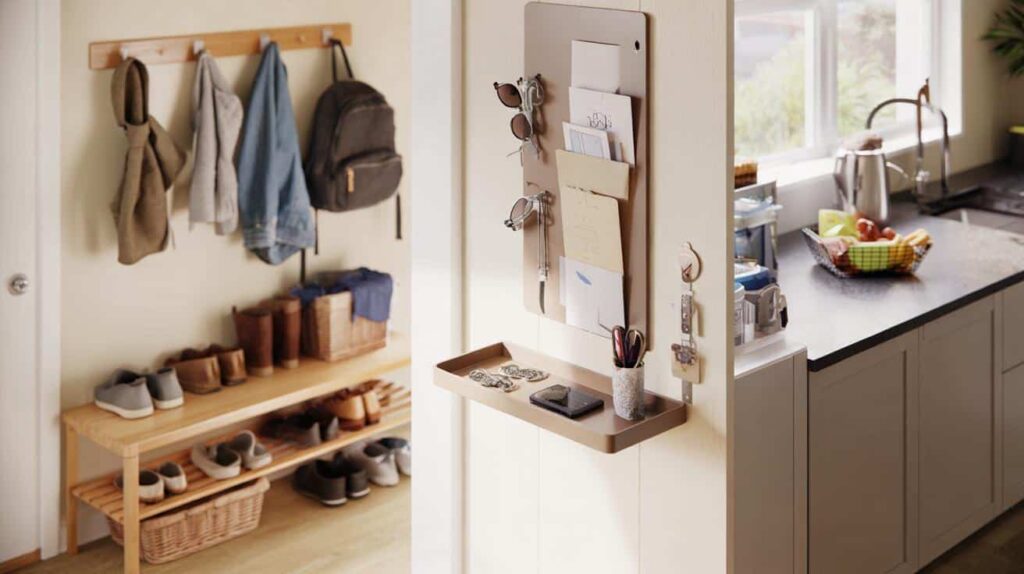
So I created a literal “Drop Zone” right by the door: one shallow tray for keys and sunglasses, a vertical letter sorter for mail, a small cup for coins and mystery screws. I moved the phone chargers to a single charging station near the same spot.
Within a week, my counters stayed 80% clearer without me nagging or bending over every hour. People still dropped things everywhere, but suddenly “everywhere” was confined to a 40×40 cm area I could reset in 30 seconds.
The logic behind it is simple. Our brains are lazy and love the path of least resistance. If the place where you use something is even a few steps away from where it “belongs”, it’s going to end up on the nearest flat surface.
By organizing by activity, you build mini-stations where mess normally appears: coffee things near the kettle, lunch boxes right above the prep counter, homework supplies next to the table where homework actually happens.
The cleaning workload shrinks because you’re no longer fighting against reality. You’re designing for it. *Housework starts to feel less like constant correction and more like a series of short, predictable resets.*
From “cleaning all the time” to “resetting zones”
The practical method is simple enough to test in an afternoon. Walk through your home and, instead of seeing rooms, name the activities you actually do in each area. Not the idealized ones. The real, messy, weekday ones.

Morning rush spot. Work-bag dump spot. Snack-making corner. Makeup mirror. Dog-walking prep corner.
Then, for each activity, build a micro-station. One basket. One tray. One shelf. One hook. Keep the tools and objects you use for that activity right there, within one arm’s reach. Nothing fancy. Just literal proximity.
You’re not “making it pretty”. You’re shortening the distance between “use it” and “put it back”.
Take the entryway. Ours used to be a battlefield: shoes in a pile, backpacks slumped against the wall, jackets drifting over chairs. I would spend 10 minutes every night dragging everything back into closets.
So I created three micro-stations: a shoe bench with baskets underneath, one hook per person for bags, and a narrow shelf with two little bins: one labeled “Outgoing” (forms, parcels, returns) and one “Random”. The random bin is where things go when I don’t know what they are yet.
Now, when someone comes in, they naturally dump everything within a one-square-meter zone. I still tidy, but it’s a one-stop reset, not a house-wide scavenger hunt. Let’s be honest: nobody really does this every single day, but even on lazy weeks, the chaos doesn’t spread as far.
The real magic is that these zones quietly train everyone in the house. **You’re not giving abstract rules, you’re putting the easy option right in front of them.** A hook is easier than opening a wardrobe. A basket is easier than walking down the hallway.
Over time, you stop thinking “I need to clean” and start thinking “I’ll just reset the living room zone”. Psychologically, that feels smaller. Faster. Doable.
“Once I stopped organizing my house like a catalog and started organizing it like we actually live, the mess stayed the same… but the effort to deal with it was cut in half.”
- Give every repetitive mess its own zone
- Keep all tools for that activity within arm’s reach
- Use trays, baskets, and hooks more than closed boxes
- Design around lazy habits, not ideal behavior
- Think “reset this zone”, not “clean the whole room”
Why this feels lighter than traditional “cleaning routines”
Cleaning checklists are great on paper, but life rarely follows a checklist. You’re tired, dinner’s late, something urgent pops up, and the whole “nightly reset” collapses. Then the guilt creeps in.
Organizing by activity doesn’t depend on perfect discipline. It leans on friction, or rather the lack of it. If the dishwasher tablets live right next to the dishwasher, loading it at night takes seconds less effort. Do that tiny saving every day, and your brain stops resisting the task.
**You’re not becoming a different person. You’re shaving off just enough resistance that maintenance fits into real life.** The house doesn’t become a showroom. It becomes easier to live in.
| Key point | Detail | Value for the reader |
|---|---|---|
| Organize by activity, not by room | Create micro-stations where mess naturally appears: drop zone, snack zone, homework zone | Reduces daily picking-up by keeping clutter confined and predictable |
| Design for lazy habits | Place hooks, baskets, and trays exactly where people already dump things | Makes tidying almost automatic, with less nagging and less effort |
| Think “reset”, not “deep clean” | Focus on quick zone resets instead of full-room perfection | Lowers mental load and keeps the home consistently “good enough” |
FAQ:
- Question 1How do I start if my house already feels like a disaster?
- Answer 1Begin with just one zone: usually the entryway or the kitchen counter. Create a clear drop zone with a tray, a hook, and a small container for random items. Don’t try to fix the whole house at once; prove to yourself that one zone can stay under control, then copy-paste the idea elsewhere.
- Question 2What if my family doesn’t follow the new system?
- Answer 2Expect resistance at first. People are used to their own habits. Instead of lectures, quietly place the easiest option exactly where they already dump things. Over time, most people follow the path of least resistance, especially if you praise the times it works rather than scolding when it doesn’t.
- Question 3Do I need to buy special organizers?
- Answer 3No. Start with what you have: old shoeboxes, trays, bowls, baskets, even sturdy paper bags. Once you see which zones actually work and stick, you can upgrade to nicer containers if you want. The system matters more than the aesthetic.
- Question 4How many zones should I create?
- Answer 4Keep it simple. Focus on the 5–7 messes that annoy you the most: entryway clutter, dishes, paperwork, laundry piles, toys, bathroom products, cords and chargers. One clear micro-station per recurring mess is usually enough to feel a big difference.
- Question 5Will this replace deep cleaning completely?
- Answer 5No, you’ll still need to do deeper tasks like scrubbing, vacuuming, and washing floors. The point is that your daily maintenance shrinks, and mess doesn’t spread as far. Deep cleaning becomes occasional fine-tuning, not emergency damage control.