The first sign wasn’t a panic attack or a dramatic breakdown.
It was a Tuesday afternoon, the kind that feels like a photocopy of every other Tuesday, when Lena caught herself typing “Sorry for bothering you” at the start of an email she had every right to send.
She paused, deleted “bothering,” then put it back. Her fingers moved faster than her mind.
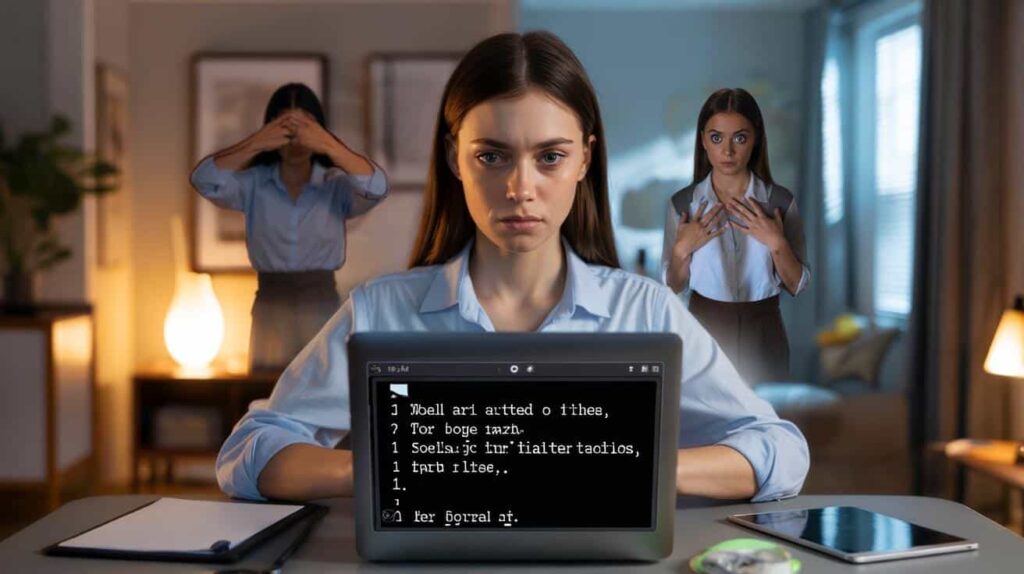
No tears, no visible anxiety, no big emotional scene.
Just a tiny automatic gesture of self-erasure, the kind of thing she’d done for years without even noticing.
On the outside, everything looked normal.
Inside, something quieter was shaping her day, her relationships, her sense of worth.
Not pain.
Habit.
And that’s the tricky part.

Why emotional pain screams while emotional habits whisper
When we’re really hurting, we usually feel it in our bodies.
A tight chest, racing thoughts, sleepless nights, tears that show up without asking permission.
Emotional pain is noisy. It interrupts. It demands attention.
Emotional habits don’t.
They blend in with our routines: the way we apologize too much, shut down in arguments, or joke instead of saying we’re hurt.
These reactions feel like “just how I am,” so we rarely question them.
Psychologists often say that pain motivates change.
Emotional habits, on the other hand, quietly protect the status quo.
That’s why they’re harder to spot.
Take Sam, 34, a project manager who swore he had “no real problems.”
He had a stable job, a few close friends, a gym membership he used sometimes.
When he finally landed in therapy, it wasn’t because of a big breakdown.
It was because his partner had said, for the third time in a year, “I never really feel like you’re here with me.”
Sam didn’t feel depressed.
He just had a reflex: every time a conversation got emotional, he changed the subject, made a joke, or went into practical-fix mode.
No yelling, no tears, no cold silence.
Just a well-practiced habit of emotional dodging that slowly starved his relationship.
On paper, he was “fine.”
In practice, he was running on autopilot.
From a psychological point of view, emotional habits are built the same way as any other pattern.
Cue, response, relief.
Your brain learns, “When I feel this, I do that, and I survive the moment.”
As children, those habits often kept us safe.
Maybe you learned to stay quiet when adults were tense.
Maybe you became the helpful one, the funny one, the easy one, just to keep the peace.
Over time, these moves stop feeling like choices and start feeling like personality.
That’s the trap.
What once was a smart survival strategy becomes an invisible script running in the background of your life.
*You can’t change a pattern you can’t see.*
Spotting emotional habits hiding in plain sight
One simple starting point psychologists use: follow the “always” and “never” in your daily life.
“I always end up fixing everyone’s problems.”
“I never say what I really want.”
These words usually point to a script rather than a decision.
If you notice you respond the same way across different people and situations, you’re probably not reacting to the present moment.
You’re playing an old role.
Try this for a week.
Pick one area: work, family, or romantic life.
At the end of each day, jot down a few quick notes about moments when you felt even slightly uncomfortable.
Then ask, gently: “What did I do automatically?”

Many people expect emotional awareness to show up as big insights or sudden clarity.
In reality, it’s often boring, repetitive, and a little annoying.
You’ll notice you laughed off a hurtful comment.
You downplayed your own success.
You said “I’m fine” when you absolutely weren’t.
Let’s be honest: nobody really does this every single day.
You’ll forget, get tired, or feel silly writing it down.
That’s okay.
What matters is starting to see the small, repeated moves.
Because emotional habits leave fingerprints: the same tension in your shoulders, the same regret after a conversation, the same feeling of being slightly off with yourself.
Once you’ve seen the pattern enough times, you can’t fully unsee it.
That’s when change slowly becomes an option.
“People often come to therapy because of emotional pain,” explains Dr. Elena Ruiz, a clinical psychologist.
“They stay because they start to notice their emotional habits.
That’s where the real work—and the real freedom—usually begins.”
- Notice your “go-to” reaction
Do you shut down, please others, over-explain, or go into advice-giving mode when things get tense? - Track the cost over time
Ask yourself: if I keep doing this for the next five years, what happens to my relationships, my work, my sense of self? - Look for body clues
Jaw clenching, shallow breathing, fidgeting, scrolling without thinking—your body often spots the habit before your mind does. - Ask one safe person
Gently say: “When I’m stressed, what do you notice I always do?”
Their answer can reveal hidden patterns you’ve normalized. - Practice tiny experiments
Say one honest sentence where you’d usually stay quiet.
Wait two more seconds before apologizing.
Small shifts expose big habits.
Turning awareness into a new emotional language
There’s no quick hack to delete emotional habits.
They’re built over years, sometimes decades, and your nervous system treats them like old, trusted friends.
The aim isn’t to attack them but to get curious.
Psychologists often invite people to ask three questions in charged moments:
“What am I feeling?”
“What am I about to do automatically?”
“Is this response from today, or from a much older story?”
You won’t catch it every time.
Some days you’ll only notice after the fact, replaying the conversation in your head on the train home.
Yet this “late” awareness still counts.
It slowly rewires the way you relate to yourself.
We’ve all been there, that moment when you walk away from a situation thinking, “Why did I default to that reaction again?”
Maybe you over-explained at work instead of stating your idea confidently.
Maybe you brushed off a friend’s concern with a joke, then felt oddly lonely later.
A gentle step is to name the habit without shaming it.
“This is my ‘keep the peace at all costs’ move.”
“This is my ‘don’t need anyone’ mask.”
By naming it, you stand next to the pattern instead of inside it.
People often think healing is about never feeling emotional pain again.
Psychology suggests something quieter and deeper: building a life where your emotional habits are conscious, flexible, and chosen, not just inherited.
The next time you feel “fine,” that neutral, flat, going-through-the-motions kind of fine, you might pause for a second.
Not to dig for trauma or dramatize your day, but to listen for the small, familiar moves you repeat without thinking.
Maybe your emotional habits are protecting you from conflict.
Maybe they’re protecting you from intimacy.
Maybe they’re keeping you productive, praised, and a little bit lonely.
You don’t need to diagnose yourself or fix everything at once.
Just begin to notice what you always do, when you feel just a little off, and what part of you those moves were designed to protect.
Sometimes the most life-changing emotional work doesn’t start with a crisis.
It starts with a quiet question:
“What if this isn’t just my personality, but a habit I’m allowed to change?”
| Key point | Detail | Value for the reader |
|---|---|---|
| Emotional pain is loud | It shows up as obvious distress, conflict, or physical symptoms that disrupt daily life | Helps you recognize when you actually need support, rest, or professional help |
| Emotional habits are subtle | They appear as repeated, automatic reactions that feel like “just how I am” | Encourages you to question old scripts and notice patterns you can change |
| Small awareness creates leverage | Tracking reactions, body signals, and “always/never” statements reveals hidden patterns | Gives you concrete ways to build healthier, more conscious emotional responses |
FAQ:
- Question 1How do I know if something is an emotional habit or a real personality trait?
Look at flexibility. If you can sometimes act differently when you feel safe or supported, it’s likely a habit, not your core personality. Traits feel like preferences; habits feel like reflexes.- Question 2Can emotional habits be changed without therapy?
Yes, especially when you start observing them regularly and experimenting with small new responses. That said, therapy can speed up the process and offer a safer space to explore deeper roots.- Question 3Why do my emotional habits get worse with certain people?
Some relationships activate older emotional scripts—family patterns, past relationships, authority figures. Your nervous system recognizes a “type” of situation and replays an old response.- Question 4Is ignoring my feelings always a bad emotional habit?
Not always. Short-term, it can help you get through crises or demanding tasks. The problem comes when it’s your only strategy and you never return to listen to what you feel.- Question 5What’s one small thing I can start doing today?
Once a day, after a tricky interaction, ask: “What did I feel?” and “What did I do automatically?”
Write down a single sentence answer. Over time, those sentences will draw a clear map of your emotional habits.