Shutting vents in empty rooms feels like an easy winter hack, but that simple twist of a grille can backfire fast.
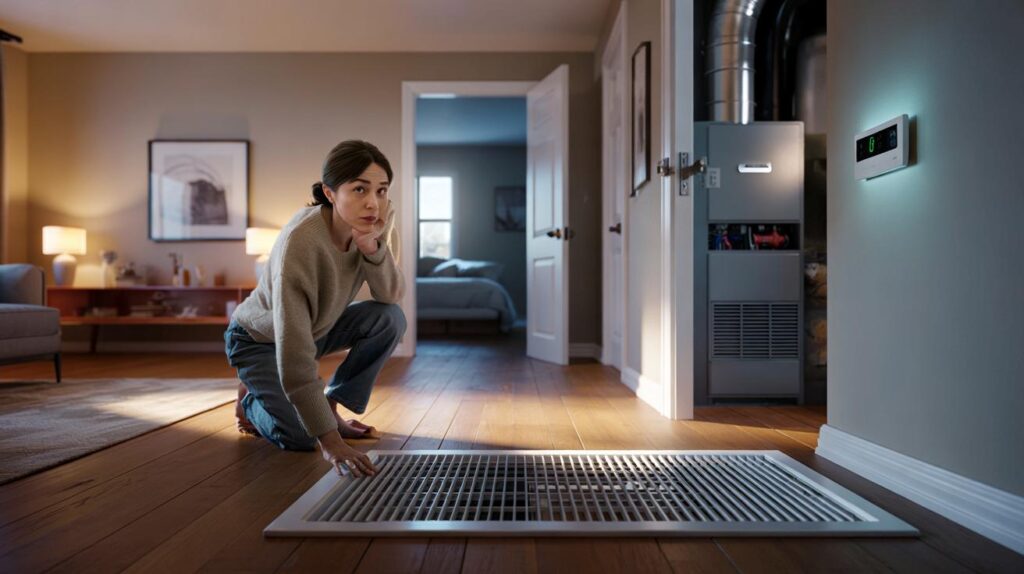
Many households try it each year, hoping to cut heating costs and funnel warmth only where people actually live. Heating engineers, though, say this quick fix misunderstands how modern systems move air, and may quietly push your furnace or heat pump towards breakdown.
Why so many people still close vents
The logic sounds straightforward. If you close supply vents in spare bedrooms, guest rooms, or a rarely used office, the system has fewer spaces to heat. Less space, less energy, smaller bill. Right?

That idea made more sense in older homes with basic, oversized systems and leaky windows. Today’s central heating is usually designed around a calculated airflow for the entire property. Shut down part of that system and the carefully balanced pressures inside the ductwork start to shift.
Closing vents in standard modern systems does not reduce how much heat the equipment produces; it mainly reshapes where pressure builds up.
Instead of asking your boiler or furnace to do less, you might simply be making its job harder.
What actually happens inside your ducts
Think of your ductwork as a road network. Every vent is a junction where air turns off the main route and spills into a room. When you close a vent, you are not telling the heating system to slow down. You are just throwing up a roadblock.
The fan in your furnace or air handler runs at a speed designed for a certain volume of air. When vents are closed:
- Air pressure in the ducts rises.
- The fan pushes against more resistance.
- Air looks for weak spots in the system, such as joints and seams, and can leak out.
- Some rooms become hotter, others cooler, and comfort levels shift unpredictably.
That increased back pressure forces the blower motor to work harder. Over time, this can wear out bearings, belts, and motors. In some homes, restricted airflow can even cause the heat exchanger to overheat and shut the system down on safety controls.
Does closing vents actually save energy?
For most modern forced-air systems, the short answer is no.
The heating equipment still fires as usual, based on the thermostat reading in the main living area. The boiler or furnace does not “know” that some vents are closed. It simply continues producing heat until the thermostat says the target temperature has been reached.
At best, your savings are negligible. At worst, the system cycles erratically as hot and cold spots form, and you end up running the heating longer to make the main rooms feel comfortable.
How HVAC pros look at the numbers
Engineers design ducts and select fans to move a certain cubic feet per minute (CFM) of air. That figure is tied to efficiency and safety. Reduce the number of outlets without rebalancing the system and that design falls apart.
| Action | Effect on airflow | Likely impact on bills |
|---|---|---|
| Closing one or two vents | Small increase in pressure, minor imbalance | Little to no measurable saving |
| Closing several vents in unused rooms | Notable back pressure, hotter ducts, more leaks | Potentially higher costs and more wear on equipment |
| Leaving vents open, improving insulation | Stable airflow, consistent temperatures | Steadier comfort with genuine long-term savings |
The key message from technicians: if your system was not designed to be zoned, closing vents is closer to sabotage than to strategy.
When closing vents does make sense: true zoning systems
There is one big exception. Some homes are built or upgraded with zoning. In these systems, the ductwork contains motorized dampers controlled by separate thermostats in different zones of the house.
Here, individual areas can call for heat or stand down independently. The system knows when a damper has closed and adjusts fan speed and heat output accordingly. This is very different from you manually flipping a grille in the spare room.
Unless a professional has designed your heating as a zoned system, treat all vents as part of a single, connected circuit that needs to stay open.
If you are unsure whether your home has zoning, look for:
- Two or more wall thermostats controlling the same heating system.
- Visible motorized dampers on ducts near the furnace or air handler.
- A control panel labelled with “zone” numbers or names.
No signs of these? Assume manual vent closing is off the table as an energy tactic.
Better ways to stay warm and cut the bill
The experts tend to agree: leave the vents open and focus your effort where it pays off more quickly. Several straightforward changes can trim winter costs without stressing your boiler or furnace.

Smarter temperature control
Smart and programmable thermostats make a noticeable difference. They automatically lower the set point at night or when the house is empty, then raise it before you return or wake up.
Heating engineers often suggest dropping the temperature by around 7–10°F for eight hours a day. Over a year, many households see close to a 10% reduction in heating spend with little sacrifice in comfort.
Hold onto the heat you already paid for
Before trying tricks with vents, look at the shell of your home. Heat usually escapes through the roof, walls, and gaps around openings, not just through vents.
- Add or top up insulation in lofts, crawl spaces, and exterior walls.
- Seal gaps around window frames, door thresholds, and pipe penetrations.
- Use thick curtains at night, especially on older single-glazed windows.
These measures reduce the workload on your heating system at all times, regardless of how many rooms you happen to be using.
Keep air flowing cleanly
A simple but often forgotten task: change the air filter on schedule. Most filters should be replaced every 30–90 days. Homes with pets, smokers, or renovation dust may need more frequent changes.
A clogged filter chokes airflow just as much as a closed vent. The result is the same: the fan strains, efficiency falls, and some rooms never feel quite right.
Use humidity to your advantage
Moist air feels warmer than dry air at the same temperature. Running a humidifier during winter can let you set the thermostat slightly lower while feeling just as cosy.
Warmer-feeling air at a lower thermostat setting is one of the simplest ways to reduce running costs without sacrificing comfort.
Just keep humidity in a reasonable range, commonly around 30–50%, to avoid condensation on windows and mould problems.
What can go wrong when vents stay shut
Closing vents rarely causes instant drama. The trouble tends to build slowly. Over one or two winters, you may see some of the following:
- Hot or cold spots that never quite go away.
- Short cycling, where the system starts and stops more often than usual.
- Higher noise from whistling vents or straining duct joints.
- Unexpected repair bills for motors, control boards, or even cracked heat exchangers in worst cases.
Homes with older ductwork are particularly vulnerable. Extra pressure can push warm air through seams and gaps, heating loft spaces and wall cavities instead of your living room.
Thinking about closing off a room? Better options
If you have a guest room or box room that genuinely sees little use, there are still ways to reduce its heating demand without upsetting the whole system.
- Keep the door mostly closed, but leave the vent open, so the room still receives some air circulation.
- Use a lower target temperature on a separate electric radiator only when guests arrive, rather than trying to starve the room of central heating.
- Improve insulation and draught-proofing in that room specifically, so it requires less energy to keep at a background temperature.
In large homes with significant “dead space”, a professional evaluation can be worthwhile. An HVAC engineer may recommend adding proper zoning, installing a variable-speed blower, or even splitting the house into two separate systems for better control.
Key terms homeowners often ask about
Two concepts frequently come up in these conversations: back pressure and short cycling.
Back pressure is the resistance the fan feels when pushing air through ducts. Closing vents, blocking returns with furniture, or using overly thick filters all raise back pressure. High resistance means the fan uses more energy and may overheat.
Short cycling describes a pattern where the system switches on and off more often than it should. That can happen when some rooms overheat quickly due to imbalanced airflow, tripping safety limits or satisfying the thermostat too rapidly. Frequent starts are tough on components and usually waste energy.
Understanding these ideas makes it easier to see why a simple closed vent can have ripple effects far beyond a single unused room.