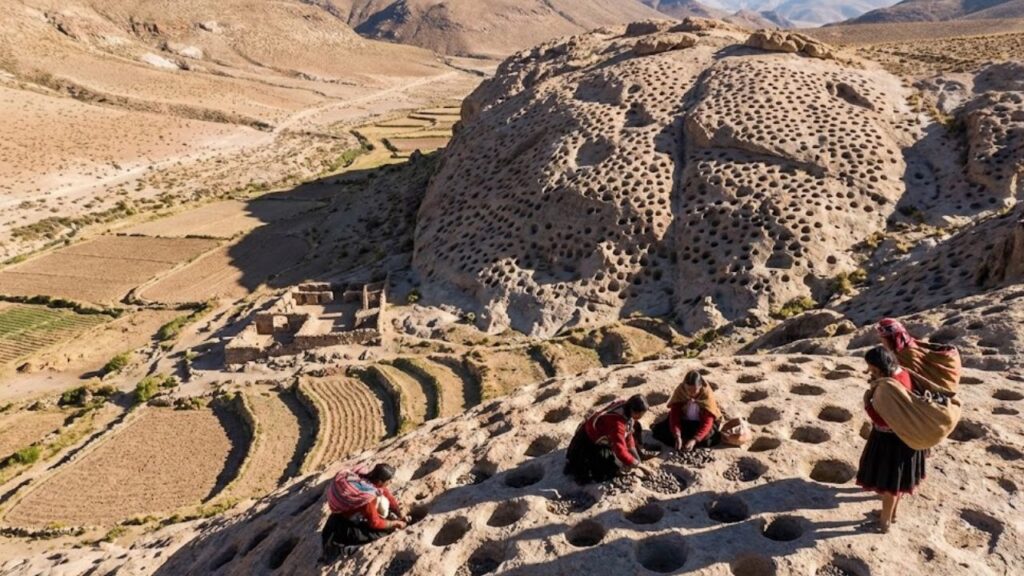
As the wind sweeps across the rocky plateau of Peru’s Pisco Valley, it carries a dry, dusty scent, tinged with metallic undertones, as if it has been traveling over stone for ages. Standing on this plateau, with the Andes mountains faintly visible in the distance, something strange catches your eye. At your feet, the ground is pockmarked with thousands of man-made holes, carved into the rock in almost perfect lines, stretching over 1.7 kilometers. There are no signs, no explanations, just these cavities staring upward, as though part of an ancient, forgotten game. Some are shallow, others deep, some appear to merge, as though their creators had changed their minds mid-way. Local guides can only shrug and smile, referring to it as “the mystery of the Band of Holes.” But now, this mystery is finally being unraveled.
The Mystery of the Band of Holes Unveiled
From above, the “Band of Holes” looks like a pale scar across the land, a ribbon of hollowed stone cutting through the earth. Each dark spot, a hollow carved into the rock, is spaced roughly shoulder-width apart. For decades, pilots flying over the Pisco Valley were baffled by this sight. Even satellite imagery failed to explain why 5,200 holes were carved into such a barren and unforgiving landscape. Tourists often arrived with theories of UFOs or lost civilizations in mind, eager to capture a piece of the inexplicable. However, the truth has remained quietly hidden in the dust, waiting for someone to decode the landscape as a record of the past.
Understanding the Purpose of the Holes
A researcher who studied the Band of Holes describes walking along the line and noticing an unusual pattern—not in the sky, but in the way the land itself changed. The band crosses through different ecological zones, almost like a thread stitching together distinct altitudes that don’t typically coexist. This is peculiar if you think of it as a ritual site, but it makes more sense when viewed through the lens of food management. The holes are not all identical. Some sections feature uniform pits, while others are broader, forming clusters of cavities, resembling storage units. Once you start viewing the structure as infrastructure, rather than a mystery, it becomes clear that this was a well-organized system.
Revealing the Pre-Inca Economic System
Recent research by archaeologists and landscape specialists suggests that the Band of Holes was not merely a site of religious significance, but rather a state-level storage and accounting system. Think of it as an open-air spreadsheet carved into stone. Long before coins were used, pre-Inca leaders relied on goods, labor, and memory to manage resources. The holes could have been a way to physically record the flow of resources—each filled cavity representing a counted unit, while the empty ones symbolized future promises. This stone-based accounting system was as solid as the landscape it was etched into.
How 5,200 Holes Became an Economic Tool
Imagine a scene centuries ago. Caravans of llama herders, each carrying goods from distant villages, trek up the slope. As they reach the Band of Holes, they are greeted by officials who know exactly which section of the holes belongs to each community. The goods are unloaded, sorted, and placed into designated cavities. One for every bundle, every family’s contribution, or every unit of tax. A worker walks along the line, reciting numbers aloud, as if in prayer. There’s no paper, no coins—just stone and human hands. This economy was carved directly into the hillside.
Incan Connections and the Pre-Inca Legacy
This system has parallels with later Incan methods. The Incas used large storage complexes, known as qollqas, to manage crops like maize, quinoa, and dried potatoes across their vast empire. They also employed quipus—knotted strings—to record everything from warriors to livestock. The Band of Holes is an earlier version of this system, seemingly more primitive but ingenious in its simplicity. During a drought year, for example, officials could walk the site and instantly assess the amount of food in reserve. Each cavity was a literal buffer against hunger, a safety margin carved into the hillside.
The Band of Holes: A Pre-Inca Fiscal Tool
The strategic location of the Band of Holes near trade routes and areas producing different crops strongly suggests its role in economic management rather than ritual practices. The “band” functions as a bridge between different regions and people. Researchers now view it as a pre-Inca fiscal tool used by a regional power that predated the Incas, but already had an understanding of resource redistribution and control. Instead of centralizing their accounting in a warehouse, they spread it across the land—open to inspection, indestructible, and impossible to lose.
What We Can Learn from the Band of Holes
The most remarkable feature of the Band of Holes is its design: it’s public, visible, and impossible to hide. Anyone passing by could see if the band was full, half-empty, or nearly bare. This transparency, in many ways, mirrors our modern ideals of accountability. Although the pre-Inca elites may have been strict and controlling, their accounting system was something anyone could witness. In today’s digital age, where numbers flicker on banking apps, there’s something refreshing about the tangible, physical nature of this ancient system.
Why We Misunderstand the Past
For modern observers, the Band of Holes was so strange that many assumed it must have been religious, mystical, or alien. We often imagine the past as either pure survival or pure ritual, overlooking the mundane realities of logistics, taxes, and stock management. This gap in our understanding says more about us than it does about the ancient people. By romanticizing their lives, we erase their real struggles: how they moved food, managed scarcity, and built trust among strangers. The real story is hidden in these everyday challenges, not in the grand rituals we often assume.
Ancient Memory Systems and Modern Parallels
As one Peruvian archaeologist puts it, “Once you recognize these 5,200 holes as part of a pre-Inca economic network, you stop asking about the gods they served, and start questioning what kind of society needed such detailed accounting.” This shift in perspective is what makes this discovery so exciting. The ancient people of Peru weren’t just concerned with survival—they were creating systems to manage their economy, their resources, and their relationships.
Key Lessons from the Band of Holes
Through this discovery, we can appreciate how early societies turned uncertainty into something measurable and shareable. The Band of Holes shows us that even in the ancient world, power was about knowing who owed what, who had what, and where it was stored. These methods may seem primitive to us today, but they laid the groundwork for modern economies, from digital wallets to global supply chains. The next time you check your banking app or track a delivery, remember that hillside in Peru. The tools may have changed, but the obsession with managing resources remains the same.
Summary of Key Insights
- Pre-Inca economic system: The Band of Holes was likely a system for storage and tribute accounting, reframing the “mystery” as a smart financial tool.
- Landscape as ledger: The 5,200 cavities carved along ecological zones and trade routes show how ancient societies utilized geography as infrastructure.
- Transparency and control: The open visibility of stocks and contributions invites comparisons with modern concepts of accountability and trust.